

 INFRA
INFRA
INFRA
INFRA
INFRA

The vast majority of data centers are kept cool using air-based data center cooling systems, but China’s Lenovo Group Ltd. is betting that things won’t always be that way, as it reckons water-based cooling tech will soon be a thing.
Water-based cooling systems are nothing new, but up until now, they’ve been primarily used with high-performance computing, or supercomputers, that use vastly more energy resources than regular servers.
The reason is simple: Air-based systems are more economical. But pretty soon they may not be so practical.
That’s because data centers are growing increasingly reliant on things such as graphics processing units and tensor processing units which are able to accelerate artificial intelligence and data analytics workloads. GPUs and TPUs are more difficult to keep cool using air-based systems, which is why data center operators are looking for more efficient alternatives.
Enter Lenovo with its new liquid-based cooling system called Neptune, which combines a variety of technologies that it’s developed through its work on systems used to cool supercomputers. The technologies include Rear Door Heat Exchangers, Thermal Transfer Modules, which are a hybrid system mixing water with air, and Direct to Node liquid cooling, Scott Tease, Lenovo’s executive director of HPC and AI units, told DataCenterKnowledge.
Tease reckons that Neptune is suitable for more than just HPC scenarios, since it can efficiently cool regular data centers while helping enterprises to cut their energy consumption. He said the new system is just 2 percent more expensive than current air-based systems. Not only that, but liquid cooling can also reduce the real estate requirements of data center operators, he said.
Lenovo’s Rear Door Heat Exchanger is essentially an add-on radiator for cooling systems that’s already been deployed in about 30 percent of the company’s HPC customer’s data centers. It attaches to the rear door of a server rack and absorbs the heat discharged from standard air-cooled systems. This process diminishes the hot air expelled into the “hot aisle,” reducing overall air conditioning costs and allowing slightly improved system performance.
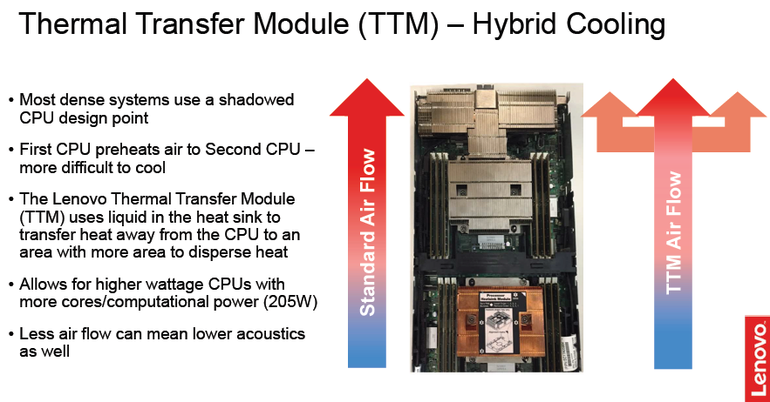
The company also unveiled a Thermal Transfer Module, which is a heat sink that uses liquid to carry heat away to an area where it can disperse more easily:
Source: Lenovo
As for the Direct to Node cooling technique, this is a more customized system that works by using unchilled water to remove heat from the processor cores.
Holger Mueller, principal analyst and vice president at Constellation Research Inc., told SiliconANGLE there’s a growing need for new data center cooling technologies because the new compute load around AI and analytics is getting too hot to handle.
“The problem is that the only water running in data centers at the moment is in the restroom,” Mueller said. “Any solution that allows CIOs to run new compute infrastructure with an organic solution that does not require building new data centers will be a very welcome addition.”
Lenovo isn’t the only company betting on a water-cooled future for tomorrow’s data centers. Facebook Inc. recently unveiled its own StatePoint Liquid Cooling system, which evaporates water through a membrane separation layer in order to cool it. The social media giant plans to leverage that system so it can build new data centers in more “extreme” arid climates.
Support our mission to keep content open and free by engaging with theCUBE community. Join theCUBE’s Alumni Trust Network, where technology leaders connect, share intelligence and create opportunities.
Founded by tech visionaries John Furrier and Dave Vellante, SiliconANGLE Media has built a dynamic ecosystem of industry-leading digital media brands that reach 15+ million elite tech professionals. Our new proprietary theCUBE AI Video Cloud is breaking ground in audience interaction, leveraging theCUBEai.com neural network to help technology companies make data-driven decisions and stay at the forefront of industry conversations.