



 APPS
APPS
APPS
APPS
APPS

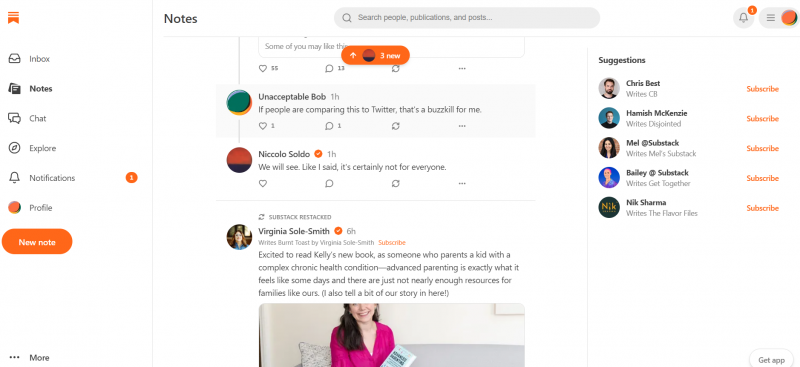
Substack Inc. today launched Notes, a platform where Substack creators can interact with subscribers and where the entire experience looks very much like Twitter.
The differences are only in the language. Users don’t post tweets; they post notes. There’s no such thing as a retweet, but there is a restack. Everything else looks like a Twitter clone, with one side panel offering links to the Inbox, notifications and Notes and the other far panel offering suggestions of creators to subscribe to. The middle pane is the news feed.
“You can share links, images, quick thoughts, and snippets from Substack posts,” the company wrote today in a post. “As well as being lightweight and fun, we hope that Notes will help writers grow their audience and revenue.” To access Notes, people can hit a tab on substack.com and in Substack’s mobile app.
Last week, Elon Musk was accused of trying to stop Substack creators from making a living when there was a loss of functions on any tweet that carried a link to Substack. That came at a time when Substack had just announced Notes. It was assumed by many that Musk was up to his old tricks again, throttling the competition.
One of Substack’s best-known creators, Matt Taibbi, was less than pleased. Taibbi was one of the writers who had worked with Twitter to publish the “Twitter Files.” He said at the time that if Twitter didn’t sort out the mess, he’d leave the platform, just as Musk was being called a “bully” by countless people. It’s uncertain why Twitter later reversed the decision, but it did.
“We’re glad to see that the suppression of Substack publications on Twitter appears to be over,” Substack tweeted. “We believe that Twitter and Substack can continue to coexist and complement each other.” Although Notes does look like a mirror of Twitter, one might argue that such a layout is now generic. Substack said again in another post that Notes was not an effort to replace other social networks.
It’s true that Substack’s 35 million active subscribers and 2 million paid subscribers exist in a kind of rarefied universe in which subscribers receive emails about new content and where there’s no real place on the Substack website to see people interact. Notes does make a lot of sense, but it’s doubtful many creators would want to leave Twitter.
Still, last weekend, Substack co-founder Hamish McKenzie said the company was just trying to give creators more control over their work in a world where they rely too much on social media. “Substack may be a small upstart, but the combined power of the writers on it is already tremendous,” he tweeted. “If enough of us choose to play this new game, it will work, and there’s nothing anyone will be able to do to stop it.”
Support our mission to keep content open and free by engaging with theCUBE community. Join theCUBE’s Alumni Trust Network, where technology leaders connect, share intelligence and create opportunities.
Founded by tech visionaries John Furrier and Dave Vellante, SiliconANGLE Media has built a dynamic ecosystem of industry-leading digital media brands that reach 15+ million elite tech professionals. Our new proprietary theCUBE AI Video Cloud is breaking ground in audience interaction, leveraging theCUBEai.com neural network to help technology companies make data-driven decisions and stay at the forefront of industry conversations.