




 AI
AI
AI
AI

AI

Generative artificial intelligence is the story of the year, and innovations are reshaping industries across the board. At Supercloud 4, theCUBE is unpacking all the hot topics, technologies, business models and, of course, startups.
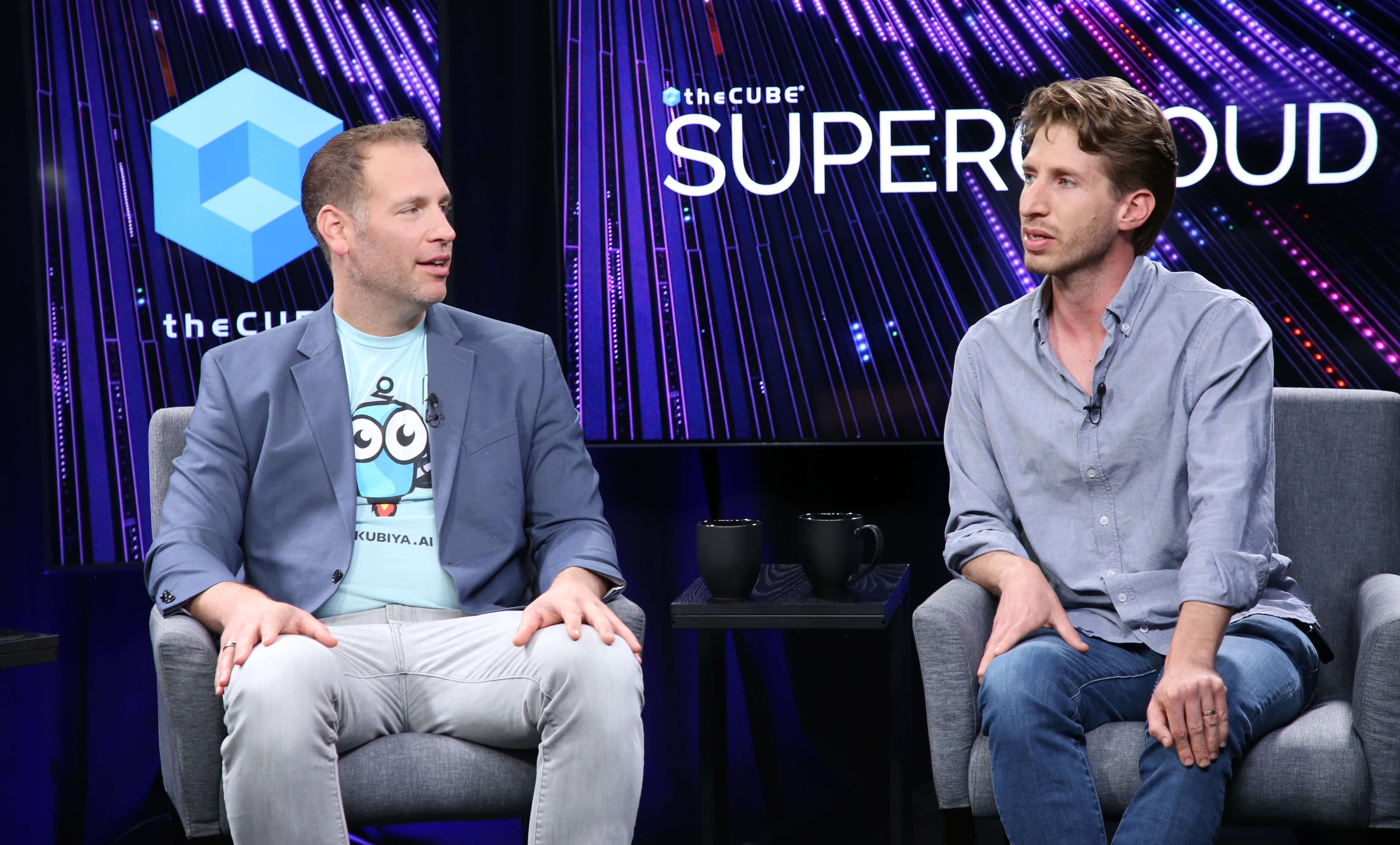
Two of those young, hot startups include Kubiya.ai and Wand.ai. In the latter case, Wand.ai seeks to serve as a business assistant, taking generative AI and enabling it for enterprise companies, according to Yogev Shifman (pictured, right), co-founder and chief product officer at Wand.ai.
“Basically, strike down any barrier for entry for generative AI technologies for those kind of companies,” Shifman said.
Meanwhile, Kubiya.ai is seeking to solve a particular exchange between developers and platform engineers and DevOps, according to Amit Eyal Govrin (left), co-founder and chief executive officer of Kubiya Inc. When it comes to self-service for organizations — how to essentially serve yourself to infrastructure, automation and knowledge — things aren’t always intuitive.
“Even in 2023 with large language models, there’s still a lot of adoption barriers, and we’re seeing that plateau. Most organizations who pick up [an] internal developer platform or try to develop themselves usually have a 10% adoption barrier,” Govrin said. “That’s typically what we’re seeing even with Backstage and technologies of that nature. And our thesis all along has been, how do you go and unlock that?”
Shifman and Govrin spoke with theCUBE industry analysts John Furrier and Dave Vellante at Supercloud 4, during an exclusive broadcast on theCUBE, SiliconANGLE Media’s livestreaming studio. They discussed the founders’ visions and journeys while emphasizing the importance of execution and differentiation.
Of course, as a startup, it’s important to remain agile when it comes to an opportunity recognition perspective. For Kubiya.ai, it involved an initial discussion of a concept that involved “Siri for DevOps” — a discussion that took place about “45 days and 12 hours” before ChatGPT, according to Govrin.
“Then, ChatGPT came to the world, and then the biggest barrier of entry for us, the market education, we didn’t have to concentrate on that anymore — a million people in 48 hours,” he said. “All of a sudden, we’re on the platform, enjoying conversational AI with the machine. Now where do you take this?”
For Kubiya.ai, the company already had all the scars of training its own models and effectively creating rule-based systems and merging them with LLMs. The next question was how to go and reign in the business potential.
“We saw the agent-based framework as the way to do it. People, even though they enjoy talking to intelligence machines, they still want a bidirection interaction,” Govrin said. “Workflow-based systems are one-directional. So, how do you go and create the nearest best thing to a human interaction? It’s with agent framework, obviously chain of thought, chain of reason, retrieval, augmentation. You can go through all the different practices here. At the end of the day, it’s a human interaction.”
These days, people consume so much content across so many different apps, with a huge amount of data collected. Wand.ai wants to be a productive assistant for any task one wants to perform on a business daily, according to Shifman.
“A big part of it is personalization — really taking your data and connecting it to who you are [in] the organization. What is your contribution to the organization, or how do you like to interact with it?” he said. “Nowadays, when you interact with a bot, we call it passive personalization. You tell it what to do, and, eventually, it does whatever it does. We develop what we call active personalization. We can actually learn what you’re trying to do.”
The market is moving fast, and technology is evolving quickly. There’s smart money out there right now, and what really matters is execution, according to Shifman.
“I think that’s the one thing startups need to have in mind,” he said. “Not investors, not the markets. You just need to focus on your execution — because [we] are agile. We can move fast, we can break stuff. And differentiate, like decide on the value that you bring to the market that no one else does, even if it’s small, and make it grow.”
Here’s the complete video interview, part of SiliconANGLE’s and theCUBE’s coverage of Supercloud 4:
Support our mission to keep content open and free by engaging with theCUBE community. Join theCUBE’s Alumni Trust Network, where technology leaders connect, share intelligence and create opportunities.
Founded by tech visionaries John Furrier and Dave Vellante, SiliconANGLE Media has built a dynamic ecosystem of industry-leading digital media brands that reach 15+ million elite tech professionals. Our new proprietary theCUBE AI Video Cloud is breaking ground in audience interaction, leveraging theCUBEai.com neural network to help technology companies make data-driven decisions and stay at the forefront of industry conversations.