Google Kubernetes Engine scalability is moving from theory to practice as teams push clusters to unprecedented sizes — all while keeping costs and performance in balance. Enterprises are no longer questioning GKE scalability and are instead focusing on how to expose the appropriate controls in Kubernetes for measurable, predictable results.
As organizations stretch GKE to these new limits, they are finding that raw scalability is no longer the bottleneck. Instead, the real challenge is orchestrating heterogeneous workloads in a way that keeps infrastructure efficient, governed and fair across teams. This is exactly the gap new capabilities such as Dynamic Resource Allocation are addressing as artificial intelligence proliferates, according to Jago Macleod (pictured), director of engineering, Kubernetes, at Google Cloud.
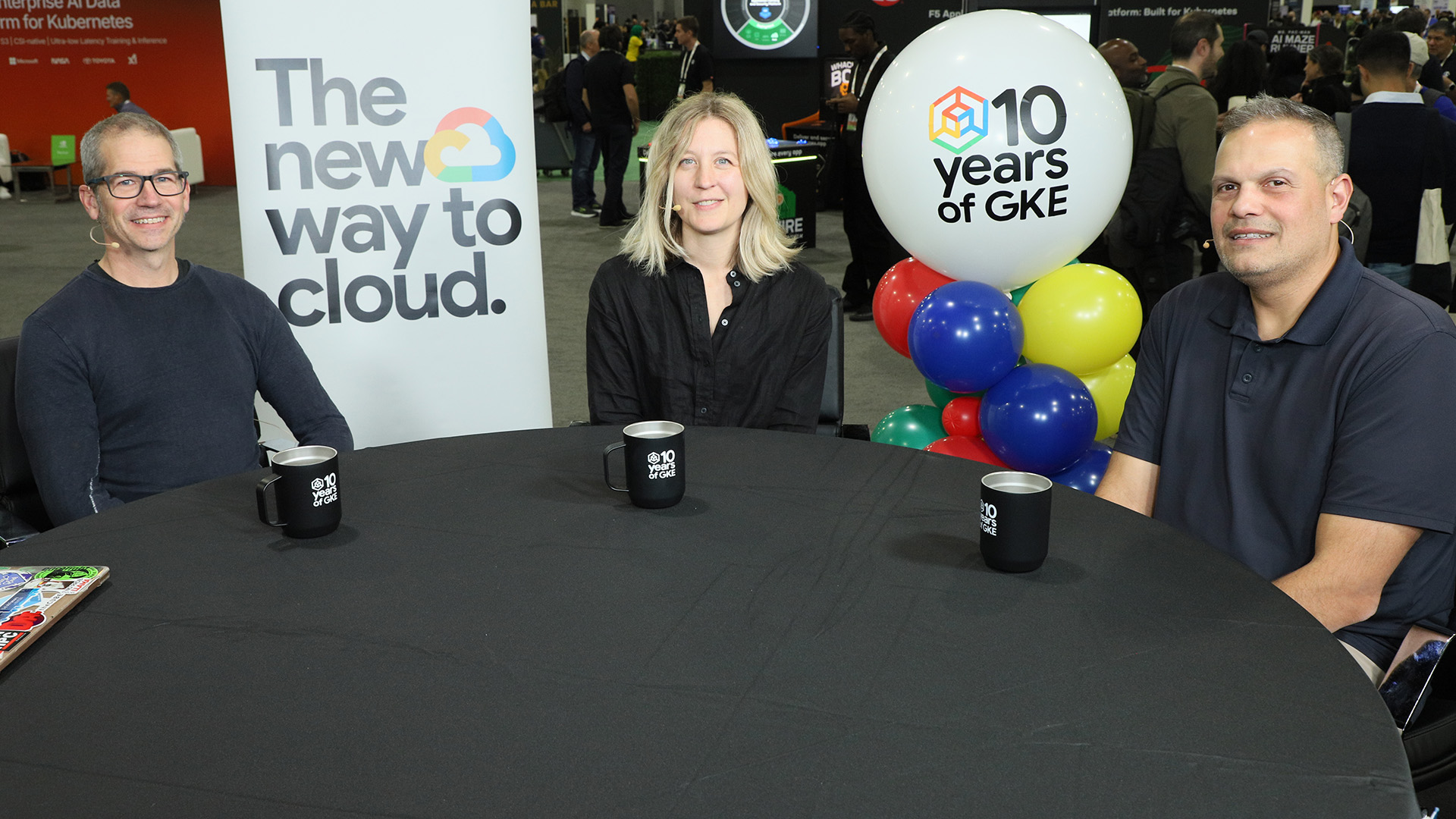
Google Cloud’s Jago Macleod and Gari Singh, along with RedMonk’s Kate Holerhoff, talk with theCUBE about GKE scalability.
“The DRA — Dynamic Resource Allocation — has now gone [generally available],” Macleod said. “The AI workloads are the real motivating factor, but it inspired a lot of really cool conversations with the ScheMD folks behind Slurm and their next round of adopters, who already run Kubernetes and are now adopting Slurm, but don’t want to learn how to run it on VMs or bare metal.”
Macleod, Gari Singh, product manager at Google Cloud, and Kate Holerhoff, senior industry analyst at RedMonk, spoke with theCUBE’s Savannah Peterson at the KubeCon + CloudNativeCon NA event, during an exclusive broadcast on theCUBE, SiliconANGLE Media’s livestreaming studio. They discussed GKE scalability milestones in light of added node capabilities, control-plane resilience and AI-driven operations. (* Disclosure below.)
GKE scalability meets real-world constraints
AI adoption is raising the ceiling on cluster sizes while exposing very physical limits — power, cooling and specialized hardware mixes. As enterprises pair Kubernetes with AI workflows, they’re prioritizing standards and community-backed practices to keep agentic systems reliable and performant, according to Holerhoff.
“I think one of the big takeaways I’ve had from this conference is absolutely how we’re pairing these technologies,” she said. “Using the AI conformance, a lot of these initiatives are preparing us to be using Kubernetes as part of that workflow to make sure that we can create AI agents and run these workflows in a way that makes sense, that has a lot of community support, and that is going to be performant.”
At the upper end of scale, the practical drivers are massive-scale model training and the need to provision — and later shrink — fleets of graphics process units quickly. That pushes the control plane, scheduling and autoscaling to stay aware of health, updates and placement at extreme node counts, Singh noted.
“It’s usually in the massive training jobs, [the] massive AI jobs that need a lot of compute,” he said. “Typically, with nodes you can use the entire GPU … There’s typically a match of a node to a GPU. You’ll end up saying, ‘I need 130,000 GPUs to train whatever these massive models,’ … You need to quickly provision those up.”
Here’s the complete video interview, part of SiliconANGLE’s and theCUBE’s coverage of the KubeCon + CloudNativeCon NA:
(* Disclosure: Google Cloud sponsored this segment of theCUBE. Neither Google Cloud nor other sponsors have editorial control over content on theCUBE or SiliconANGLE.)
Photo: SiliconANGLE
A message from John Furrier, co-founder of SiliconANGLE:
Support our mission to keep content open and free by engaging with theCUBE community. Join theCUBE’s Alumni Trust Network, where technology leaders connect, share intelligence and create opportunities.
15M+ viewers of theCUBE videos, powering conversations across AI, cloud, cybersecurity and more
11.4k+ theCUBE alumni — Connect with more than 11,400 tech and business leaders shaping the future through a unique trusted-based network
Are you an AWS customer? Support SiliconANGLE financially by buying your AWS services from our Marketplace portal page and links: https://siliconangle.com/aws-marketplace/
About SiliconANGLE Media
SiliconANGLE Media is a recognized leader in digital media innovation, uniting breakthrough technology, strategic insights and real-time audience engagement. As the parent company of SiliconANGLE, theCUBE Network, theCUBE Research, CUBE365, theCUBE AI and theCUBE SuperStudios — with flagship locations in Silicon Valley and the New York Stock Exchange — SiliconANGLE Media operates at the intersection of media, technology and AI.
Founded by tech visionaries John Furrier and Dave Vellante, SiliconANGLE Media has built a dynamic ecosystem of industry-leading digital media brands that reach 15+ million elite tech professionals. Our new proprietary theCUBE AI Video Cloud is breaking ground in audience interaction, leveraging theCUBEai.com neural network to help technology companies make data-driven decisions and stay at the forefront of industry conversations.






 CLOUD
CLOUD