
 AI
AI
AI
AI
AI

Microsoft Corp. is infusing artificial intelligence agents into Azure Copilot to turbocharge cloud operations with agentic automation.
Announced today at Microsoft Ignite 2025, the revamped Azure Copilot has been transformed into an “agentic interface” teams can use to orchestrate a half-dozen highly specialized AI agents that automate a wide array of complex cloud infrastructure operations.
Azure Copilot is already familiar to most Azure users, but its capabilities have always been somewhat limited. Previously, it was really just a conversational assistant, which helped users to get started, providing information on the best resources to use and how to deploy them, answering questions and so on.
But with today’s update, Azure Copilot unlocks access to a team of AI agents with specialized reasoning capabilities that enable them to plan and take actions on behalf of infrastructure teams. The company said it represents the start of an entirely new operating model for cloud management that it’s calling “Agentic Cloud Ops,” where intelligent agents help teams to run their cloud infrastructure much faster and with full confidence that nothing will go wrong.
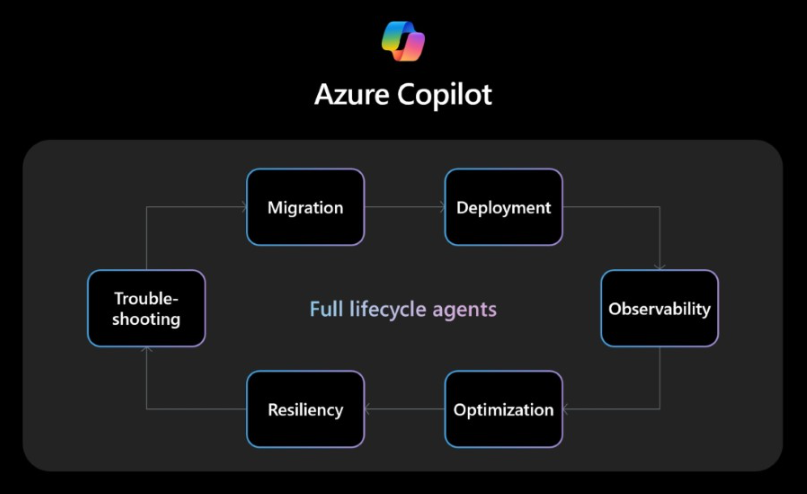
The new agents span every aspect of the cloud management lifecycle, Annie Pearl, Microsoft’s corporate vice president and general manager of Azure Experiences & Ecosystems, said in a blog post. For instance, there’s a new Deployment agent to help automate infrastructure planning and application deployments in-line with an organization’s best practices, and a Migration agent for speeding up app modernization. It has the intelligence to discover legacy apps on its own and generate infrastructure-as-a-service recommendations for easy deployment onto the Azure cloud.
The new Optimization agent is all about finding ways to save money and improve efficiency, and not only with applications. For instance, it can compare financial considerations with carbon emission goals to find the most efficient way for a company to meet its sustainability goals, validating its recommendations with evidence. Meanwhile, the new Observability agent taps into the Azure Monitor application’s insights to help teams investigate complex problems across apps and generate recommended steps to mitigate them.
There’s also a new Resiliency agent that aims to downtime and improve business continuity by providing recommendations on zonal resiliency. It also provides ransomware protection, enabling customers to design more resilient environments for their most critical applications. Finally, there’s a Troubleshooting agent that’s designed to identify the root cause of infrastructure issues across virtual machines, databases and Kubernetes deployments.
The new Azure Copilot has more than just AI agents. It also provides users with a smarter and more intuitive experience, with Pearl promising a more immersive, personalized and intuitive user interface that’s embedded into user’s workflows. It can be accessed via the Azure cloud console, the command line interface or directly in chat, and it will remember all conversations and context across these channels. It also supports multitasking, so users can enter a new prompt even while the previous one is still being processed.
“You’ll experience contextual interactions with agents, so when you use Copilot within a specific service or task, its responses stay relevant to that context,” Pearl said. “Azure Copilot will intelligently surface the right agent at the right time. We give you the ability to dig in and see all the steps the agent took to arrive at its answer, and you can browse any artifacts Copilot procured while it processed the task.”
This new experience is what opens the door to Microsoft’s concept of Agentic Cloud Ops, where cloud infrastructure management is transformed into a conversational experience. Azure Copilot comes with a deeply integrated orchestration engine to manage each of the six new agents simultaneously and ensure they can always interpret the user’s intent, understand the context of any prompt and use the right tool to fulfill whatever is requested of them.
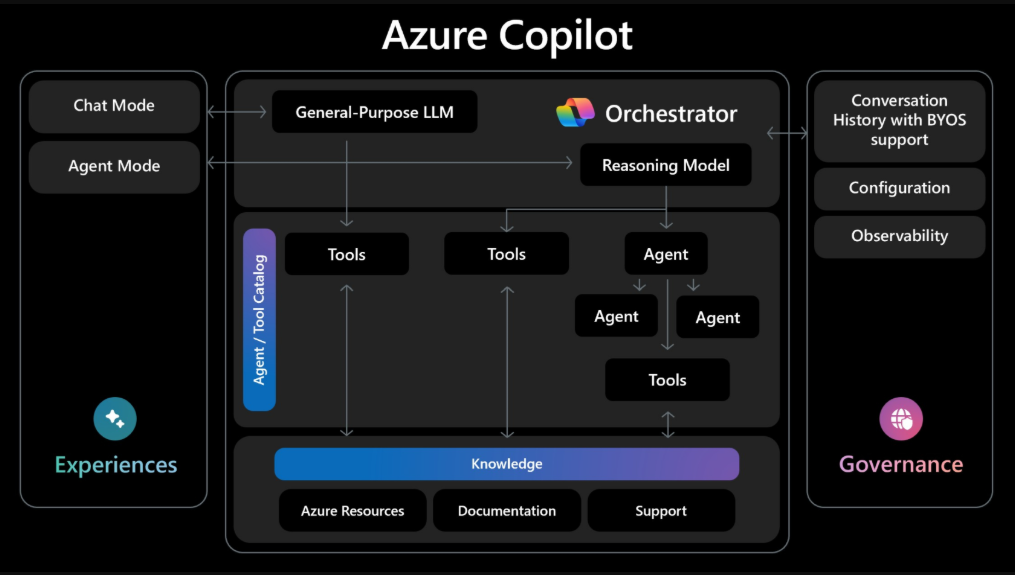
Pearl explained that every automated action begins with a user request, which immediately triggers Azure Copilot’s orchestration pipeline. Each prompt is screened first of all to ensure relevance and safety before the agent starts the reasoning process. The next step is to interpret the user’s request or question and the context it has been made in. It takes into consideration the Azure Portal resources and views the user is engaged with, as well as what their role-based access control permissions are, allowing it to determine which tools or agents are needed.
Once Azure Copilot understands the request, the orchestration engine identifies the right agent or tool for the job, selecting from all available resources. Then, the agent executes the request on behalf of the user’s identity.
In this way, the agents are like an “extension” of each user, Pearl said. But the entire process keeps the human-in-the-loop, she said, and before any action is executed, it will request explicit approval from the user, ensuring that all actions it takes are safe and deliberate.
Pearl said Azure Copilots agents all operate in a secure way, following established RBAC, Azure policies and compliance frameworks, and will never invent actions or access data they’re not allowed to see.
To support its Agentic Cloud Ops, Microsoft introduced a number of other Azure infrastructure updates launching in preview today, including the availability of Managed Instance on Azure App Service, enabling web applications to be migrated to the cloud with only a few small configuration changes. It’s aimed at older .NET-based web applications that might be running on-premises or in virtual machines, and redeploys them inside a fully managed and future-proofed platform-as-a-service environment, the company said.
It’s a key update because many organizations continued to rely on legacy .NET applications for tasks such as billing and human resources management. They rely on Windows-specific features and custom tools, which means it’s challenging to rewrite them. Managed Instance on Azure App Service automates this work, retaining their critical dependencies on Windows services and third-party tools.

Also launching in preview from today is Azure Boost, a new server subsystem that offloads server virtualization processes traditionally performed at the hypervisor level in order to speed up application workloads. It can deliver remote storage throughput of up to 20 gigabits per second, one million remote storage input/output operations and network bandwidth of up to 400 Gbps, the company said. Other benefits include enhanced virtual machine security and isolation, as Azure Boost provides a physical boundary between the infrastructure and customer’s workloads, preventing host-level attacks.
Finally, Microsoft announced preview availability of Azure Cobalt 200, its next-generation Cobalt central processing unit, which is designed to support cloud-native apps running on Azure. It’s based on Arm Holdings Plc’s latest architecture and built on 3 nanometer process technology, and provides up to 50% higher performance than the Cobalt 100 CPUs it’s designed to replace, with more computing cores, a larger cache and faster memory. The company said it’s the most energy-efficient compute platform now available on Azure, and will significantly reduce power consumption for all types of workloads.
Support our mission to keep content open and free by engaging with theCUBE community. Join theCUBE’s Alumni Trust Network, where technology leaders connect, share intelligence and create opportunities.
Founded by tech visionaries John Furrier and Dave Vellante, SiliconANGLE Media has built a dynamic ecosystem of industry-leading digital media brands that reach 15+ million elite tech professionals. Our new proprietary theCUBE AI Video Cloud is breaking ground in audience interaction, leveraging theCUBEai.com neural network to help technology companies make data-driven decisions and stay at the forefront of industry conversations.