



 AI
AI
AI
AI

AI

A new era of agentic infrastructure is taking hold as the industry runs up against real limits in power, physics and system design.
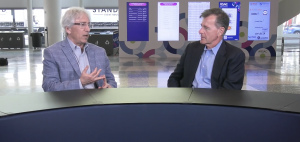
What was once a race for faster chips now hinges on tougher questions about cooling, supply strain and the cost of keeping advanced systems online. With high-performance computing pushing into every corner of the economy, companies are rethinking density and efficiency out of necessity, not ambition, according to John Furrier (pictured, left), executive analyst at theCUBE Research.
“Every industry is being impacted,” Furrier said. “AI is rewriting the rules of infrastructure. This show [is] very nerdy, high-performance computing, now full-blown supercomputing, AI factories, new software stacks that will comprise the AI factory. All [of] this is underpinned by the chips, Nvidia, AMD, all the vendors that make the data centers. The AI infrastructure is hitting physical limits and the word physical is in there because there’s physics of the chips and the density, but there’s also the physical aspect of the facilities.”
Furrier spoke with fellow theCUBE analyst Jackie McGuire (right) at SC25, during an exclusive broadcast on theCUBE, SiliconANGLE Media’s livestreaming studio. They discussed how agentic infrastructure is reshaping data centers by pushing against physical limits in power, cooling, storage and security, driving a fundamental shift toward AI-centric “factory” architectures. (* Disclosure below.)
The rise of agentic infrastructure is colliding with real-world constraints, requiring organizations to evolve long-standing assumptions about hardware, energy and the environment. Shrinking the space between compute, cooling and storage unlocks new performance tiers, but it also fundamentally changes how facilities must be designed. These shifts echo a broader industry push toward modular upgrades and hybrid cooling models rather than wholesale retrofits, McGuire noted.
“Hardware’s cool again, but hardware also has these very firm physical limits, not just in your ability to produce it, but then your ability to run it at temp,” she said. “We heard from a lot of companies who were doing some really cool things to try to address this. The world has reality of physical limits, and we can say we’re going to do [artificial general intelligence], but without the servers to run it, how are we going to do a AGI?”
As density climbs, cooling becomes a central pillar of modern design, not an afterthought. Liquid systems are transitioning from experimental to essential as new classes of GPUs, accelerators and networking gear generate thermal loads legacy buildings were never designed to handle. Innovations in immersion systems, precision loops and distributed plumbing networks are reshaping expectations for how next-generation clusters must operate, McGuire explained.
“It’s actual plumbing, like hoses and pipes and all of the fittings and all of that,” she said. “We had some really interesting conversations, not just around liquid cooling for the servers, but cooling for network cards and power supplies too. There’s this whole kind of ecosystem of primary and secondary liquid cooling being built around every component because they all produce heat.”
Storage performance is also emerging as a defining factor of agentic infrastructure scale. Compute acceleration no longer unlocks the biggest gains; instead, speed and efficiency now hinge on how quickly systems can move, reuse and persist data in high-velocity workflows. KV cache strategies and storage optimization are becoming central to delivering the responsiveness required for multi-agent systems.
“If you can’t do that at the speed that you expect your agents to be running … what we talked about was kind of the in-out of storage and optimizing storage,” McGuire said. “The storage is also not cheap. Being able to figure out what memory needs to live where is something we’re still working on.”
Here’s the complete video interview, part of SiliconANGLE’s and theCUBE’s coverage of SC25:
(* Disclosure: TheCUBE is a paid media partner for SC25 event. Sponsors of theCUBE’s event coverage do not have editorial control over content on theCUBE or SiliconANGLE.)
Support our mission to keep content open and free by engaging with theCUBE community. Join theCUBE’s Alumni Trust Network, where technology leaders connect, share intelligence and create opportunities.
Founded by tech visionaries John Furrier and Dave Vellante, SiliconANGLE Media has built a dynamic ecosystem of industry-leading digital media brands that reach 15+ million elite tech professionals. Our new proprietary theCUBE AI Video Cloud is breaking ground in audience interaction, leveraging theCUBEai.com neural network to help technology companies make data-driven decisions and stay at the forefront of industry conversations.