 EMERGING TECH
EMERGING TECH
EMERGING TECH
EMERGING TECH

Sunday, an artificial intelligence robotics startup founded by Stanford Ph.D. roboticists, launched today to introduce Memo: a household robot capable of doing everyday chores.
The new robot is built for homes, with safety and stability as a priority.
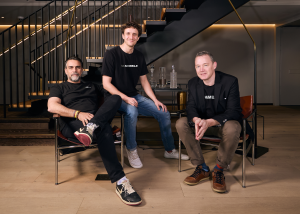
Founder and Chief Executive Tony Zhao and founder and Chief Technology Officer Cheng Chi started Sunday in a garage, working 24/7 with 3D printers to develop and build the robot’s hardware and appearance.
“We built Memo to give people back time for what matters, with the safety needs for any family in mind,” said Zhao. “This is a turning point for home robotics.”
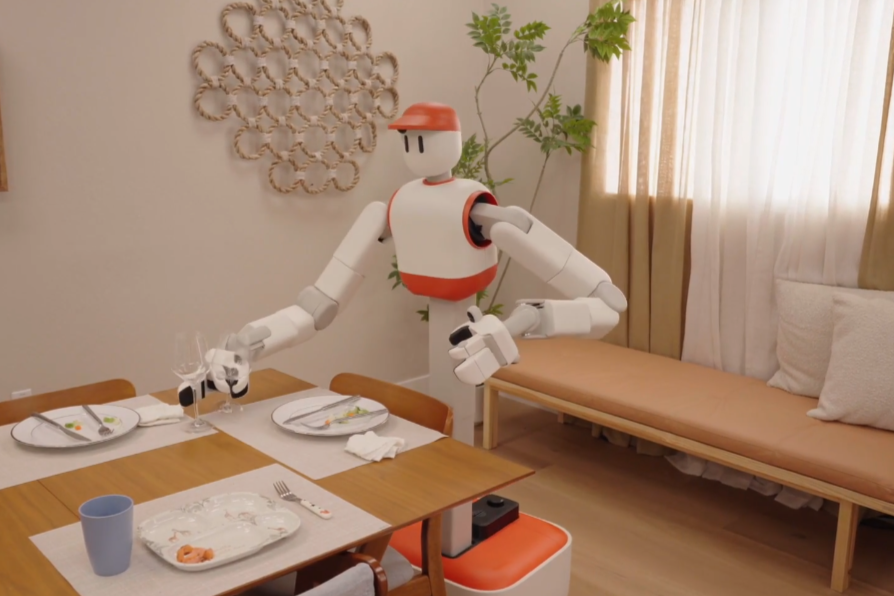
Memo diverges from the current rush to build humanoid-style robots in that it has no legs, which removes one of the biggest problems with humanoid robots: modeling balance alongside upper body motions. It has a “torso” that extends from a thick rolling platform (like a huge Roomba). Overall, the robot’s aesthetic is somewhat chunky with smooth white limbs and joints, a cartoonish face and a plastic “ballcap.”
Despite its appearance and deliberate movements, Memo is surprisingly nimble and capable of completing basic household tasks. It can perform various activities in the kitchen and living areas, such as cleaning plates and glasses, loading them into the dishwasher, removing clothing, making espresso and even assisting in the preparation of simple dishes.
Humans intuitively learn and understand how to interact with their environment because of the wiring of their own brains. As they become more comfortable within an environment, their dexterity improves.
AI robots, on the other hand, depend on vision action models that don’t have this grounding and must be trained in completing even basic tasks such as picking up objects, closing cupboards and navigating obstacles like tables and chairs.
To overcome this challenge, Sunday developed what they call the Skill Capture Glove, a wearable that captures how people move, clean and organize in their own homes. Using a pair of these gloves, the company’s researchers built a dataset of about 10 million genuine household routines captured in more than 500 homes, representing a massive amount of data diversity.
According to Sunday, the combined domestic training of this dataset enables Memo to adjust to the unpredictable nature of home environments, including kitchens, living rooms and laundry areas.
“Tony’s ALOHA and Cheng’s UMI research told us that with enough data, dexterous manipulation tasks are actually possible with pretty low-cost hardware,” said Camilla Guo, head of product at Sunday.
ALOHA, or a low-cost open-source hardware system, developed at Stanford University in collaboration with Google LLC’s DeepMind AI division, sought to build low-cost robotics platforms using imitation learning to train them to perform complex tasks. UMI, or universal manipulation interface, provided a data collection and policy learning framework for teaching robots how to handle tasks using human demonstrations, paving the way for the company’s skill capture gloves.
Sunday launched with a noteworthy $35 million in funding from Benchmark and Conviction.
“The promise of AI robotics isn’t back-flipping or dancing demos, but robots that work in messy, real-world situations,” said Eric Vishria, general partner at Benchmark. “To have those, we need real-world training data. We have about one-millionth of the data we need.”
Sunday said applications for the company’s Founding Family Beta program, which will put the robots in homes, opened Nov. 19. From the applicants, the company will select 50 households to become early adopters of Memo in late 2026.
“There are plenty of companies building on our work to advance their research,” said Zhao, “but what we are building here is something that is even larger: to put a robot in every home.”
Support our mission to keep content open and free by engaging with theCUBE community. Join theCUBE’s Alumni Trust Network, where technology leaders connect, share intelligence and create opportunities.
Founded by tech visionaries John Furrier and Dave Vellante, SiliconANGLE Media has built a dynamic ecosystem of industry-leading digital media brands that reach 15+ million elite tech professionals. Our new proprietary theCUBE AI Video Cloud is breaking ground in audience interaction, leveraging theCUBEai.com neural network to help technology companies make data-driven decisions and stay at the forefront of industry conversations.