








 AI
AI
AI
AI
AI

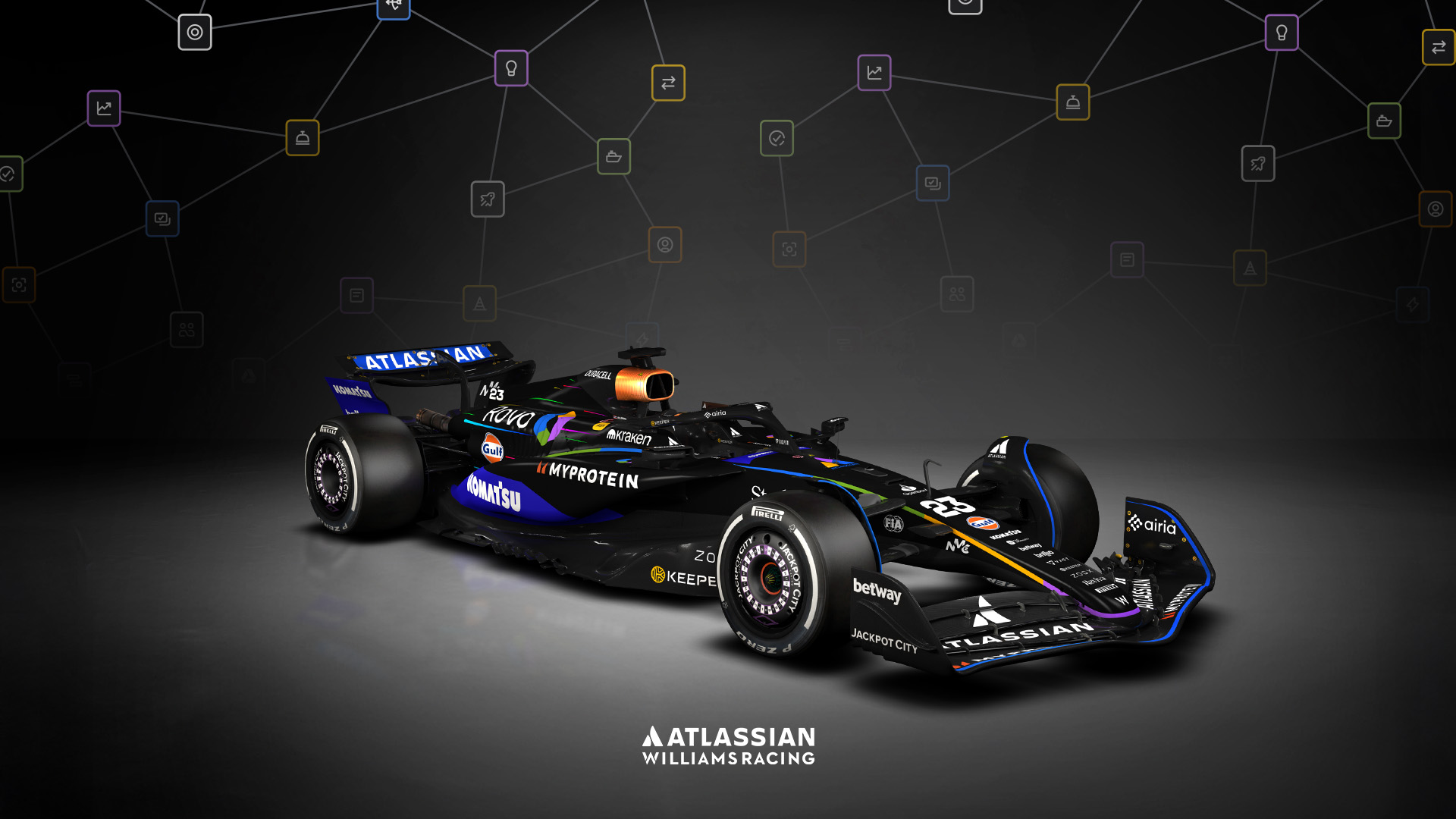
The partnership between Atlassian Corp., the enterprise software giant best known for products such as Jira and Confluence, and Formula 1 team Williams Racing is far more than a simple sponsorship with a logo on a helmet.
One of the aspects I like most about Formula 1 is that the value of all technical sponsorships counts towards the race teams operating cap. That means even if a vendor were to give the organization free hardware or software, the value of that is calculated and counts toward the annual spend. And that means any brand being associated with any of the race teams is being used by them.
Atlassian is the title sponsor for Williams, hence the name “Atlassian Williams Racing,” and the collaboration is an excellent proof point for how its “System of Work,” powered by AI, can transform one of the most data intensive and demanding sports on the planet. A big part of my research is the cross over between sports and tech, and there is no sport that collects as much data and acts on it as quickly as F1. Because of this, I was looking forward to attending the F1 Las Vegas Grand Prix in late November and spending time with Atlassian to get a deeper dive on the partnership.
At the track, I met with Jamil Valliani, head of AI product for Atlassian. I mentioned that for many years, the Atlassian brand was synonymous with Jira, which has become an indispensable tool for software development and issue tracking. Valliani agreed that was the case, but that perception is now changing. While Jira remains foundational, Atlassian’s vision has broadened to encompass a complete System of Work — a philosophy and product suite designed to empower virtually any team with complex projects, goals, and knowledge bases.
This system is an integrated collection of tools, including:
The ultimate goal is to connect the entire organization — from HR to the pit crew — using standardized, accelerated processes. Valliani explained, the partnership with Williams is built on a shared commitment to unlocking “human potential through technology and teamwork.”
The cornerstone of the Atlassian System of Work, and the engine of innovation for Atlassian Williams Racing, is Rovo. Rovo is not a single product but an AI-powered intelligence layer that runs across all Atlassian’s offerings.
Valliani describes Rovo as a multifaceted capability that serves as an “AI teammate” to the workforce:
World-class enterprise search: Rovo can query across the vast, disparate knowledge locked within an organization’s Jira, Confluence and Loom content.
AI Rovo Chat: A conversational interface that allows users to ask questions and receive intelligent answers based on their internal company knowledge.
Rovo Studio (agent building): This is perhaps the most transformative feature. Studio allows nontechnical users to build custom agents and automations simply using natural language, providing an “extra pair of hands” for repetitive or complex tasks.
The adoption of Rovo across Atlassian’s paid customers has been very strong. Valliani cited more than 3.5 million monthly users. The growth rates — over 100 times growth in Rovo search and 50 times growth in Rovo chat — underscore the immediate value teams are finding in accelerating their work. Also, the studio feature has seen more than 2 million automations and workflows accelerated, demonstrating that the future of work is not just about using AI for personal tasks (like writing an email), but for accelerating teamwork.
The highly regulated and competitive environment of Formula 1 makes it the perfect testing ground for a System of Work. As mentioned above, because of the sport’s cost cap rules, every piece of technology must deliver verifiable, competitive value. The Atlassian Williams Racing F1 team is utilizing the System of Work and Rovo across their entire organization for several uses cases, including:
The most compelling example shared by Valliani involves the team’s wind tunnel testing:
Williams’ widespread adoption of Loom, especially for recording all team meetings, demonstrates how Rovo turns unstructured data into organizational memory:
Atlassian and Williams Racing offer a critical lesson for any company looking to realize value from AI. As Valliani noted, many organizations are “stuck” because they focus only on using AI for individual acceleration. The key to true organizational transformation lies in teamwork acceleration.
Valliani’s advice for successful AI adoption, proven by the Williams partnership, is twofold:
The Atlassian Williams partnership is a tangible demonstration that when AI is integrated not just as a feature, but as the foundational layer of a connected, cross-organizational System of Work, it delivers measurable results. In the high-stakes world of Formula 1, this means better cars, faster processes and climbing the championship ranks. For the rest of the enterprise world, it means a proven blueprint for competing effectively in the new AI era.
The ability to drive organizational transformation has had tangible results for Williams. Atlassian became the title sponsor in 2025, and Williams Racing has seen a major shift in results. From 2018 to 2024, Williams accumulated a total of 84 points. With the 10 points earned in Las Vegas, the team now has 111 points in 2025 alone. When it comes to any organization, F1 included, teamwork matters but that requires having the right tools in place to see across every member.
Zeus Kerravala is a principal analyst at ZK Research, a division of Kerravala Consulting. He wrote this article for SiliconANGLE.
Support our mission to keep content open and free by engaging with theCUBE community. Join theCUBE’s Alumni Trust Network, where technology leaders connect, share intelligence and create opportunities.
Founded by tech visionaries John Furrier and Dave Vellante, SiliconANGLE Media has built a dynamic ecosystem of industry-leading digital media brands that reach 15+ million elite tech professionals. Our new proprietary theCUBE AI Video Cloud is breaking ground in audience interaction, leveraging theCUBEai.com neural network to help technology companies make data-driven decisions and stay at the forefront of industry conversations.