

 EMERGING TECH
EMERGING TECH
EMERGING TECH
EMERGING TECH

Tutor Intelligence Inc., a provider of artificial intelligence-powered warehouse robot workers, said today it has raised $34 million in early funding to accelerate the commercialization of its state-of-the-art intelligent robot fleet.
The Series A capital round was led by Union Square Ventures, with the additional participation of Fundomo and Neo. Today’s funding brings the total raised by the company to $42 million.
Tutor grew out of Massachusetts Institute of Technology’s Computer Science and Artificial Intelligence Laboratory to develop a data engine powering fleets of AI-powered robots used to move packaged goods in North American factories and warehouses.
“I’ve been a robot kid, basically obsessed with robots since I was about eight years old,” co-founder and Chief Executive Josh Gruenstein told SiliconANGLE in an interview. “We don’t have robots everywhere in our day-to-day lives. Work and labor is a manual process for human beings today.”
As an engineer, Gruenstein said, he became preoccupied with the major bottleneck in real-world robot deployment: Most robots don’t have human-level physical intelligence. Alongside his co-founder, he noted that 8 billion people already have the intuition to recognize objects, pick them up and move them.
That inspired a system that lets robots learn from human experience at scale and the vision became the “virtuous cycle” underlying Tutor’s core proposition.
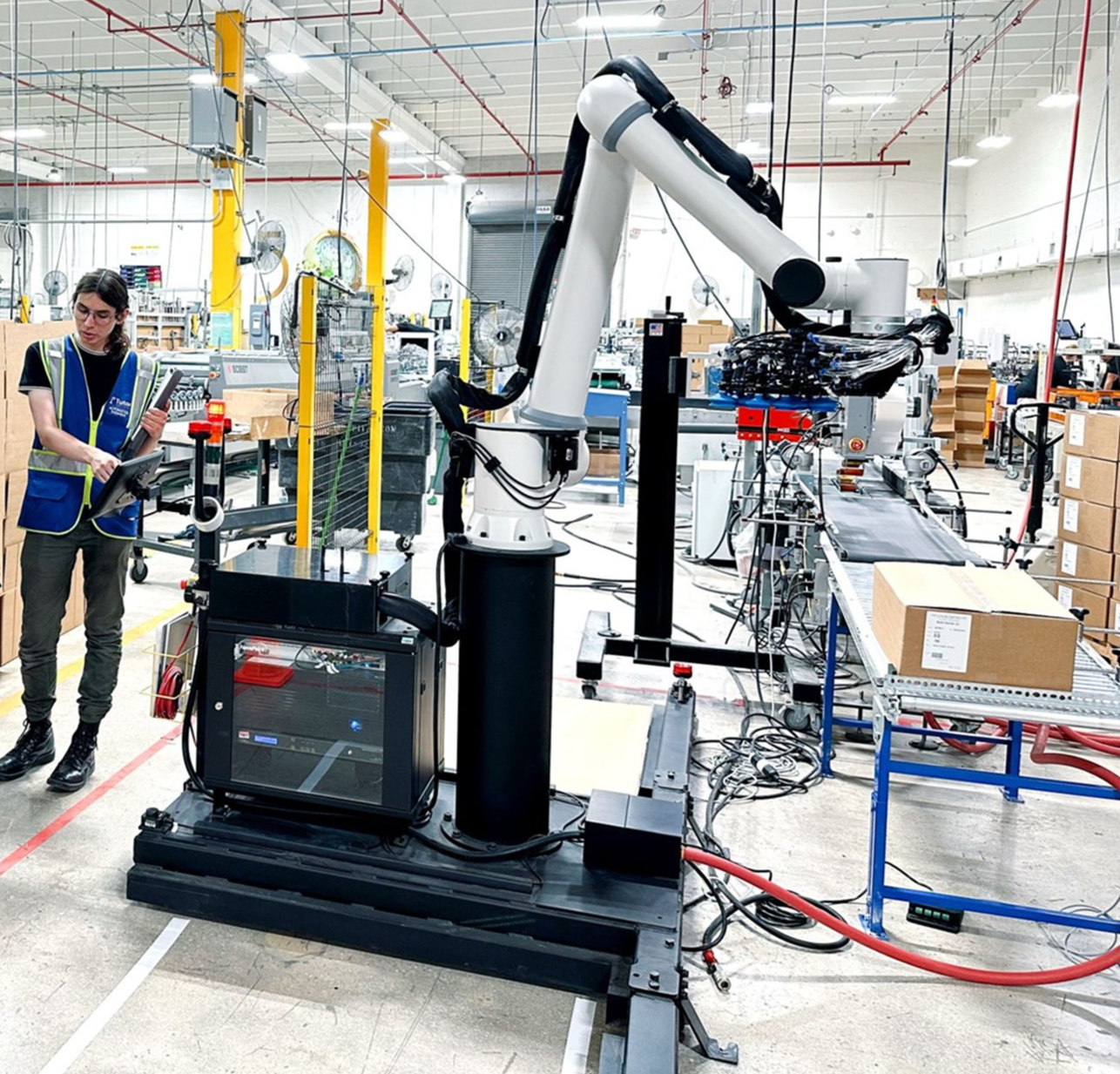
The company’s robots are primarily robotic arms that identify, grasp and move objects to sort and place them in appropriate locations. Tutor’s centralized intelligence system logs tens of thousands of hours of real-world production experience, which is annotated by a staff of human “tutors” who label the data to improve the models. As a result, the experience collected in the field can be continually reinvested to make the robots faster, smarter and easier to use.
Unlike traditional robots, which rely on narrowly tailored rules and procedures, Tutor’s robots can identify and adapt to most inventory found in live production environments. With constant motor data and ongoing training, the machines can handle odd situations and rapid changes that occur during real-world operations.
“There’s a misconception about warehousing and factories. You’re imagining all these conveyor belts and machines — things whizzing around,” said Gruenstein. “The reality is that the vast majority of factories don’t have any robots.”
Although public awareness of robotics is rising, Gruenstein noted that about 90% of factories in the United States still operate without robots. This forces companies to rely on arduous, sometimes unsafe manual labor.
Factories want automation, he said, but traditional solutions are too rigid or too capital-intensive. That dynamic often prices out smaller businesses, which make up almost 99% of U.S. manufacturers. A significant portion of these small manufacturers have fewer than 20 employees.
To address that, Tutor provides robots — along with its specialized intelligence system — that can be delivered to customer sites within 30 days, and typically become operational just one day after arrival. Companies don’t face a massive upfront cost to adopt the technology; instead, they pay through a robot-as-a-service subscription model that maps closely to traditional labor expenses.
That allows large firms to expand rapidly across multiple sites, while small firms can scale quickly without being priced out of automation.
Tutor plans to use the new capital to increase its manufacturing capacity and expand the deployment of robots across the United States. Additionally, it is investing in research and development to support a wider range of use cases, ensuring that the platform is suitable for companies of all sizes, from tiny manufacturers to Fortune 500 logistics giants.
“Everything you interact with came from a factory or a warehouse,” said Gruenstein. “The industrial world is this really valuable training ground –[an] industrial boot camp for robots. Our ambition is to provide robots for as much of the world as we possibly can.”
The data drawn from industrial applications represents both a foundation for future robotics and a proving ground where robots learn the generalizable skills needed in other domains. That will allow Tutor to expand its ability to provide autonomous robots that can operate in a wider variety of circumstances.
“In the next five to 10 years, the world is going to look really different because of robots,” Gruenstein added.
Tutor Intelligence aims to be part of the engine driving that change.
Support our mission to keep content open and free by engaging with theCUBE community. Join theCUBE’s Alumni Trust Network, where technology leaders connect, share intelligence and create opportunities.
Founded by tech visionaries John Furrier and Dave Vellante, SiliconANGLE Media has built a dynamic ecosystem of industry-leading digital media brands that reach 15+ million elite tech professionals. Our new proprietary theCUBE AI Video Cloud is breaking ground in audience interaction, leveraging theCUBEai.com neural network to help technology companies make data-driven decisions and stay at the forefront of industry conversations.