 EMERGING TECH
EMERGING TECH
EMERGING TECH
EMERGING TECH

Canadian quantum computing startup Photonic Inc. said today it has closed on CAD$180 million ($130 million) in funding as part of the first phase of its latest investment round.
The company said it’s aiming to raise much more in the coming months as it looks to scale up its quantum entanglement-based networking technology for quantum computers. The latest round was led by London-based Planet First Partners and saw participation from the venture capital arm of telecommunications giant Telus Corp. Existing investors including Microsoft Corp. and BCI also participated in the round, which brings the total amount raised to $271 million.
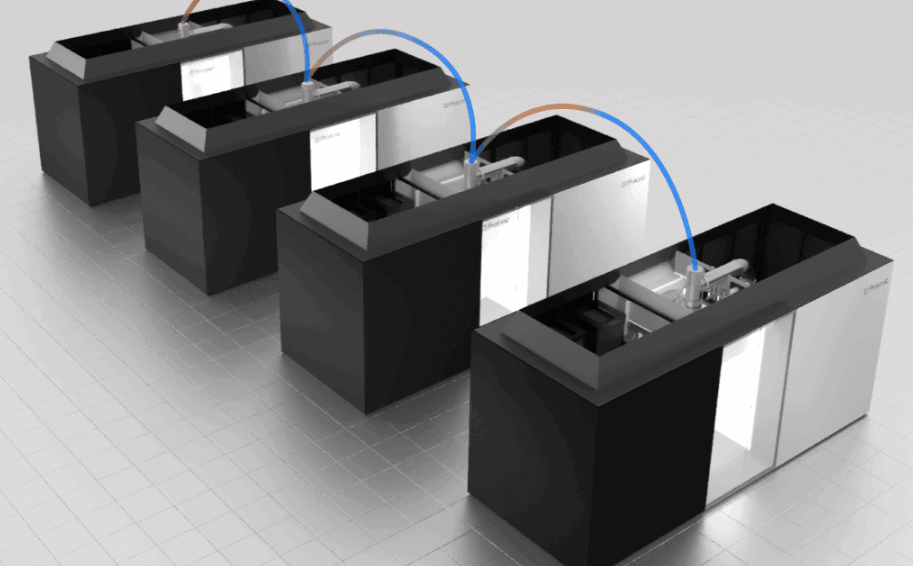
Photonic says it’s trying to build the world’s first highly scalable fault-tolerant quantum computer. It’s doing so with a unique technology based on quantum entanglement, which allows it to network potentially thousands of “qubits” together so they can work in unison and perform more complex calculations.
Entanglement refers to the weird nature of quantum physics, where two separate particles are linked together, even when they’re located far apart from one another. In principle, it should allow any two qubits to teleport information between each other.
In an interview with BetaKit, Photonic co-founder and Chief Quantum Officer Stephanie Simmons said the company wants to use entanglement to solve the challenge of scaling quantum computers. She explained that quantum computers have long held the promise of being able to solve tasks that are too computationally challenging for classical computers, leading to new advances and applications in drug and material discovery, machine learning, financial forecasting and other areas.
But quantum computers are very different from their classical counterparts. Rather than deriving power from manipulating “bits” of information, they work by tapping the peculiar properties of light and matter at microscopic levels. So instead of bits – the 1s and 0s used as the basis of digital computations – they use qubits, which can be either a 1, a 0 or both at the same time.
The difficulty lies in harnessing those qubits, which are inherently unstable due to their microscopic nature. Basically any kind of interference, such as the vibrations caused by someone walking around a room, or temperature fluctuations, can cause errors to show up. For that reason, qubits need to be stored very carefully, either at extremely low temperatures close to absolute zero, or else in a vacuum where they can be manipulated using lasers.
Doing this at scale is problematic, though, and for quantum computers to become truly useful, they’re going to need thousands of qubits to work together. That explains why Photonic is trying to use entanglement, so it can harness the power of thousands of individual qubits without having to house them all together.
Photonic’s goal is to sell access to its quantum computing systems to governments and corporations as a service, similar to how today’s cloud computing giants operate. That’s why Microsoft has gotten onboard with Photonic. More than an investor, it’s also a partner, with plans to integrate Photonic’s technology with its Azure cloud computing platform so it can provide access to quantum computing services to customers from the cloud.
Planet First Partners’ Nathan Medlock said he’s backing Photonic because he believes that quantum computing has the potential to unlock breakthroughs in clean energy, advanced materials and human health. “Photonic’s distributed architecture provides a credible path to rapidly scale towards utility-scale systems – enabling innovations in areas such as battery materials, low-carbon catalysts and drug design that can meaningfully accelerate climate solutions and improve global wellbeing,” he said.
Photonic Chief Executive Paul Terry told BetaKit that today’s round is just the start, for the company plans to “raise a lot more than that” in the next three months. He said he’s already in talks with prospective investors and is looking at raising up to $250 million in total.
Canada has become something of a leader in quantum computing technology. Its best-known quantum computing company is the publicly traded D-Wave Quantum Inc., which was originally founded in Burnaby, British Columbia, but has since moved to Silicon Valley. It’s valued at more than $10 billion, and it has long claimed to be the only company in the world that sells a fully-operable quantum computer – although its machines have yet to reach the point of “quantum advantage,” where they become more powerful than classical computers.
Canada is also home to Xanadu Quantum Technologies Inc., which has previously partnered with Nvidia Corp. and plans to go public via a merger with a Nasdaq-listed special purpose acquisition company. The proposed offering seeks to raise up to $500 million and would value the combined entity at more than $3.1 billion.
Support our mission to keep content open and free by engaging with theCUBE community. Join theCUBE’s Alumni Trust Network, where technology leaders connect, share intelligence and create opportunities.
Founded by tech visionaries John Furrier and Dave Vellante, SiliconANGLE Media has built a dynamic ecosystem of industry-leading digital media brands that reach 15+ million elite tech professionals. Our new proprietary theCUBE AI Video Cloud is breaking ground in audience interaction, leveraging theCUBEai.com neural network to help technology companies make data-driven decisions and stay at the forefront of industry conversations.