 AI
AI
AI
AI
AI

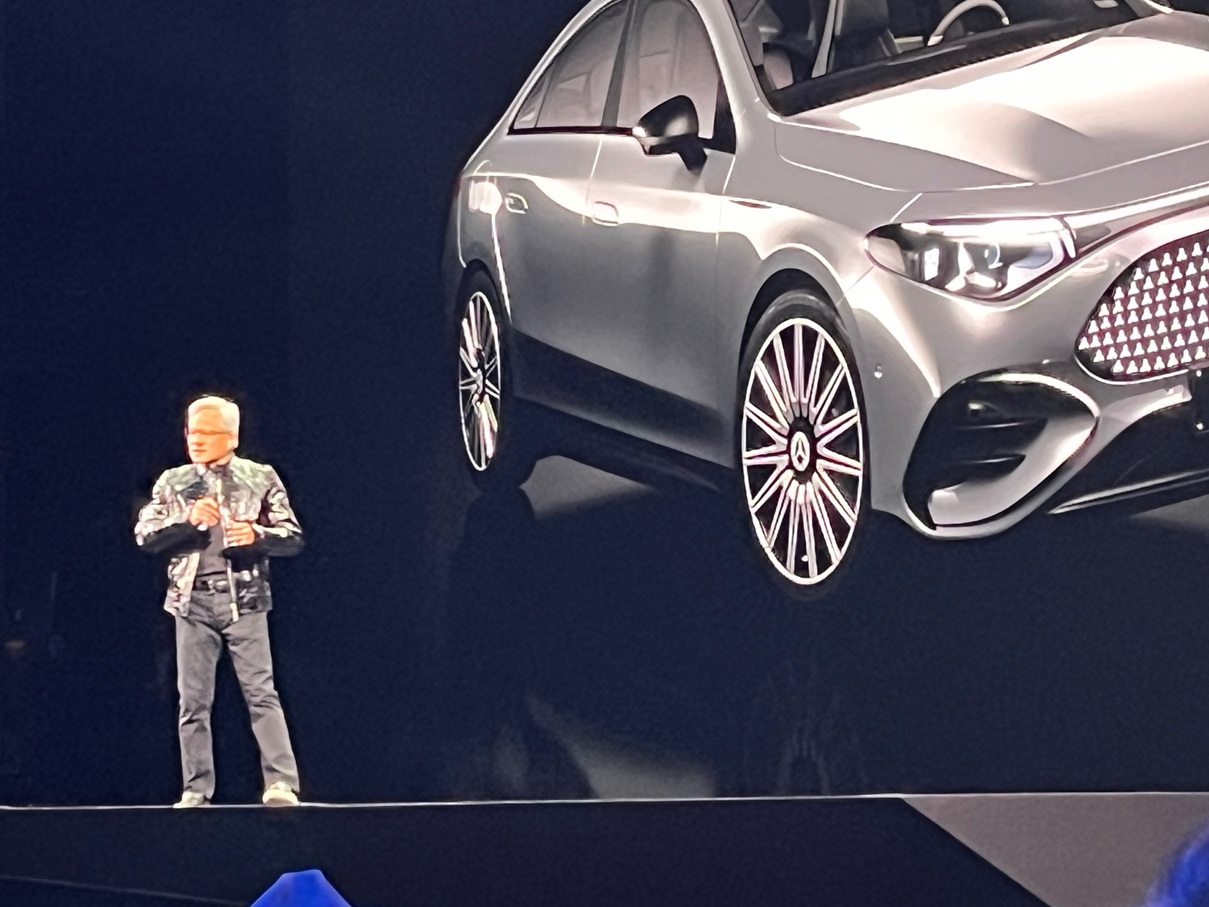
Last January, Nvidia Corp. Chief Executive Jensen Huang walked onto the keynote stage at the CES trade show in Las Vegas and declared that robotics had reached an inflection point and artificial intelligence was poised to deliver on its promise for navigating the physical world. This week at the annual event, Huang (pictured) made another keynote appearance and demonstrated how far physical AI had progressed.
The company announced Alpamayo, a new open family of AI models designed to improve safety and reliability for autonomous driving systems by leveraging real data feeding simulation, and simulation feeding learning loops. At least for robotic cars, AI is growing up fast.
“We have to create a system that allows AIs to learn the common sense of the physical world,” Huang told the audience. “Our vision is that someday every single car and every single truck will be autonomous. This is already a giant business for us.”
Rapid advances in autonomous driving over the last two years have made cars a natural test bed for physical AI. Waymo, the self-driving arm of Alphabet Inc., currently offers fully driverless robotaxi services in Phoenix, Los Angeles, Atlanta, Austin and multiple cities in the San Francisco Bay Area. Tesla Inc. owners are beginning to test out the company’s FSD v.14 self-driving update. Nvidia will deploy Alpamayo initially in Mercedes Benz models later this year.
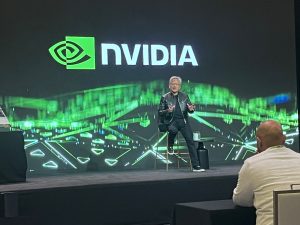
Jensen Huang met with the media during CES on Tuesday and talked about autonomous driving and AI computing.
“This is likely one of the largest and fastest growing technology sectors in the next decade,” Huang said at a CES press briefing on Tuesday. “Everything that moves should be autonomous.”
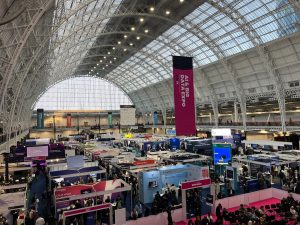
There was plenty of evidence at CES this week that a number of companies are taking Huang’s advice to heart. Emblematic of the tech world in general, CES has become an AI showcase, with major companies demonstrating new autonomous products for the consumer world.
LG Electronics Inc. brought a robot onstage during its press conference on Monday to showcase autonomous capabilities for household tasks. The bot rolled across the stage and placed a towel in a laundry machine on command.
Hyundai Motor Group-owned Boston Dynamics Inc. announced its newest Atlas humanoid robot line during one CES presentation. Atlas, checking in at six feet, three inches tall and weighing about 200 pounds, will assist Hyundai with car assembly at a plant in Georgia.
“We’re seeing a ton of industrial applications,” Bill Briggs, chief technology officer at Deloitte Touche Ltd., said during a panel session on Tuesday. “The promise of the consumer is the promise of the humanoid.”
The evolution of physical AI has been accompanied by a strategic decision on the part of consumer tech providers to position artificial intelligence on personal terms. This is no longer software run by sophisticated chips. AI has become the consumer’s friend, what Samsung Electronics Co. Ltd. describes as a “true AI companion experience.”
To build “companionship” into its products, Samsung has deployed AI into its home appliance lineup. The company has upgraded its AI Vision capability inside of refrigerators with an expanded list of recognizable food items. The solution includes the ability to make recipe recommendations based on what AI sees, and offers a weekly report on the owner’s food intake patterns.

CES is expected to draw more than 140,000 attendees to Las Vegas this week.
“It’s an evolution of home appliances to true home companions,” Cheolgi Kim, executive vice president and head of Samsung Electronics Co. Ltd.’s digital appliances business, said during the company’s “First Look” unveiling at CES on Sunday.
Another company in prime position to observe this personal connection with artificial intelligence is the one that kicked the technology into high gear three years ago: OpenAI Group PBC. The pioneering AI model firm was a notable presence in many of the presentations at CES this week in Las Vegas.
An executive from Walmart Inc. spoke about the retail giant’s recent partnership with OpenAI to complete purchases within ChatGPT and develop an agentic shopping experience. Zeta Global Holdings Corp. announced during the show that it will collaborate with OpenAI on powering a superintelligent agent for enterprise marketing. And Greg Brockman, OpenAI’s co-founder, president and chairman, joined Advanced Micro Devices Inc. Chief Executive Lisa Su on the CES keynote stage Monday night to discuss the technology’s continued evolution.
“People are using it for very personal, very important things in their lives,” Brockman said. “We are moving to a world where human intent becomes the most precious resource.”
Inevitably, the physical AI roadmap comes back to Nvidia. The company’s unveiling of Alpamayo on Monday was accompanied by the rollout of Vera Rubin, the firm’s six-chips-in-one machine to drive AI supercomputing. The Rubin platform represents Nvidia’s answer to questions about what enterprises will need for the AI factory.
As SiliconANGLE analysts have noted, Rubin reflects Nvidia’s vision for the shift taking place from computing as infrastructure to computing as production. The demands of physical AI will require an ability to pull intelligence up the stack, beyond data centers and GPU clusters and into networking, storage, security, scheduling, and serviceability in a fully compatible architecture.
“The demand for computing is really off the charts, this is why demand for Nvidia is so great,” Huang told the assembled media on Tuesday. “Every year we are going to deliver more computing capability. We are going to try to keep this rhythm going as long as we can.”
Huang was asked how long he plans to keep going as Nvidia’s leader. His tenure at the helm began in 1993, making him one of the longest-serving CEOs in the tech industry today.
Huang deflected the question about his plans, but did offer advice to fellow top executives. “The secret to being a CEO this long is one, don’t get fired and two, don’t get bored,” Huang said. “If you do something for 34 years, you are going to figure it out.”
Support our mission to keep content open and free by engaging with theCUBE community. Join theCUBE’s Alumni Trust Network, where technology leaders connect, share intelligence and create opportunities.
Founded by tech visionaries John Furrier and Dave Vellante, SiliconANGLE Media has built a dynamic ecosystem of industry-leading digital media brands that reach 15+ million elite tech professionals. Our new proprietary theCUBE AI Video Cloud is breaking ground in audience interaction, leveraging theCUBEai.com neural network to help technology companies make data-driven decisions and stay at the forefront of industry conversations.