 AI
AI
AI
AI





AI

OpenAI Group PBC said today it’s partnering with four of the world’s biggest technology consulting firms in an effort to help more enterprises adopt artificial intelligence agents.
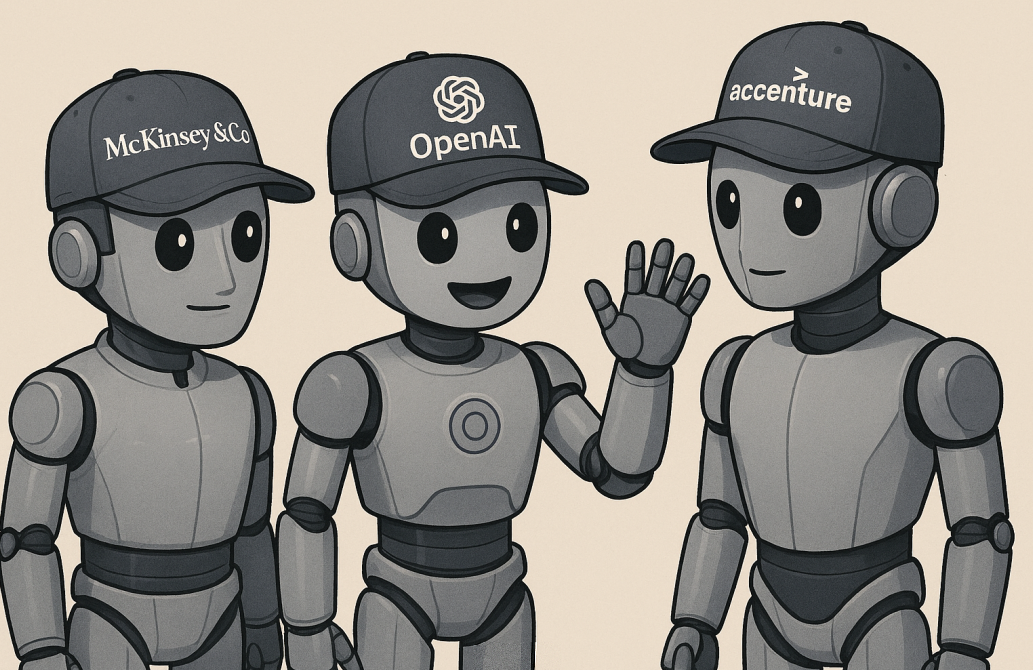
The ChatGPT maker has created an initiative it’s calling “Frontier Alliances” in collaboration with Accenture Plc., Boston Consulting Group Inc., Capgemini SE and McKinsey & Co.. They’re going to work with OpenAI to help teach enterprise customers have to use Frontier, the company’s recently launched agentic AI platform for building, deploying and orchestrating AI-powered co-workers.
OpenAI said the limiting factor that’s stopping most enterprises from realizing the value of AI agents isn’t the intelligence of the models that power them, but the way those agents are built and run in their organizations. To get around this barrier, OpenAI will provide the “technical skill of its forward-deployed engineering teams” with the “deep transformation experience and global delivery teams” of the consulting firms.
The company is making a big bet on AI agents, because it believes that if they can automate business work and help to improve productivity, they can create an enormously lucrative new revenue stream. AI agents are systems powered by generative AI models that can work with external tools to take actions on behalf of users. For instance, they can perform tasks such as creating files, searching the internet, using software applications.
McKinsey and Boston will help the company with higher-level stuff, such as helping businesses to create AI co-worker strategies, operating models and change-management plans. Meanwhile, Accenture and Capgemini will assist with the technical implementation and support, taking care of tasks such as connecting agents to enterprise data.
McKinsey said it will try to help leadership teams work out “where to focus, how to redesign operating models and how to embed intelligence into day-to-day work.” Meanwhile, BCG said it will make sure that “AI transformations reflect how the business truly operates and deliver measurable value.”
Accenture said its role is to help enterprises modernize their data architectures and securely scale agent deployments across their entire organizations. It has an existing relationship with OpenAI, helping businesses turn pilot projects into core workflow automations. Finally, Capgemini said it will help businesses to embed OpenAI Frontier with the key technology systems they use and put in place “the operating processes needed to run agents consistently at scale.”
None of the consultants is working exclusively with OpenAI. For instance, McKinsey has been working with Google LLC to help enterprises deploy its Gemini chatbot since 2024, while Anthropic PBC announced a major new partnership with Accenture in December, where the consultant will help its enterprise customers work out ways to deploy its Claude models.
OpenAI is perhaps a tad late to the enterprise game. Over the last year, Anthropic has made major inroads with big businesses, which are using its Claude Code and Claude Cowork tools to enhance automation. It’s thought that the bulk of Anthropic’s revenue now comes from enterprise contracts, whereas most of OpenAI’s still comes from consumer subscriptions.
Reports indicate that roughly 80% to 85% of Anthropic’s revenue comes from corporate customers, including developers using its API and enterprise-level subscriptions, rather than individual consumer subscriptions. On the other hand, business customers are thought to account for just 40% to 45% of OpenAI’s revenue.
While OpenAI may see Anthropic as its main rival, the launch of Frontier and the new partnerships announced today could cause more worries for established software-as-a-service providers such as Salesforce Inc., ServiceNow Inc., Workday Inc. and perhaps even Microsoft Corp. These companies also work with big consulting firms to help market and deploy their software to big enterprises and governments, and they’re also betting on AI agents.
However, investors are worried about their ability to compete, and shares of all four have declined recently over concerns that businesses will choose OpenAI’s and Anthropic’s agentic platforms over their own agents. It has also been suggested that businesses could one day use agentic coding tools to develop their own software platforms, eliminating the need for SaaS platforms altogether.
It remains to be seen if OpenAI and Anthropic will be that successful. For now, the Frontier platform is still available to only a limited number of customers, with OpenAI promising wider availability to come in the next few months.