 AI
AI
AI
AI









AI

Nvidia Corp. is no longer just selling technology. It is helping create a financial asset class around artificial intelligence compute.
In our last Breaking Analysis, we argued that AI can be technologically transformative and still produce a capital bubble. Our thesis was simply that the bubble pops if deployable supply grows faster than monetizable demand – and financing stops bridging the gap.
Nvidia Chief Executive Jensen Huang has just attacked that weak link directly.
Nvidia announced partnerships with Apollo, BlackRock, Blackstone, Brookfield, Goldman Sachs and KKR to establish financing platforms designed to mobilize more than $500 billion for AI infrastructure. This is not a funded $500 billion pool today. The final agreements still have to be completed.
But the goal is quite clear. Specifically, Nvidia is trying to turn AI compute into collateral – and the AI factory into a repeatable, financeable infrastructure asset.
That makes AI much more than a chip story. If the memorandum of agreement turns into solid agreements, it intertwines AI with credit, leverage, customer contracts, productive monetization, cash flow and the residual value of aging silicon. And if this market scales as we believe it will, the same assumptions about AI demand will connect semiconductor suppliers, neoclouds, data-center developers, utilities, private-credit funds, infrastructure investors and governments.
A failure in one part of that system may no longer stay contained.
Did Jensen just make the AI buildout too big to fail? Not yet. But he may be making it too interconnected to fail quietly.
Welcome to this Breaking Analysis No. 322. In this episode, we will briefly explain how compute-backed credit works, why Nvidia’s residual-value support is an important tell sign, what CoreWeave Inc. and Nebius Group NV earnings prints reveal about the current demand and economics picture; and whether this new capital market reduces the AI bubble risk or simply moves it downstream.
Because independent capital can extend the buildout. But independent capital is not independent demand.
Let’s begin with exactly what Nvidia did and didn’t announce.
Nvidia signed memorandums of understanding with Apollo, BlackRock, Blackstone, Brookfield, Goldman Sachs and KKR to establish independent financing platforms designed to mobilize more than $500 billion of third-party capital over time.
That is obviously a major announcement. But it is not $500 billion of Nvidia revenue. It is not one funded pool. It is not an immediate commitment to specific customers or projects. And the final agreements have not yet been completed.
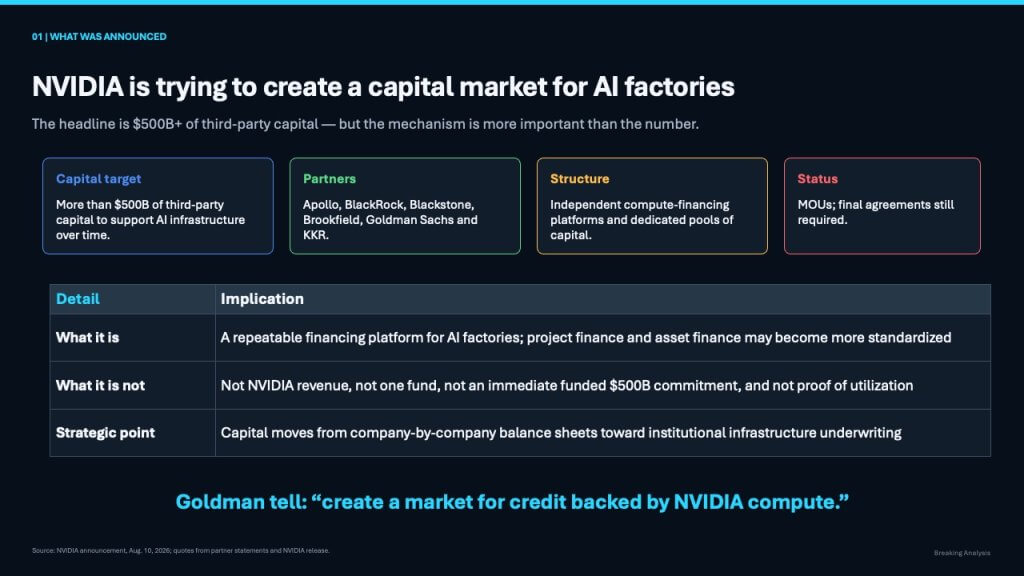
So the headline number is exciting but the mechanics are more important to understand. Specifically, today, many AI factories are financed one company and one project at a time. Builders use some combination of corporate debt, customer prepayments, asset-backed loans, equity and vendor financing. Nvidia is essentially trying to make that process repeatable.
The idea is to bring long-duration institutional capital into the market and underwrite AI factories against customer commitments, utilization, cash flow and the expected residual value of the installed compute.
The most notable phrase in the announcement came from Goldman Sachs:
“Create a market for credit backed by Nvidia compute.”
That is the transition we need to better understand. Nvidia wants its systems to be treated as more than technology equipment. It wants the compute to serve as collateral – and the AI factory to become an investable infrastructure asset class.
If this works, capital can move away from individual company balance sheets and into infrastructure funds, private credit, insurance capital and other institutional pools. That could potentially reduce the cost of capital and broaden access to AI infrastructure. But it does not eliminate risk. It does change who holds the risk, how the risk is financed and how widely the exposure is distributed.
Don’t think of this as a program designed to sell more graphics processing units. It is that. But it’s much more. Nvidia is attempting to build a capital market around its architecture by making AI infrastructure an investable asset.
And this is the key to understanding this prospective deal:
The AI chip cycle is becoming a credit cycle.
The next question is how an AI factory actually becomes a financeable asset – and what investors are being asked to underwrite.
To understand what Nvidia is building, let’s put our banker hats on and think like a finance lender. This proposed structure is similar to the financing used for power plants, aircraft fleets or large infrastructure projects.
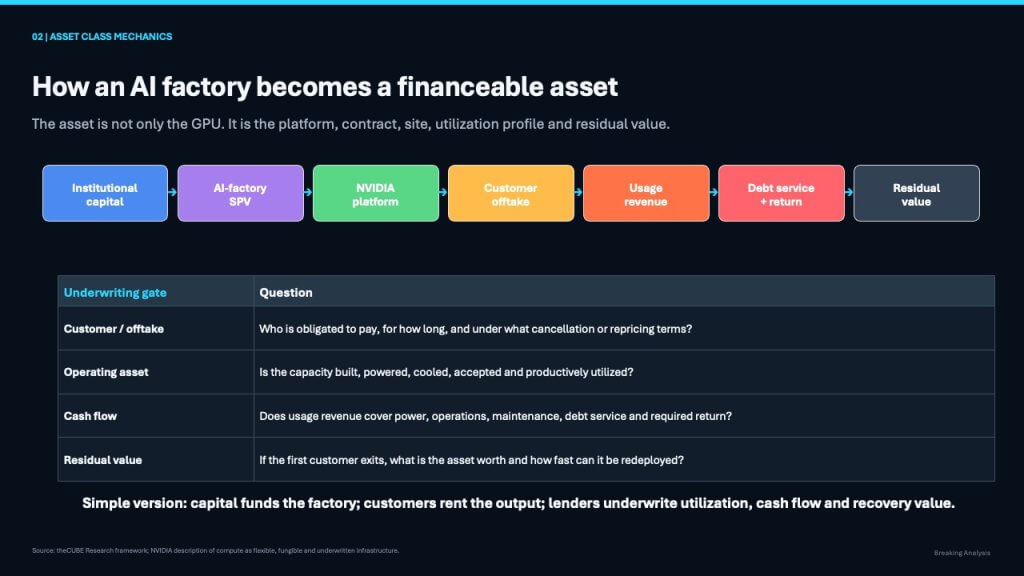
Institutional investors provide debt and equity to a dedicated financing vehicle – often called a special-purpose vehicle, or SPV. That SPV uses the capital to buy or lease the Nvidia systems, secure the site and power, and build the AI factory.
But the physical infrastructure is only one part of the asset. The complete asset includes the Nvidia platform, the customer contract, the site, the power connection, the expected monetization profile and the residual value of the equipment after the first contract ends.
The customer agreement – or what’s called an “offtake contract” is super important.
The lender wants to know four things: 1) Who is obligated to pay? 2) How long is the commitment? 3) Is the contract take-or-pay – meaning the buyer either takes a minimum amount of product or pays for the shortfall if they don’t take delivery? And 4) Can the customer cancel, delay acceptance or renegotiate the price?
Once the factory is operating, usage revenue has to cover power, cooling, maintenance, operating costs, debt service and the return required by the equity investors.
And then there is the residual-value question. When the first customer contract ends, can the cluster be leased to another customer? In other words, does it have enough value to be redeployed to inference or a different workload? And what is that value?
This is why Nvidia emphasizes that its systems are fungible, transferable and improved over time through CUDA. Those salient characteristics are intended to support a longer economic life and give lenders confidence that the equipment still has value if the original customer leaves.
So from an underwriters perspective – they don’t care about AI hype.
They only care if this specific AI factory generates enough predictable cash flow – and retains enough recovery value – to support the capital structure?
This is how compute becomes collateral.
Capital funds the factory. Customers rent the output… and lenders underwrite utilization, cash flow and recovery value.
And this framework also tells us exactly where the risk moves if demand, pricing or residual value fails to live up to expectations
This all may sound like infrastructure finance – like leasing IBM mainframe computers in the 80s and 90s. But once these loans and leases begin to be pooled and distributed, the model starts to resemble something more like asset-backed credit – and eventually, perhaps, securitization.
There’s lots of talk in the media about how this is like mortgage-backed securities. We need to be careful with the MBS analogy. It is useful – but it can get ahead of the actual facts. What Nvidia announced is not securitization today. We are not seeing pools of AI-factory loans being divided into tranches, rated and sold into a broad secondary market. Nvidia has announced financing platforms and dedicated pools of institutional capital. The final agreements are still pending.
This is not MBS, yet anyway.
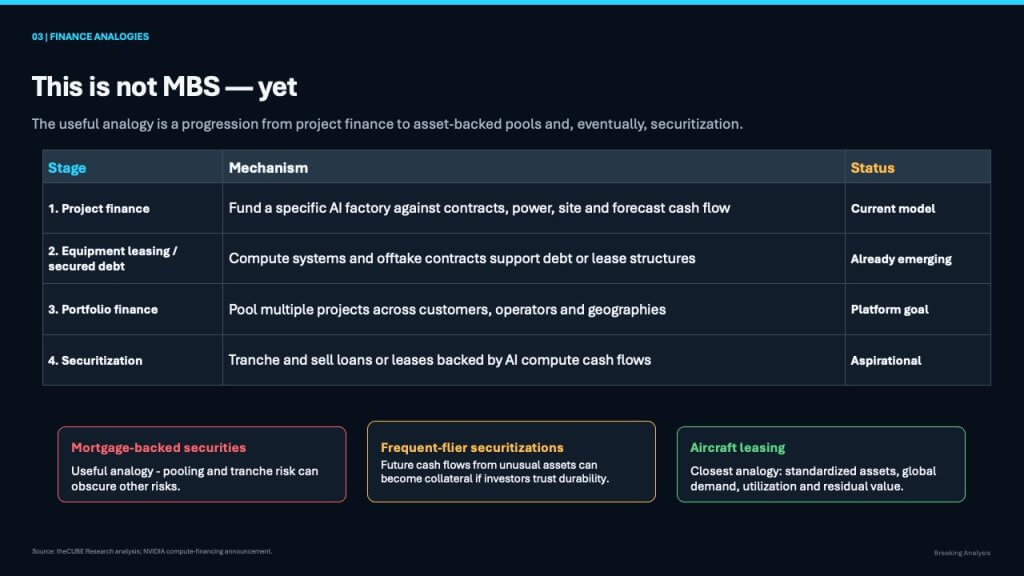
What we are seeing is a steady movement.
The first stage is project finance. A lender finances a specific AI factory against a customer contract, a site, available power and forecasted cash flow. The lender underwrites that individual project.
The second stage is equipment leasing and secured debt. Here, the compute systems and the customer contracts help support the borrowing.
We have clear evidence that this is already happening. CoreWeave has financed high-performance-computing infrastructure through syndicated term loans, including financing supported by shorter-duration customer contracts. Nebius completed a $775 million asset-backed facility secured by deployed GPUs and contracted cash flows from an investment-grade customer.
The third stage is portfolio finance.
Instead of financing a one-off AI factory, investors pool multiple projects across customers, operators and geographies. That diversification – and the operating data created over time – can make the asset class easier to underwrite.
That appears to be the direction of Nvidia’s institutional platforms.
Then, potentially, comes securitization. If transaction volume grows and the assets develop a reliable and proven performance history, loans or leases could eventually be pooled, divided into senior and junior risk tranches and distributed to a broader investor base. But that is a possible future state – not what was announced.
The mortgage-backed-securities analogy helps us understand pooling, tranching and distribution. It also gives us the warning: Financial diversification can conceal economic concentration if every loan depends on the same demand assumptions and collateral values.
Frequent-flyer securitizations is an example that shows how unusual future cash flows can support borrowing when investors believe those cash flows are durable.
Aircraft leasing is probably the closest operating analogy. Here you have standardized assets, multiple potential customers, recurring lease revenue and strong residual value after the first contract ends.
Even that comparison however has limits. An aircraft can be flown to another customer. A complete AI factory remains tied to power, cooling, networking, software and a physical site.
So the key question is not whether Wall Street can package this risk – Wall Street can package almost anything.
The more important question is whether packaging the financing actually diversifies the underlying economics.
Pooling projects does not diversify the risk if every project depends on the same customers, the same Nvidia architecture and the same utilization assumptions.
And that brings us to the most revealing part of the announcement:
Nvidia’s willingness to provide residual-value support.
Let’s look at Nvidia’s willingness to support this arrangement and what it actually tells us. Huang announced that Nvidia has the option to backstop up to $125 billion – or 25% – of this massive $500 billion-plus AI infrastructure financing initiative.
Key issue: Does the backstop bring confidence – or indicate that lenders still require credit de-risking?
The answer is both. Many media reports interpreted the term “backstop” in a negative light. But what they fail to convey is that the backstop is at Nvidia’s option. In other words, if the financier feels the deal is too risky, Nvidia has the option of absorbing up to 25% of that risk. But if Nvidia doesn’t feel the project is viable it can choose not to provide the backstop and the deal blows up.
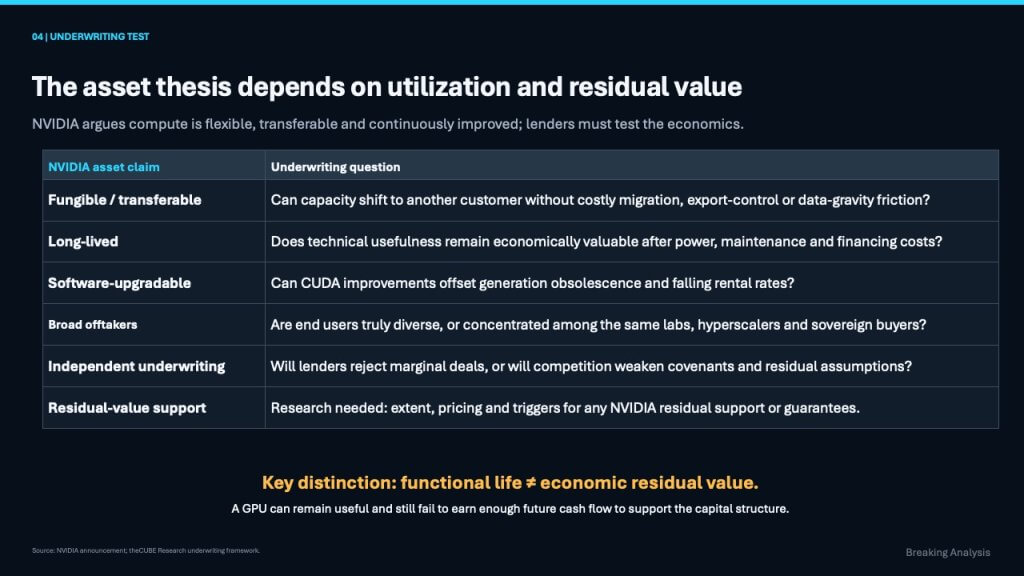
This underscores the most important stress test in the entire financing model. As we explained earlier, Nvidia’s premise is that its compute is not disposable technology equipment – rather it’s an investable asset.
But lenders ask a different set of questions. If the original customer leaves, can another customer take the capacity quickly – without costly migration, reconfiguration, export-control issues or data-gravity friction? Can CUDA improvements offset the performance and power-efficiency advantages of newer generations? Are the potential offtakers truly diverse – or are many projects ultimately dependent on the same frontier labs, hyperscalers and sovereign buyers? And most importantly, does the capacity generate enough cash after power, cooling, site expense, maintenance, operations, debt service and refinancing costs?
Some early evidence supports part of Jensen’s argument.
CoreWeave says a typical five-year contract can repay the asset-level debt used to build the cluster. It also recently contracted A100 capacity through 2029 at what it described as an attractive price – even though the A100 architecture was introduced in 2020. CoreWeave says its prior-generation Ampere and Hopper fleets also remain largely sold out.
That is significant evidence that older Nvidia infrastructure can retain commercial value.
But it is not yet a full-cycle stress test.
Those residual values are being seen during a period when supply remains constrained and rental pricing is unusually strong. The real test comes after a capacity-surplus cycle – when newer systems are broadly available, rental prices normalize and customers have more alternatives.
That is the key distinction at the bottom of this slide:
Functional life is not the same as economic residual value.
A GPU can remain technically useful and still fail to earn enough future cash flow to support its carrying value or capital structure. Independent underwriting only creates discipline if lenders are willing to reject projects that are of marginal value or too risky. Now if Nvidia must provide residual-value support, that does not mean the asset thesis is wrong. It means the market has not yet accepted the thesis without credit enhancement.
The next question is what happens if capital becomes tighter – and the upfront payment starts to matter more than lifetime total cost of ownership – in other words, if I can’t fund the initial capital outlay, I don’t care if Nvidia’s performance per watt is better.
Now let’s test Nvidia’s asset-class thesis against actual data. If compute-backed credit is going to become a durable market, the neoclouds are a good proving ground, right? And at the moment, that proving ground is flashing green – but mainly on the front half of the cycle.
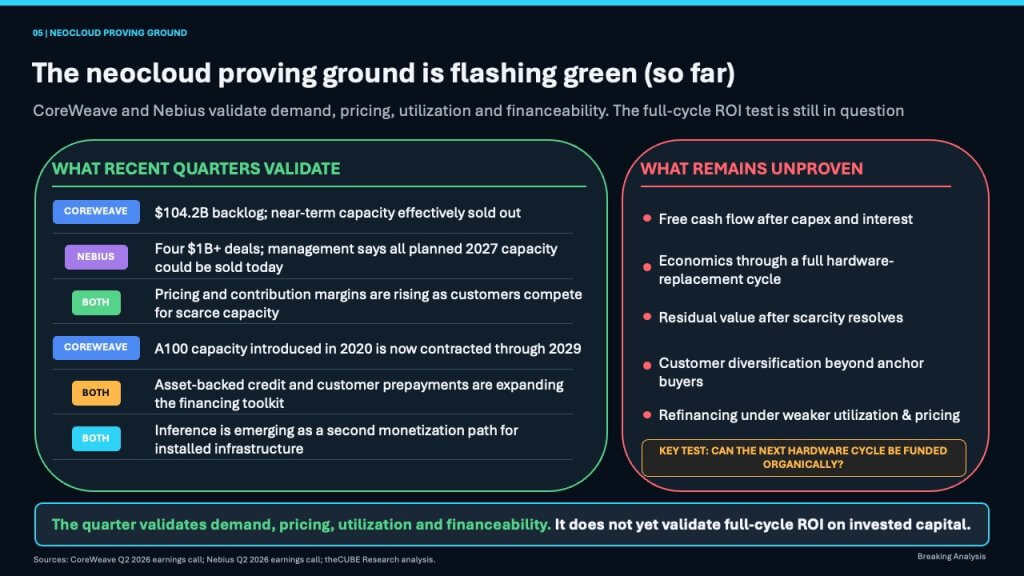
Let’s start with CoreWeave.
The company reported $2.6 billion of quarterly revenue, up 112%, and ended the quarter with $104.2 billion of backlog. That figure did not include more than $25 billion of additional customer commitments signed shortly after quarter-end. Management says near-term capacity is effectively sold out, with multiple buyers competing for each GPU brought online. Pricing and expected contribution margins on recent contracts are also rising.
More than half of CoreWeave’s backlog is already attached to contracts where delivery has begun, and management expects that figure to exceed two-thirds by year-end. That is important because backlog is beginning to convert into installed, revenue-producing capacity.
Nebius provides similar evidence from a different operating model.
It signed four AI-cloud deals averaging more than $1 billion each. Customer prepayments cover roughly 50% to 60% of the associated capex, and management says it could sell its entire planned 2027 capacity today if it chose to do so. Its capacity auction also cleared 15% above its previous record price, showing that scarcity – not surplus – still clearly defines the current market.
We are also seeing preliminary support for Nvidia’s residual-value thesis.
CoreWeave recently signed an A100 contract extending into 2029. As we said, that architecture was introduced in 2020. Its Ampere and Hopper lines also remain largely sold out.
And the financing market is responding.
CoreWeave raised approximately $18 billion during the quarter and more than $32 billion cumulatively. Its latest structures support shorter-duration customer contracts. Nebius completed a $775 million asset-backed facility secured by deployed GPUs and contracted cash flows.
Inference is also emerging as a second monetization vector. CoreWeave’s managed-inference booked annual run rate increased from $1 million to more than $100 million within several months, and the company expects at least $250 million by year-end.
So the current evidence validates four things:
Demand is real.
Pricing power remains strong.
Capacity is being productively utilized.
And the assets are increasingly financeable.
But it does not yet validate the complete economic cycle.
CoreWeave still reported $9.4 billion of quarterly capex, $640 million of interest expense and a $626 million net loss. Nebius is relying heavily on customer prepayments, asset-backed debt and continued external capital while guiding to $20 billion to $25 billion of annual capex.
Neither company has yet demonstrated that it can fund a complete hardware-replacement cycle from organic free cash flow after scarcity pricing normalizes. And as we’ve suggested, the neoclouds need to diversify – and many are doing so – otherwise they’ll simply be a low-margin reseller of Nvidia hardware. Coreweave’s acquisition of Weights and Biases to build out its software stack and Crusoe’s moves into diversified infrastructure like storage are examples of this diversification. We would expect that to continue over time as a hedge if and when supply and demand come into equilibrium.
Nonetheless. The key test remains the following:
Can the next generation of infrastructure be funded from the cash produced by the current generation – without depending on another large debt raise, equity issuance, customer prepayment or vendor backstop?
So our conclusion is the quarter validates demand, pricing, utilization and financeability. It does not yet validate full-cycle returns on invested capital.
And that distinction determines whether compute-backed credit becomes a durable infrastructure asset class – or simply finances the next stage of the buildout before the market-clearing test we talked about last week arrives.
This brings us back to the AI bubble forecast we published last week.
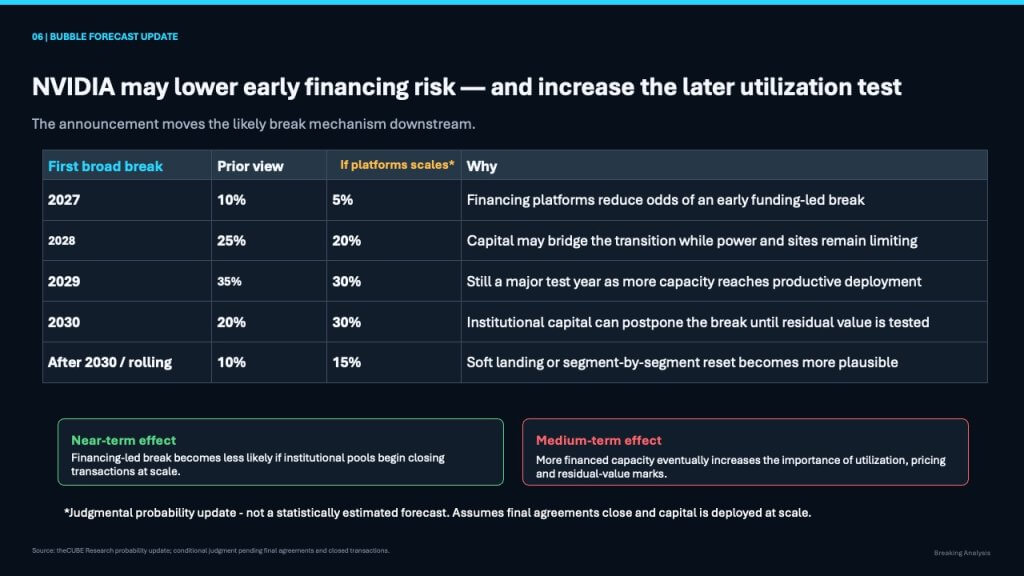
We should not change a probability outlook simply because Nvidia announced memorandums of understanding. The $500 billion is not yet funded capital, and the final agreements still have to be completed. So the right side of this slide is conditional:
What happens if these deals close, attract capital and begin financing AI factories at scale?
The immediate effect is to reduce the probability of an early financing-led break. We previously assigned a 10% probability to a broad break beginning in 2027. Under the conditional case shown here, that falls to 5%. The 2028 probability declines from 25% to 20%.
That is not because the underlying economics has suddenly been proven. It is because institutional capital can bridge the gap while highh-bandwidth memory, packaging, power and sites remain constrained – and while customers continue absorbing available capacity.
The recent CoreWeave and Nebius results support that delayed-reckoning scenario. Demand clearly remains strong. Pricing remains elevated. Capacity is being absorbed. And the financing market is becoming more willing to lend against contracted compute cash flows.
But more available capital does not eliminate the market risk. It postpones the clearing test we discussed last week. As more projects receive financing, more hardware gets ordered, more sites are built and more capacity eventually becomes energized. That increases the amount of infrastructure that must ultimately find productive workloads and generate sufficient cash flow.
So we think the risk shifts later. Our 2029 probability falls modestly from 35% to 30%, but it remains a major test year as more of the current buildout reaches productive deployment. The 2030 probability rises from 20% to 30%.
In other words, the risk window becomes 2029 through 2030, rather than one specific year. That is when utilization, rental pricing, refinancing and residual values are more likely to face a genuine full-cycle test. The probability of a soft landing – or a series of rolling, segment-level corrections after 2030 – also rises modestly in our view.
But there is one important caution from Ben Thompson’s recent analysis. The financing cycle can turn before the operating cycle. Clusters can still be sold out and rental pricing can remain strong while lenders begin widening spreads, reducing advance rates, requiring more equity or applying larger residual-value haircuts. So even this conditional distribution assumes the new platforms remain open and willing to finance projects on attractive terms.
The paradox is this:
More capital makes an early break less likely – but it can make the eventual utilization and residual-value test even more critical.
That changes the likely mechanism of a correction if it occurs. Instead of the buildout stopping because companies cannot finance construction, the eventual break could come through weaker productive utilization, lower rental pricing, residual-value markdowns and refinancing pressure after more capacity reaches the market.
So Nvidia may be reducing near-term financing risk. But it may also be increasing the stakes of the later market-clearing event we discussed last week.
Let’s bring the argument together. Nvidia is trying to solve the capital bottleneck. If the financing platforms in the announced MOUs come to fruition and work, more AI factories can be funded. More GPUs can be purchased. More sites can be built. And companies with real compute demand can gain access to capital at a lower cost. That reduces the risk of builders running out of money before the infrastructure becomes productive.
But it does not solve the full bubble problem. It moves the decisive event downstream.
The next constraint becomes creditworthy customer demand. Then productive utilization. Then residual value. Then cash flow.
Remember – Independent capital does not create independent demand. The lenders may be different, but the projects may still depend on the same frontier labs, hyperscalers, sovereign buyers and assumptions about AI adoption.
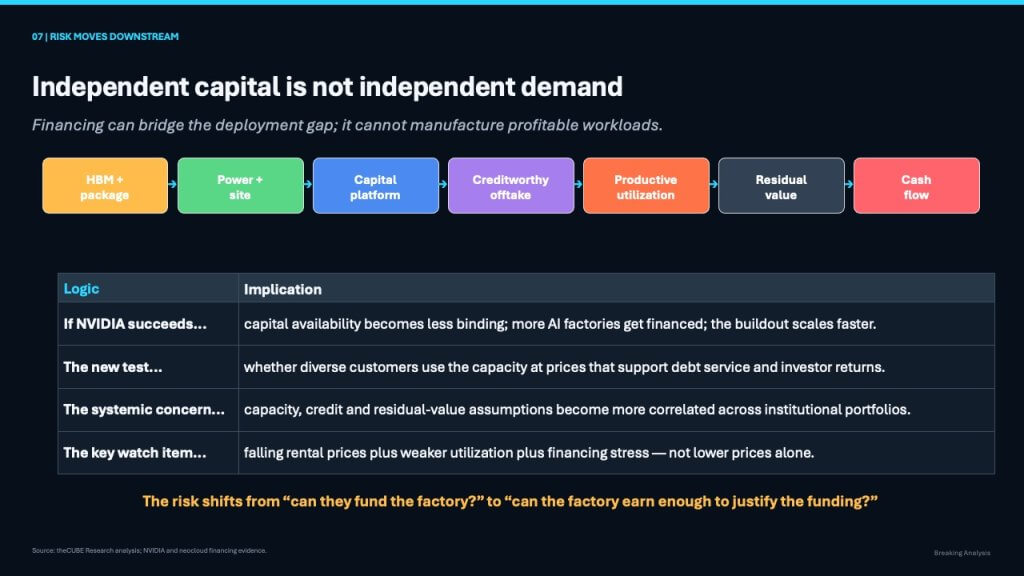
And that creates a systemic concern.
If many institutional portfolios own loans backed by the same Nvidia systems, the same customer contracts and the same utilization forecasts, the financing may look diversified while the underlying economic risk remains concentrated. The key warning signal is not lower GPU rental prices by themselves. Lower prices could expand demand and create a healthy volume cycle (Jevons Paradox).
The alarm goes off if three things happen together:
Rental prices fall.
Productive utilization weakens.
And financing terms tighten.
At that point, residual values get marked down, lenders reduce advance rates, borrowers need more equity and refinancing becomes harder.
We can take a lesson from 1986 when congress rescinded the investment tax credit (the ITC). At that time, mainframe residual values suffered a steep collapse when the tax advantages for leasing incentives dried up. It coincided with a huge technological shift toward less expensive microprocessor-based systems and marked the downfall of IBM Corp. as the leading company in the technology industry.
The point is, a financing cycle can turn before the GPUs go idle. This is the Ben Thompson comment we believe is most worth highlighting. When capital is abundant, buyers optimize around total cost of ownership (perf/watt). When capital becomes scarce, the upfront purchase price, required equity check and time to cash flow become more important. If I can’t write the initial check I don’t care about the total cost of ownership.
So this move by Jensen potentially addresses the funding question for now. And the critical point becomes:
Can the factory earn enough to justify the funding?
Let’s close with how this move by Jensen affects our the current scorecard.
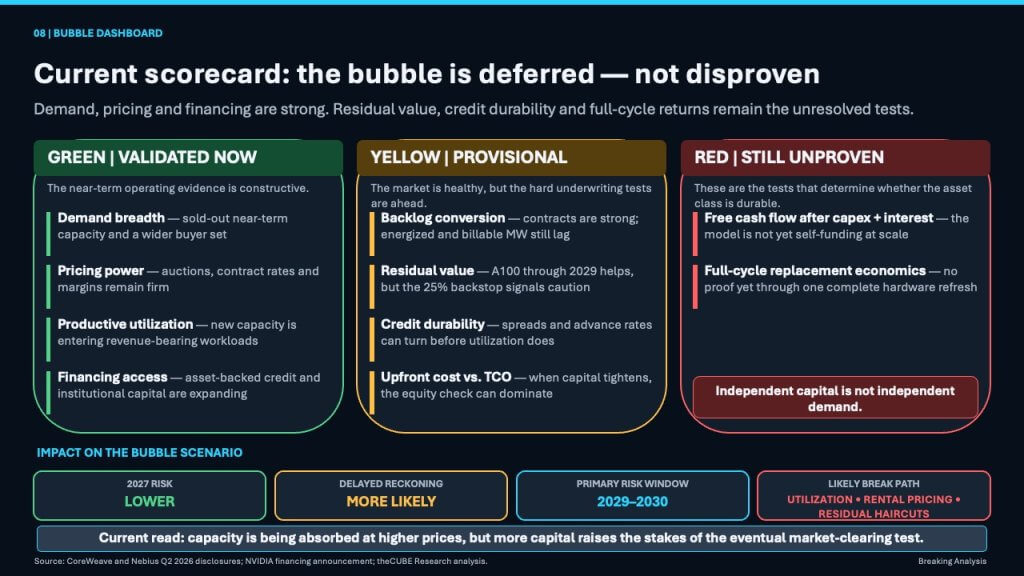
The announcement is a profound validation of AI infrastructure as an emerging asset class. Nvidia has brought together six of the world’s largest institutional-capital providers to establish financing platforms designed to mobilize more than $500 billion over time. But the announcement also makes this dashboard more important – not less important. Why? Because the question shifts from How much capital is being committed to: Does that capital convert into productive utilization, durable cash flow and an asset that retains value through a complete cycle?
Right now, the green signals shown above are quite constructive. Demand is broadening. Near-term capacity remains effectively sold out. Pricing and contribution margins remain solid. New capacity is entering revenue-producing workloads. And the financing market is demonstrating that it will lend against Nvidia infrastructure and contracted compute cash flows.
That is why we believe the near-term bubble risk has declined.
But the yellow signals tell us that the difficult underwriting tests are still ahead. Backlog must become energized, accepted and billable capacity. Older systems must retain value after scarcity pricing begins to normalize. Credit markets must remain open if spreads widen, advance rates decline or lenders require larger equity checks. And if capital tightens, buyers may care less about lifetime TCO and more about the upfront acquisition cost and time to cash flow.
Then we have the red signals. Neither CoreWeave nor Nebius has yet demonstrated free cash flow after the full burden of capital expenditures and interest at the scale being contemplated. And neither has completed an entire hardware-replacement cycle funded organically from the cash generated by the prior generation. That is a decisive test of whether this becomes a durable infrastructure asset class.
By the way, Microsoft is currently the only hyperscaler promising positive cash flow.
So our current read is:
Lower probability of a broad 2027 break.
A stronger delayed-reckoning case.
And a wider primary risk window in 2029 and 2030.
The likely break path also moves downstream. In other words, it becomes less about an immediate inability to finance construction and more about productive utilization, GPU rental pricing, residual-value haircuts and refinancing once substantially more capacity reaches the market.
That is why we say the bubble is deferred but not disproven. Could the AI bubble mimic the sports franchise bubble where valuations have gone up perpetually. Maybe.
But look… independent capital can fund more factories. But independent capital is not independent demand. Jensen may not have made the AI buildout too big to fail. But he may be making it too interconnected to fail quietly.
As always, we’ll be watching and updating our scenarios as needed.
Support our mission to keep content open and free by engaging with theCUBE community. Join theCUBE’s Alumni Trust Network, where technology leaders connect, share intelligence and create opportunities.
Founded by tech visionaries John Furrier and Dave Vellante, SiliconANGLE Media has built a dynamic ecosystem of industry-leading digital media brands that reach 15+ million elite tech professionals. Our new proprietary theCUBE AI Video Cloud is breaking ground in audience interaction, leveraging theCUBEai.com neural network to help technology companies make data-driven decisions and stay at the forefront of industry conversations.