


 AI
AI
AI
AI
AI

U.S. Department of War Secretary Pete Hegseth met with Anthropic PBC Chief Executive Dario Amodei in Washington D.C. today, where he delivered a stark warning – either remove restrictions on how the military uses the company’s Claude AI chatbot, or face severe consequences.
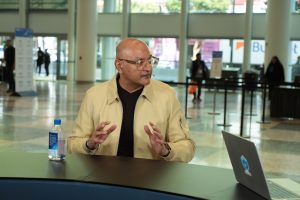
Hegseth reportedly told Amodei (pictured) that the Pentagon may effectively blacklist his company by designating it as a “supply chain risk,” or else force it to comply with his demands through the Defense Production Act, if he doesn’t change his mind. He reportedly gave him a deadline of Friday.
Anthropic’s Claude chatbot is currently the only major chatbot that’s approved to work with America’s classified military systems, but the Pentagon has issues with certain restrictions on how it should be used. Hegseth is demanding that the company lift those restrictions and allow the military to use Claude for “all lawful use,” Axios reported.
But Anthropic is refusing to budge over two issues – it doesn’t want Claude to be used to control weapons, nor does it want to partake in any mass surveillance of U.S. citizens. One source familiar with the company’s stance said Amodei doesn’t believe artificial intelligence systems are reliable enough to be trusted with weapons. He’s also worried that there are no laws governing how AI can be used for surveillance. On the other hand, Pentagon chiefs believe that the military’s use of any technology should be governed by U.S. law, not the private usage policies of the companies that develop them.
If Anthropic were to be designated as a supply chain risk, that would prohibit any company with a military contract from doing business with it. It would be a major blow for the AI company, which has secured dozens of enterprise contracts over the last couple of years. Normally, the designation is reserved for companies with connections to hostile governments. As for the DPA, this is a law that gives the U.S. President the authority to force companies to prioritize and expand production for national defense reasons. Originally conceived for use in times of war, the Act was most recently invoked during the coronavirus pandemic, forcing companies such as General Motors Co. to mass produce ventilators and masks.
According to Axios’ sources, the meeting between Hegseth and Amodei was cordial enough, but in no way was it “warm and fuzzy” as both men doubled down on their stance. Amodei reiterated that he could not support the use of his models to operate weapons without human oversight or engage in mass surveillance, and insisted that these red lines have never comprised any military operations. Hegseth, meanwhile, reportedly praised Anthropic and said he’d like to continue working with the company, but refused to back down.
In a statement to CNN later, a spokesperson for the Pentagon said the issue “has nothing to do with mass surveillance and autonomous weapons being used,” before adding that the military has “always followed the law.” The concern is that “you can’t lead tactical ops by exception,” and that “legality is the Pentagon’s responsibility as the end user.”
The tension between the two stems from the fact that the Department of Defense doesn’t have any alternatives to Anthropic’s Claude at this time. While it has reportedly reached a deal to use xAI Corp.’s Grok model with classified systems, it’s thought that switching to another provider would be a massive headache and cause severe disruption to the Pentagon’s operations.
Dean Ball, senior fellow at the Foundation for American Innovation and former senior policy advisor on AI in Trump’s White House, told TechCrunch that the lack of redundancy is the reason for the Pentagon’s aggressive stance. “The DOD has no backups. This is a single-vendor situation here,” he said. “They can’t fix that overnight.”
Despite the apparent threats looming large, Anthropic accelerated its enterprise-focused strategy today when it announced new updates to Claude Cowork and a host of partnerships with software-as-a-service companies.
The update will enable applications including Salesforce Inc.’s Slack, Intuit, DocuSign LegalZoom, FactSet and Google’s Gmail to integrate with Claude Cowork, which is a platform for building AI agents that understand business context. Those agents can connect with third-party software tools via Anthropic’s Model Context Protocol.
Anthropic positions Claude Cowork as a kind of “central brain” for knowledge workers to engage with AI. When the platform was launched in earlier this month, it sent shockwaves through the stock market as investors initially perceived it as a threat to the business models of many SaaS companies. Hundreds of billions of dollars in value were wiped out, affecting firms including Thomson Reuters Corp., LegalZoom.com Inc. and Intuit Inc.
The weekslong selloff in SaaS stocks carried over into this week, driven in part by a viral Substack post from Citrini Research that predicted the profound impact AI could have on the economy in the near future. IBM Corp.’s stock fell 13% on Monday, its worst single-day decline since October 2000, after Anthropic said in another update that its tools can now help to modernize applications running on Cobol, a legacy programming language for software that runs on mainframe computers.
However, many of the affected stocks finally rebounded following Anthropic’s announcement today. Salesforce’s stock rose 4%, while IBM, Docusign and LegalZoom all rose 2%. Shares of Thomsen Reuters gained 11%, while FactSet rose 6%.
Wedbush Securities’ analysts said in a note that Anthropic’s update shows that AI’s threat to SaaS companies is “overblown.” They argued that AI models cannot replace the complex workflows that are “deeply embedded” in modern software infrastructure. “The reality is that these new AI tools will not rip and replace existing software ecosystems and data environments,” the analysts said. “These tools are only as useful as the data they can reach.”
Support our mission to keep content open and free by engaging with theCUBE community. Join theCUBE’s Alumni Trust Network, where technology leaders connect, share intelligence and create opportunities.
Founded by tech visionaries John Furrier and Dave Vellante, SiliconANGLE Media has built a dynamic ecosystem of industry-leading digital media brands that reach 15+ million elite tech professionals. Our new proprietary theCUBE AI Video Cloud is breaking ground in audience interaction, leveraging theCUBEai.com neural network to help technology companies make data-driven decisions and stay at the forefront of industry conversations.