

 INFRA
INFRA
INFRA
INFRA
INFRA

Eridu Corp. wants to break through the artificial intelligence networking “wall” after raising $200 million in early-stage funding today.
The money from the Series A round will help it to commercialize an all-new network switch that promises to scale AI workloads to unprecedented heights. Today’s round was led by Socratic Partners, venture capitalist John Doerr, Hudson River Trading, Capricorn Investment Group and Matter Venture Partners. It also saw participation from some major players in the chipmaking industry, including MediaTek Inc. and Taiwan Semiconductor Manufacturing Co., which invested through its VentureTech Alliance investment vehicle.
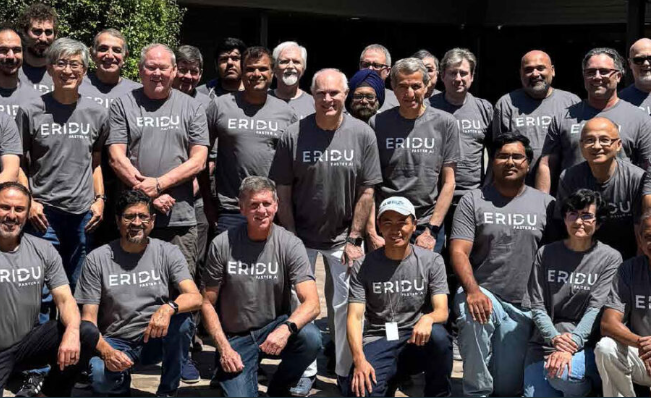
Chief Executive Drew Perkins (pictured center, alongside his team) told SiliconANGLE that billions of dollars of investment in data centers are going to waste because of a huge bottleneck in AI networks, which simply cannot cope with the massive volumes of data that need to be moved around. The situation is getting worse, he said, because new chip architectures and algorithmic innovations are increasing the demands for data, but existing networks simply cannot keep up.
According to Perkins, existing networking companies have laid out roadmaps that only promise incremental enhancements in performance, because they’re focused on improving existing architectures. But these are being pushed to their limits. “Networking technology has fallen so far behind that a completely new design is required,” he said. “The plodding pace of subscale improvement promised by other existing and new solutions is simply inadequate to solve the problem.”
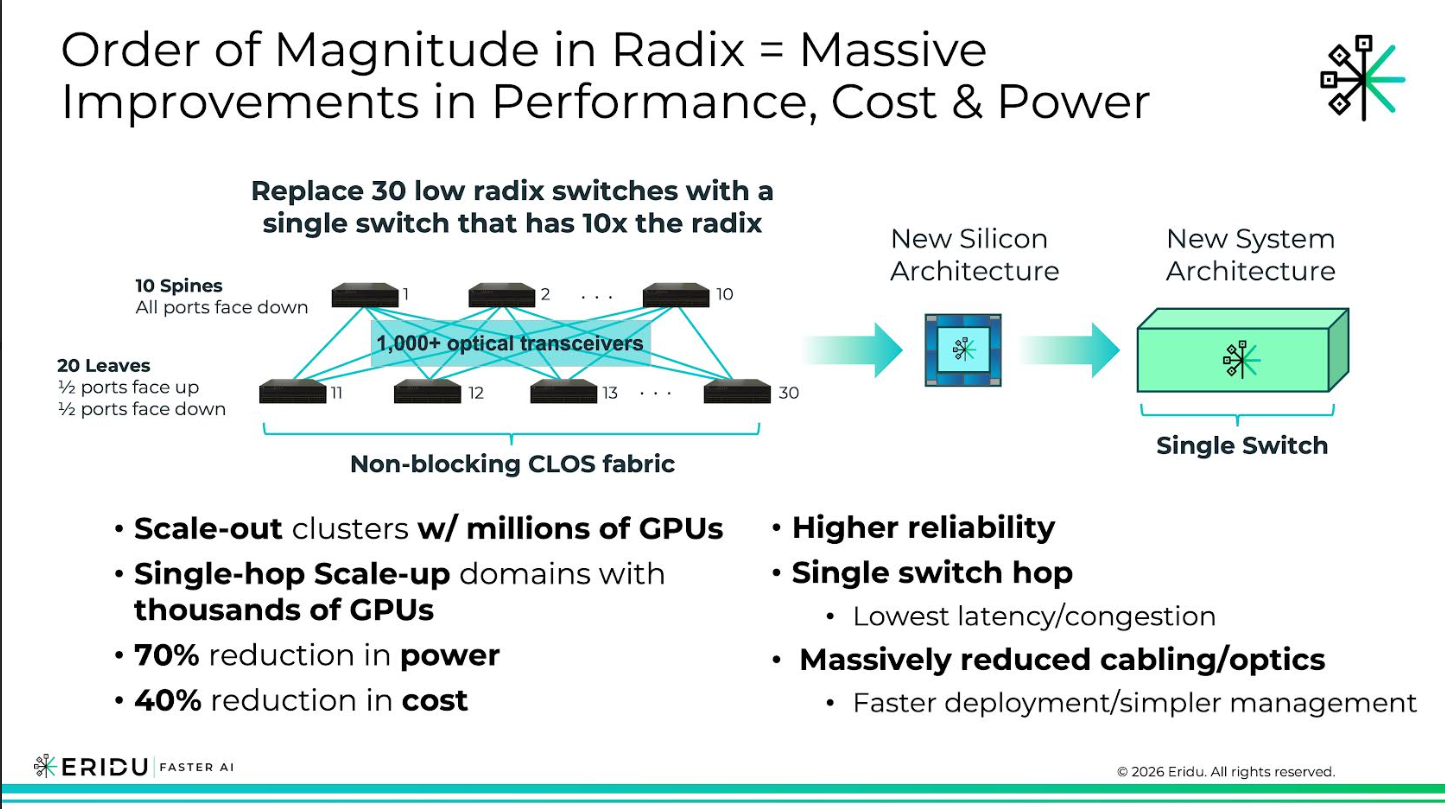
Perkins said that the bandwidth, latency, power consumption and radix (the number of input/output ports) of existing network switches are tightly coupled to the silicon architecture they’re based on, which was designed for cloud data centers that are much smaller than today’s emerging AI factories. “This silicon architecture has fundamentally been the same for the last two decades and is only incrementally improved with a doubling of capacity every two to 2.5 years,” he said. “We believe that these incremental improvements leave a lot of performance on the table.”
Eridu’s solution, Perkins explained, is a completely redesigned network switch architecture that promises to deliver an “order-of-magnitude” advance in performance and efficiency and enable previously impossible capabilities. He didn’t reveal too much about the new switch because it has not yet launched, but said it’s based on a “clean-sheet silicon architecture” that’s designed to take full advantage of the most advanced silicon and packaging technologies.
That allows a single high-radix Eridu switch to replace up to 30 lower-level radix switches, resulting in a much flatter network with lower latency and significantly lower power dissipation, with improved tokens-per-watt and tokens-per-dollar metrics. The switch reduces both latency and network “jitter” to enable data center operators to dramatically increase the scale of their graphics processing unit clusters, he said. He believes customers will ultimately be able to scale out their domains to millions of GPUs, while enjoying savings of up to 40% on their capital expenditures and benefit from faster deployment.
The funding from today’s round will help to accelerate the development of the switch and support the company’s recruiting efforts as it looks to take the next step and bring it to market.
Dylan Patel, an analyst with SemiAnalytics, said Eridu’s switch is a promising development because there’s an urgent need for redesigned network switches because the demands for bandwidth and scale are accelerating beyond what existing architectures can feasibly support. He was effusive in his praise for the startup’s technology.
“Eridu’s networking technology is purpose-built for massive AI scale, supporting both scale-out and scale-up,” he said. “It will enable more bandwidth, larger AI clusters and lower costs and deliver the next level of interconnect scale required to meet the insatiable demands of accelerated compute.”
Eridu doesn’t have any official customers yet, but Perkins said the development of its silicon, systems and software has come far along, and the company is working closely with a number of “leading hyperscalers.” He added that they have “completely validated” the company’s product definition and have been deeply involved in helping to shape its design to fit the requirements of their data centers. “We cannot name them due to NDAs, but they are deeply engaged,” he promised.
Support our mission to keep content open and free by engaging with theCUBE community. Join theCUBE’s Alumni Trust Network, where technology leaders connect, share intelligence and create opportunities.
Founded by tech visionaries John Furrier and Dave Vellante, SiliconANGLE Media has built a dynamic ecosystem of industry-leading digital media brands that reach 15+ million elite tech professionals. Our new proprietary theCUBE AI Video Cloud is breaking ground in audience interaction, leveraging theCUBEai.com neural network to help technology companies make data-driven decisions and stay at the forefront of industry conversations.