


 CLOUD
CLOUD
CLOUD
CLOUD
CLOUD

I’ve been around cloud-native computing since before it was called “cloud-native.” Back when Cloud Native Computing Foundation was just forming under the Linux Foundation, the bet was simple but bold: Standardize infrastructure, unlock developer velocity and let innovation compound.
Fast forward to KubeCon Europe 2026 this week in Amsterdam, and that bet has paid off, but not in the way many expected.
The headline stat coming out of the keynote is staggering:
That’s not a gap, that’s a chasm.
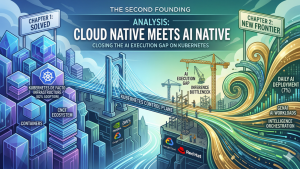
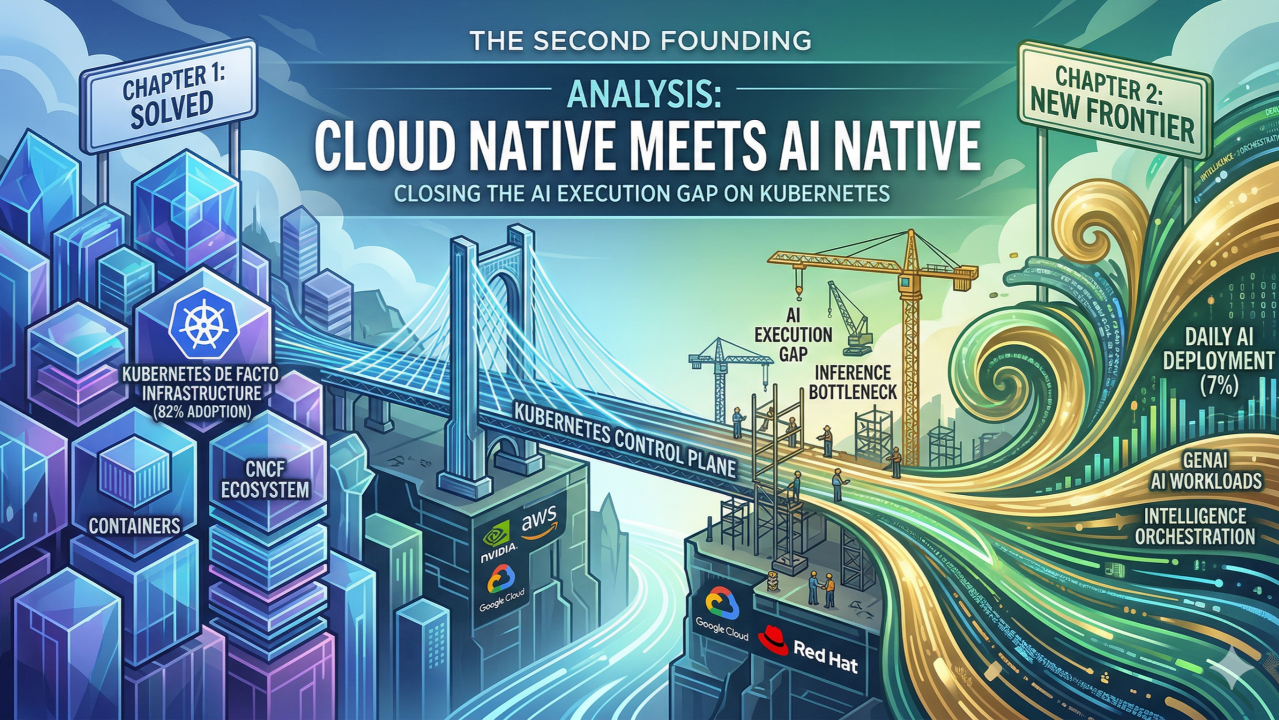
Jonathan Bryce, executive director of CNCF, framed it as the “cloud native inference challenge and a gold rush.” Kubernetes has become the de facto operating layer of modern infrastructure, but artificial intelligence is still struggling to operationalize at scale — specifically the production-grade, daily use of AI. This is the new bottleneck.
For years, we talked about containers, orchestration and microservices as the hard problems. Today, those problems are solved. The new frontier is inference: how models actually run, scale and deliver value in production environments.
Another key data point: Two-thirds of generative AI workloads are already running on Kubernetes. That’s the quiet story of this KubeCon. Kubernetes isn’t just infrastructure anymore. It’s becoming the AI operating system.
What’s different this time is who’s showing up. The leaders of the last era are now fully aligned with the next one. Nvidia Corp. is driving the AI factory stack from silicon to software, while Amazon Web Services Inc. and Google Cloud are embedding Kubernetes deeper into their AI platforms as the control layer for training and inference. At the same time, IBM Corp.’s Red Hat continues to operationalize open source at scale, bridging enterprise information technology with cloud-native and now AI-native workloads. Together, they represent a powerful convergence: Cloud-native meets AI-native, with open source as the connective tissue.
But here’s the catch: Just because AI can run on Kubernetes doesn’t mean it’s optimized, efficient or economically viable. What we’re seeing is a replay of early cloud adoption:
The difference? The stakes are exponentially higher and the new AI era is coming in hot.
One of the more under-the-radar but critical insights from Linux Foundation Research is that optimizing for open models could unlock $24.8 billion in annual global AI savings That’s not incremental. It’s structural.
We’re entering a phase where AI strategy is a cost structure strategy. The hyperscalers and model providers are pushing closed ecosystems. Meanwhile, the open-source world being led by CNCF and its ecosystem is positioning Kubernetes as the neutral control plane for AI workloads.
This sets up a classic industry tension:
A lot of theCUBE conversations in the U.S. and in Europe point to one emerging idea: AI needs its own control plane. Not just infrastructure orchestration but model lifecycle management, inference optimization, policy enforcement and cost governance. Projects like the Kubernetes AI conformance efforts highlighted in the CNCF signal where things are heading. We are seeing the standardization of AI workloads on Kubernetes.
This is early, but it’s familiar territory.
We saw this movie before with containers:
We’re somewhere between steps 1 and 2 for AI.
Many in the CNCF community are emphasizing lifecycle maturity such as certifications, project graduation and ecosystem health. That’s important, but it’s table stakes now.
The real story is this:
Cloud-native has moved up the stack.
That’s the shift.
This moment feels familiar. I was there when Kubernetes went from a Google project to the backbone of modern computing. But this is bigger. KubeCon Europe 2026 isn’t about Kubernetes adoption anymore. That war is over. This is about what runs on top — and whether the cloud native ecosystem can execute in the AI era.
Because the signal is clear:
What’s missing is execution. And execution is everything.
This is the inflection point where cloud-native either evolves into the control plane for the AI economy, or gets abstracted away by someone who does it better. If Cloud Native Computing Foundation and the open source community close the AI execution gap, they don’t just stay relevant — they define the next decade of computing.
If they don’t, the center of gravity shifts. That’s the moment we’re in right now.
And make no mistake about it, this is the second founding era of cloud-native.
Support our mission to keep content open and free by engaging with theCUBE community. Join theCUBE’s Alumni Trust Network, where technology leaders connect, share intelligence and create opportunities.
Founded by tech visionaries John Furrier and Dave Vellante, SiliconANGLE Media has built a dynamic ecosystem of industry-leading digital media brands that reach 15+ million elite tech professionals. Our new proprietary theCUBE AI Video Cloud is breaking ground in audience interaction, leveraging theCUBEai.com neural network to help technology companies make data-driven decisions and stay at the forefront of industry conversations.