



 INFRA
INFRA
INFRA
INFRA

INFRA

The rise of agentic AI is forcing enterprises to rethink data infrastructure from the ground up. Instead of maintaining separate systems for observability, search and AI applications, organizations are now consolidating onto unified AI data infrastructure layers that can handle the speed and complexity of autonomous workflows.
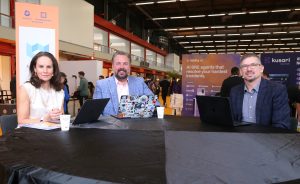
That consolidation trend is accelerating around open-source platforms designed for AI-native workloads. OpenSearch — an open-source search and analytics suite — has crossed more than 1.4 billion downloads and recently gained premier members such as IBM Corp., signaling a shift toward enterprise-grade production, according to Bianca Lewis (pictured), executive director of the OpenSearch Software Foundation.
“In the [Nvidia Corp. keynote at GTC], they positioned OpenSearch as the key AI data infrastructure layer for their AI infrastructure, NemoClaw, specifically for their agentic AI,” Lewis told theCUBE. “I think this is coming to a key part where enterprises — with the scale of agentic AI — it’s very difficult [for them] to look at AI infrastructure in silos anymore. We’re not looking at a solution for observability and a solution for search and a solution to build their AI apps and a solution to monitor. I think now what we really need is … an AI data infrastructure that you can build those use cases on.”
Lewis spoke with theCUBE’s Rebecca Knight and Rob Strechay at KubeCon + CloudNativeCon EU, during an exclusive broadcast on theCUBE, SiliconANGLE Media’s livestreaming studio. They discussed OpenSearch’s evolution into a unified AI data infrastructure platform and the broader push toward data consolidation. (* Disclosure below.)
The market is moving toward treating data infrastructure as a single platform rather than assembling per-project solutions. At its core, it’s an economics problem: As agentic AI workloads scale, the cost of duplicating infrastructure across every use case is no longer sustainable, Lewis explained.
“It’s not worth paying a data tax on an infrastructure layer per use case and per project, but it’s better to look at it systematically,” Lewis said. “Instead of paying that tax four times to use the same data, we’re not searching query by query sequentially anymore. We can now execute agentic AI searches and possibly get to a speed of 100,000 queries a minute, or maybe even more.”
To support that vision, the OpenSearch Foundation is building AI guardrails and agentic capabilities directly into the platform. The goal is to give enterprise agents more context, better grounding and more dependable output across AI applications, Lewis noted.
“The agent will actually have a memory, and from that memory, it’ll use it to give context onto that search,” Lewis said. “We will first filter that by the great power of OpenSearch’s lexical search to get more accurate results, so that you’ve got a secure, reliable, platform-wide [retrieval-augmented generation] backbone for your AI applications, which [is] cost effective because it’s not hallucinating and it’s running on the proper hardware.”
Here’s the complete video interview, part of SiliconANGLE’s and theCUBE’s coverage of KubeCon + CloudNativeCon EU:
(* Disclosure: The Cloud Native Computing Foundation sponsored this segment of theCUBE. Neither CNCF nor other sponsors have editorial control over content on theCUBE or SiliconANGLE.)
Support our mission to keep content open and free by engaging with theCUBE community. Join theCUBE’s Alumni Trust Network, where technology leaders connect, share intelligence and create opportunities.
Founded by tech visionaries John Furrier and Dave Vellante, SiliconANGLE Media has built a dynamic ecosystem of industry-leading digital media brands that reach 15+ million elite tech professionals. Our new proprietary theCUBE AI Video Cloud is breaking ground in audience interaction, leveraging theCUBEai.com neural network to help technology companies make data-driven decisions and stay at the forefront of industry conversations.