



 INFRA
INFRA
INFRA
INFRA
INFRA

Cloud-native artificial intelligence inference chip startup Rebellions Inc. is upping its game in an effort to compete better with rivals such as Nvidia Corp. and Advanced Micro Devices Inc. by raising a massive $400 million in what it calls a “pre-IPO funding round.”
Mirae Asset Financial Group and the Korea National Growth Fund led the investment in the Seoul-based startup. It comes just months after the company raised $250 million in a Series C round in September. It brings its total amount of funding since inception to $850 million, while its value has soared to $2 billion.
Rebellions is one of a handful of well-funded South Korean chip startups trying to take on AI chip giant Nvidia, and today’s round may just give it an edge over its domestic rivals, which include Furiosa AI Inc. and DeepX Co. Ltd. The company is the designer of several high-performance inference chips that can be used to run trained AI models in production. Though Nvidia is still believed to dominate the inference market, it’s coming under pressure from all sides, with U.S. chipmakers such as Cerebras Systems Inc. also vying for a piece of the pie.
Now, Rebellions wants to tap into the U.S. appetite for AI chips too. The money from today’s round will be used to fund its U.S. expansion, and with that in mind it has also hired a new chief business officer, Marshall Choy, to lead its operations in that country.
Like many of Nvidia’s rivals, Rebellions aims to make AI inference more economic and powerful. As generative AI models increase in complexity, the cost of running them has increased dramatically, especially when using graphics processing units. Nvidia’s GPUs might be powerful, but they consume vast amounts of energy and procuring them at large scale is prohibitively expensive for many companies. That’s why the limiting factor in AI adoption is no longer model capability, but the cost of the infrastructure required to make the most of them.
Rebellions co-founder and Chief Executive Sunghyun Park says it’s time for the AI industry to move beyond the “silicon-only” mindset, pointing to the friction that exists when integrating AI hardware with software. “AI is now measured by its ability to operate in the real world at scale, under power constraints and with clear economic return,” he said. “That shifts the center of gravity toward inference infrastructure and software that makes the infrastructure useful.”
In an interview with SiliconANGLE, Choy said the company is differentiating itself through a “software-centric” approach to AI hardware. Its chip hardware is built atop a cloud-native stack that’s powered by Kubernetes. Because it’s open-source, it can work most popular AI developer frameworks, such as PyTorch, Hugging Face and the vLLM inference engine, Choy said. By optimizing its infrastructure for these frameworks, he added, its neural processing units can run inference more efficiently than is possible with traditional GPUs.
The approach also speeds up iteration for customers, Choy said. “Our use of open-source software without forks enables an identical experience for admins, cloud ops, developers and end users,” he explained. “This enables our evaluation and adoption cycles to be much faster than competitive systems in the market today.”
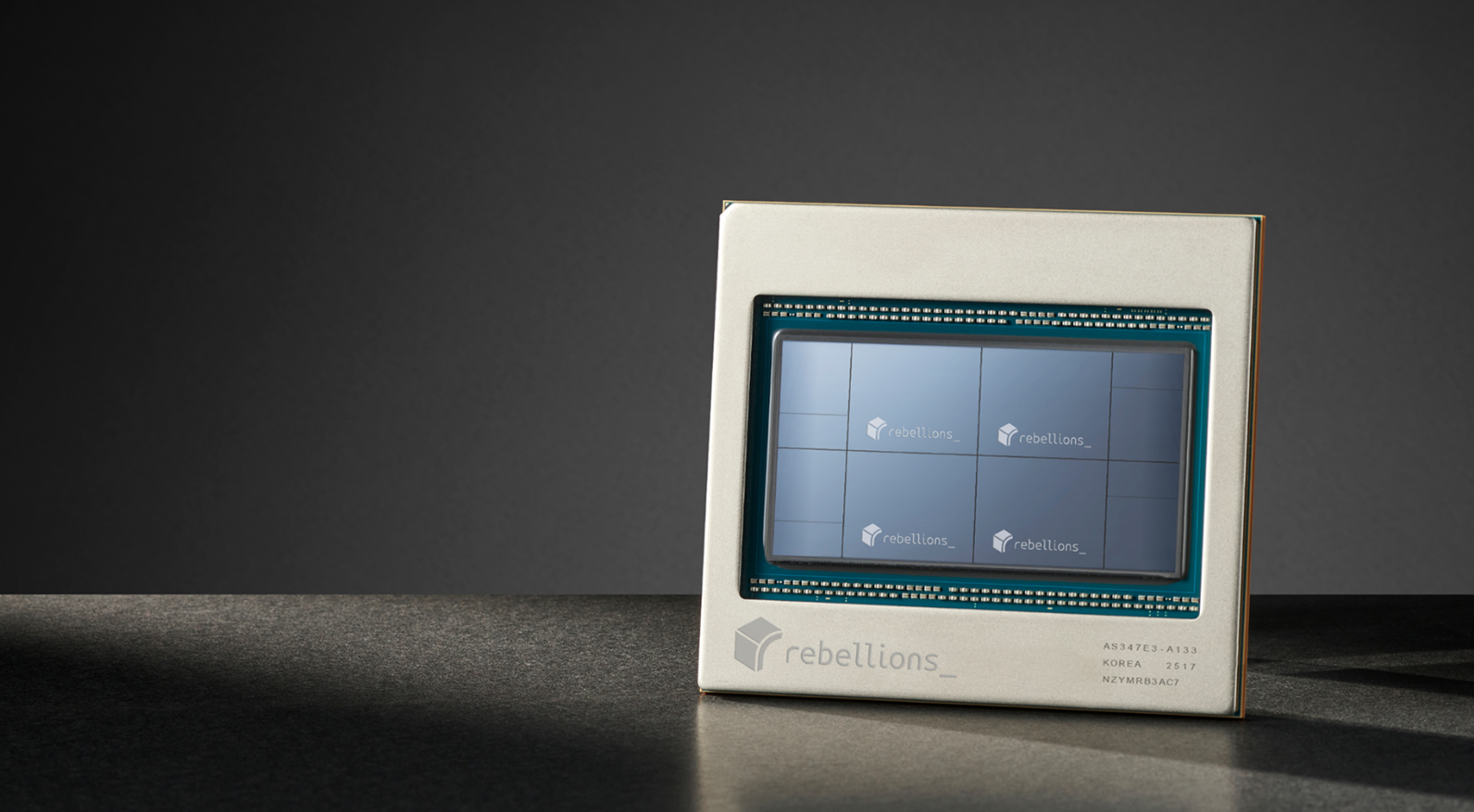
To accelerate this vision, the company has launched two new vertically integrated infrastructure offerings, called RebelRack and RebelPOD. The first is a “production-ready” unit of inference compute, while the latter clusters multiple RebelRacks together for larger deployments. The system is powered by its Rebel100 NPUs, which are chiplet-based processors optimized for superior performance per watt than GPUs.
Rebellion’s focus on software also makes it a more complete systems company, Choy said, as opposed to traditional chipmakers that leave it to developers to figure out how to get their AI to run on their hardware. “Our comprehensive approach to delivering to the market’s needs is exemplified by the announcement of the new RebelRack and RebelPOD systems, available today, far in advance of other pre-announced offerings by the competition,” he said.
There’s a perception in some quarters that breaking into the U.S. market is more challenging, because of American companies’ preference for Nvidia’s GPUs, but Choy believes that most data center operators will be open-minded about what competitors have to offer. “While some companies may have an Nvidia-first bias, very few have an Nvidia-only policy,” he said. “There is growing recognition that the future of AI computing is going to be heterogeneous, with customers looking to match different accelerators and GPU architectures to particular classes of models, applications and use cases, as well as pricing tiers.”
With $650 million raised in the last six months, Rebellions is clearly in a hurry to make its mark. It has previously said it’s working toward an initial public offering, and it’s notable that today’s round was described as a “pre-IPO” raise. But though the company is happy to state its future intentions, Choy declined to mention any specifics regarding when it might go public, saying the focus for now is strictly on scaling up its business and growing its revenue.
Support our mission to keep content open and free by engaging with theCUBE community. Join theCUBE’s Alumni Trust Network, where technology leaders connect, share intelligence and create opportunities.
Founded by tech visionaries John Furrier and Dave Vellante, SiliconANGLE Media has built a dynamic ecosystem of industry-leading digital media brands that reach 15+ million elite tech professionals. Our new proprietary theCUBE AI Video Cloud is breaking ground in audience interaction, leveraging theCUBEai.com neural network to help technology companies make data-driven decisions and stay at the forefront of industry conversations.