



 BIG DATA
BIG DATA
BIG DATA
BIG DATA

For years, the National Football League offseason was a period defined by information asymmetry. While front offices sat behind “glass walls” in war rooms, armed with proprietary Next Gen Stats and sophisticated modeling tools, the average fan was left to navigate a fragmented landscape of mock drafts, cap calculators, PDF guides and Twitter rumors.
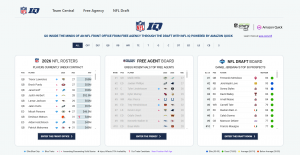
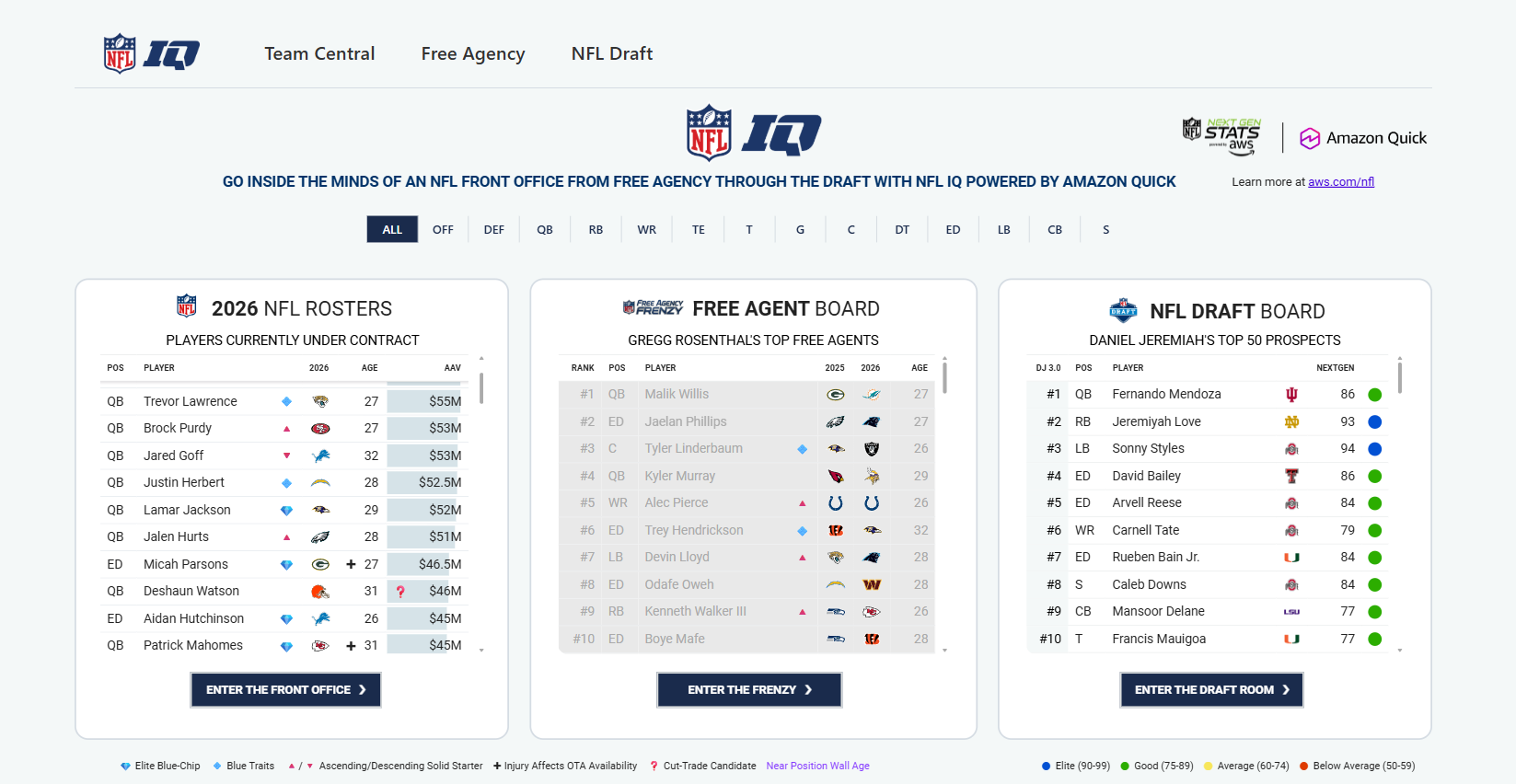
Last month, the NFL and Amazon Web Services Inc. officially took down that wall with the launch of NFL IQ. Built on Amazon Quick, this is more than just another sports dashboard on a stats website; it’s the democratization of complex data. By transforming billions of data points into a self-service, interactive hub, the NFL is moving away from “data delivery” and toward “contextual reasoning.”
There have been many parallels drawn between artificial intelligence and the internet, but it’s this last point that is the most meaningful. The internet changed the way we work, live and learn by democratizing access to information. AI will have a similar but greater impact by democratizing access to expertise.
I recently spoke with Ari Entin, head of sports marketing for AWS, to better understand how this changes the game — not just for the Sunday ticket holder, but for the enterprise chief information officer.
The core challenge of the modern NFL offseason is the “onus of effort.” As Entin noted during our conversation, the sheer volume of data available to fans has exploded, but the responsibility still lies with the individual to “troll and find different sources of information” to see whether it is even reliable. Popular fan sites include Pro Football Focus, The Athletic and Mel Kiper Jr. Though all these data sources are great, it’s up to the fan to connect the dots, and that’s the problem AWS is trying to solve.
 “The impetus here for building NFL IQ with the Next Gen Stats team was: How do we take these, which were previously disparate moments — the Combine, free agency, pro days, the draft — and provide a holistic view?” Entin explained. By leveraging Amazon Quick, the NFL is providing fans with the exact same day-to-day research tool used by league insiders. This isn’t a “lite” version of the software; it’s the same engine, scaled for millions.
“We’re essentially bringing this next level of AI and analytics insights to fans exactly how folks in the league see it, too,” Entin told me. “We’re turning the experience from a research analyst role into just a regular fan where they can just ask a question and get an answer back in seconds.”
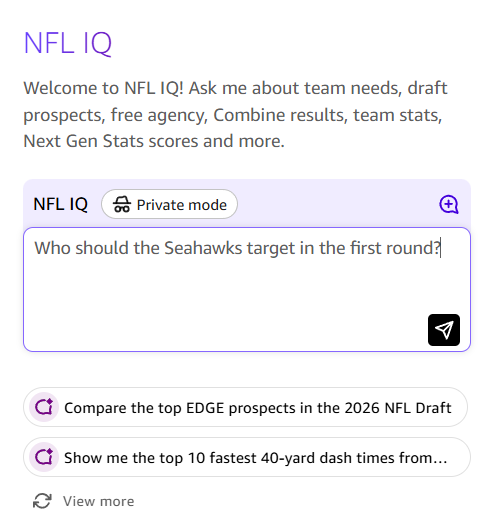
This week, a major update was announced with the debut of the NFL IQ AI Assistant. This is where the technical architecture becomes especially interesting for the enterprise. Most “sports chatbots” are basically advanced search engines that scrape public data. The NFL IQ AI Assistant, however, uses Amazon Quick’s orchestration capabilities to analyze more than 20 proprietary NFL data sources. It doesn’t just tell you who a team might select; it combines GM tendencies, cap space constraints and positional needs to explain why.
During our interview, Entin highlighted how this handles complex, multivariable queries. If a Seahawks fan asks who can replace a specific departing starter, the system doesn’t just look at a list of prospects. It evaluates:
This “reasoning” layer is updated multiple times daily to ensure that if a trade gets on social media, the AI Assistant’s logic stays grounded in reality. Entin was clear on the guardrails: “These are all from verified NFL sources — full reported and verified paperwork-related things going through the league.”
For the enterprise CIO, the NFL’s experiment is an excellent example of how to address the “blank page” problem. One of the main challenges in business intelligence adoption is that users often don’t know what questions to ask when faced with a blinking cursor. The NFL IQ tackles this by embedding the AI Assistant directly alongside the visual dashboard. The conversation doesn’t replace navigation; it enhances it.
This hybrid approach — where a user can view a trend in a chart and then immediately ask the AI to “explain that spike” — represents the future of software as a service. It addresses the “signal-to-noise” ratio that hampers most corporate data lakes.
As an example, the user interface for traditional BI is static dashboards and filters. With NFL IQ, this shifts to an interactive and conversational interface. Also, with BI, only specialized analysts could access and understand data, whereas with NFL IQ, through Quick, users can self-serve data. Also, with BI systems, data was refreshed weekly or even monthly, while NFL IQ is near-real time with intraday updates.
The NFL IQ launch shows that AI-ready infrastructure isn’t just about having more GPUs; it’s about how data is managed. By using Quick to connect technical engineers and non-technical fans, the NFL has created a model for any industry — from healthcare to retail — that deals with complex, scattered datasets. They have successfully shifted from asking “What happened?” to asking “What should I do next?”
As Entin explained, the goal was to make the NFL’s most advanced insights accessible beyond technical barriers. For the rest of the business world, the message is clear: If a fan can use AI to “reason” through a seven-round mock draft, your regional managers should be able to do the same with their supply chains.
The front office is no longer a closed room. Thanks to the NFL and AWS, it’s now a conversation.
Zeus Kerravala is a principal analyst at ZK Research, a division of Kerravala Consulting. He wrote this article for SiliconANGLE.
Support our mission to keep content open and free by engaging with theCUBE community. Join theCUBE’s Alumni Trust Network, where technology leaders connect, share intelligence and create opportunities.
Founded by tech visionaries John Furrier and Dave Vellante, SiliconANGLE Media has built a dynamic ecosystem of industry-leading digital media brands that reach 15+ million elite tech professionals. Our new proprietary theCUBE AI Video Cloud is breaking ground in audience interaction, leveraging theCUBEai.com neural network to help technology companies make data-driven decisions and stay at the forefront of industry conversations.