 AI
AI
AI
AI









AI

For years, the promise of “no-code” artificial intelligence has felt a bit like a “some assembly required” IKEA desk — sure, you aren’t sawing the wood yourself, but you’re trying to decipher how to assemble dozens of parts, many of which seem to fit poorly. With communications, low-code often had a nice user interface, but information technology pros were still knee-deep in complex flowcharts, Session Initiation Protocol trunk configurations and professional services.
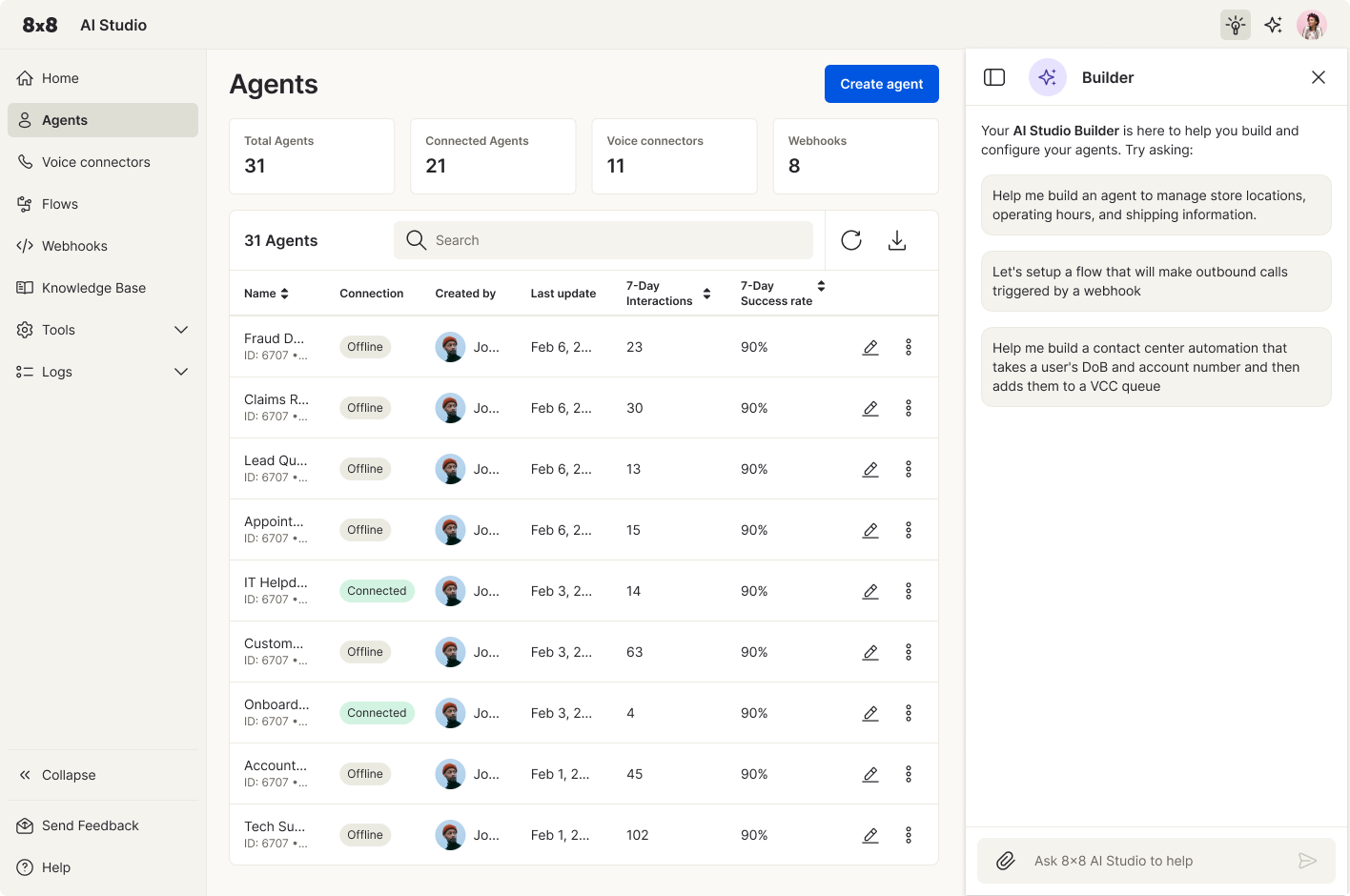
At this week’s Channel Partners Conference, 8×8 Inc. is trying to solve this problem by leveraging the interface we are all born with – your voice. The company announced its 8×8 AI Studio, which enables users to create conversational agents by talking to a system rather than clicking buttons.
The fundamental problem with most AI agents today is that they sit “on top” of the platform. You buy a specialized AI tool, then spend months trying to “wire” it into your telephony, routing and data. Last week, I spoke with 8×8 about this. Chief Product Officer Hunter Middleton explained the benefit of integrating AI into its platform.
“8×8 AI Studio is not an AI layer sitting on top of a communications platform; it’s AI embedded in the infrastructure itself,” he said. “The LLMs have direct access to real-time voice data, network telemetry and the full interaction context that external tools cannot reach.”
Because AI Studio is native, there is no new vendor, no new contract and no additional infrastructure layer. If you are an 8×8 customer, you have a “clean view” of the market, building agents on the same plumbing that already handles your voice calls and digital messages.
Despite the “voice is dead” rhetoric, the voice channel has remained alive and healthy. In fact, many business leaders I have talked to predict a “voice renaissance” is coming as AI agents get better. The problem for most organizations is that voice was a bit of a black box; it could be used to converse, but the data could not be captured. That’s not the case in the AI era.
The most salient part of the AI Studio demo wasn’t that the agents worked, as every communications vendor is building them, but rather that 8×8 is using a conversational agent to build conversational agents.
During a live demo, 8×8 showed how a user can describe an agent’s personality and goals in plain English. Want a directory assistant that speaks with a Scottish accent and files JIRA tickets? No logic tree needed — you just tell the system to do it.
The “8×8 Builder” then generates the agent, integrates the required application programming interfaces (such as JIRA or Salesforce), and assigns it a phone number in minutes. Low-code was easier but still required a small amount of technical skill. With natural language as the new interface, it makes it available to the rest of the world. Now, people who do the job can be the ones to train the agents, which is important in ensuring any kind of specific domain knowledge is incorporated.
For the mid-market enterprise, which is the sweet spot for the company, this can greatly help get AI up and running. These are organizations where the IT manager wears ten hats, and the vice president of customer support is drowning in 45 different integrations.
The early availability data shows that customers are already moving past simple “FAQ bots.” They are deploying agents for:
With this release, 8×8 is removing the “procurement barrier,” which can postpone AI deployments as companies figure out how to pay for systems. There are no extra licensing fees to access the studio. Customers build and test for free, only paying a “credits” model (essentially a simplified way to package tokens) once an agent goes live in production.
8×8 is a smaller player in a market of giants. However, its smaller size has allowed it to be more agile during this AI pivot. While some of the larger legacy incumbents need to consider how to bring AI into an older back end, 8×8 has spent the last few years rebuilding its platform since the Fuze acquisition.
Another concern for many of the larger vendors is how to roll out AI and shift from a seat-based structure to a utilization-based model without disrupting their current revenue stream. Because 8×8 is a minority shareholder, it can be much more aggressive in its use of flexible pricing models.
Also, by offering model flexibility — allowing customers to choose among OpenAI, Gemini or Claude within the same interface — 8×8 avoids the “vendor lock-in” that scares off enterprise IT.
As 8×8 Chief Marketing Officer Bruno Bertini noted during the briefing, “AI is creating this opportunity for us to build something entirely from scratch. Not having to bolt on to something old lets us enter this market with a clean product.” If 8×8 can convince its base that specialized developers are no longer needed to build “agentic workflows,” it becomes embedded in company workflows, making it much harder to churn.
The “middleware” layer of communications isn’t quite a commodity, but its features have certainly been standardized. Value now resides in the reasoning layer. By embedding that reasoning directly into the network, 8×8 is betting that the best AI isn’t the one that “demos well,” but the one that already has the keys to your house. For 8×8, AI has brought agent creation to the masses.
Zeus Kerravala is a principal analyst at ZK Research, a division of Kerravala Consulting. He wrote this article for SiliconANGLE.
Support our mission to keep content open and free by engaging with theCUBE community. Join theCUBE’s Alumni Trust Network, where technology leaders connect, share intelligence and create opportunities.
Founded by tech visionaries John Furrier and Dave Vellante, SiliconANGLE Media has built a dynamic ecosystem of industry-leading digital media brands that reach 15+ million elite tech professionals. Our new proprietary theCUBE AI Video Cloud is breaking ground in audience interaction, leveraging theCUBEai.com neural network to help technology companies make data-driven decisions and stay at the forefront of industry conversations.