 AI
AI
AI
AI


AI

ServiceNow Inc. today unveiled a broad expansion of its artificial intelligence platform, stressing governance, security and autonomous execution as foundational requirements for enterprise AI adoption.
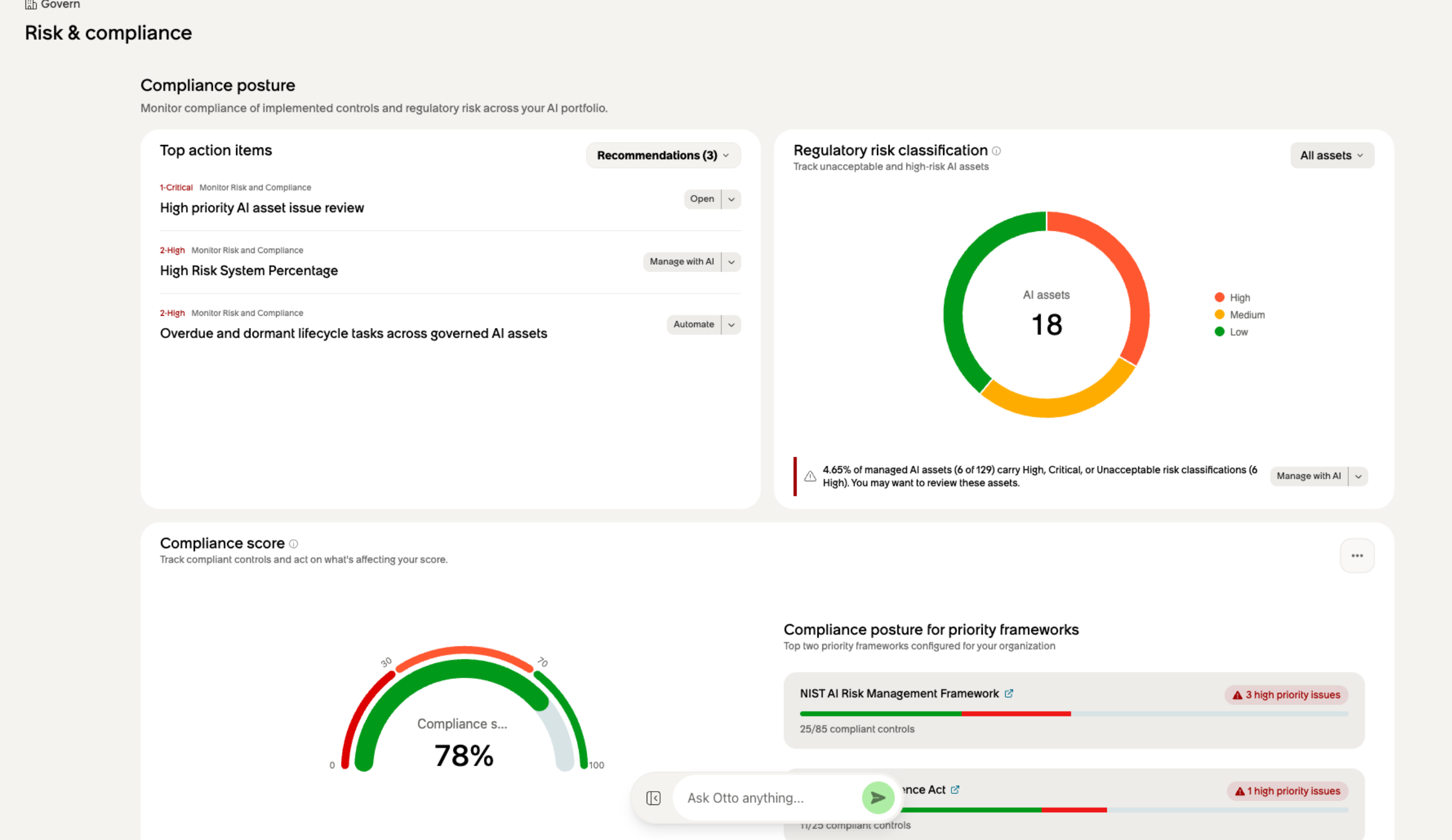
The announcements center on enhancements to the company’s AI Control Tower (pictured), a governance hub that allows organizations to monitor, manage and secure AI models and agentic workflows. The company also introduced new autonomous security capabilities and an expanded “Autonomous Workforce” of AI agents designed to execute specific business processes.
Executives framed the updates as a response to growing enterprise concerns that AI deployments are proliferating faster than organizations can manage or govern them.
“Customers are telling us AI is everywhere, but it isn’t connected, isn’t governed and isn’t finishing the work,” said Nenshad Bardoliwalla, group vice president of product management at ServiceNow. “The AI Control Tower for business reinvention is our answer.”
Introduced in 2025, AI Control Tower has evolved from a monitoring tool into what ServiceNow describes as a centralized command system for enterprise AI. The platform now spans five core functions: discovery, governance, security, observability and financial measurement.
The system is designed to identify AI assets across heterogeneous environments, including major cloud providers and enterprise applications, while applying policy controls across models, datasets, prompts and agents.
A key addition is deeper runtime observability, allowing organizations to track how AI agents make decisions and intervene when necessary. The platform also integrates risk frameworks aligned with regulatory standards such as the National Institute of Standards and Technology’s Cybersecurity Framework and the European Union’s AI Act.
ServiceNow is also introducing an AI Gateway to provide real-time controls over third-party AI systems, extending governance beyond its own platform.
The goal, executives said, is to move beyond fragmented tooling toward a unified system capable of managing AI at enterprise scale.
The expansion comes as organizations grapple with a surge in nonhuman identities and autonomous agents operating across information technology environments.
“AI-powered adversaries are moving faster than teams can human respond to or even detect,” said John Aisien, senior vice president of central product management at ServiceNow.
To address that gap, ServiceNow is introducing Autonomous Security & Risk, which integrates capabilities from recent acquisitions Veza Inc. and Armis Inc. The combined offering provides visibility into both asset inventory and identity access relationships, enabling organizations to map who or what has access to specific systems and data.
The platform correlates signals across assets, permissions and decision processes to identify risks such as unauthorized data access or policy violations. It can also trigger automated remediation workflows, with optional human approval.
Executives emphasized that the approach reflects a shift from reactive security models toward continuous, AI-driven governance.
ServiceNow is also expanding its Autonomous Workforce initiative, introducing AI “specialists” across IT, customer service, customer relationship management and risk management functions. The agents are designed to go beyond discrete tasks to execute complete workflows.
Launched in February Autonomous Workforce is “an entirely new class of AI specialists that think, act and work as part of a team right alongside your people,” Bardoliwalla said.
The new specialists can handle activities such as incident resolution, service requests and sales workflows, operating within predefined governance frameworks. Because they run on the same platform, they share data context, workflow orchestration and policy controls.
ServiceNow executives said the model addresses a key limitation of earlier AI deployments, which often provided insights without execution capability.
Rolls-Royce Holdings PLC has realized 5,000 hours of efficiency savings in IT operations alone through the use of ServiceNow’s Now Assist generative AI platform and is seeing broader productivity improvements across manufacturing workflows, said Phil Priest, head of global business services at the auto maker.
The company’s experience underscored the importance of data readiness and governance, since AI deployments can amplify existing inefficiencies if underlying data and processes are not properly structured, he said.
“As we expand Assist beyond IT to other functions, we have to almost rewrite our knowledge articles to make them AI-ready,” he said, “so when the agent deploys it, it’s done in a way that humans can get the answers they need fast and right the first time. Automation still requires good data to get the right answer.”
Priest estimated AI initiatives have had their biggest impact in manufacturing. “We’ve delivered 300,000 saved shop floor hours,” he said. “That’s real money.”
ServiceNow’s broader strategy is to consolidate AI capabilities into a single operational platform that integrates data, workflows and governance. Executives said point solutions and disconnected tools are insufficient for managing the scale and complexity of modern AI deployments, particularly as agent-based systems become more prevalent.
By combining observability, identity governance and workflow automation, ServiceNow is positioning its platform as an enterprise control layer for AI-driven operations.
Support our mission to keep content open and free by engaging with theCUBE community. Join theCUBE’s Alumni Trust Network, where technology leaders connect, share intelligence and create opportunities.
Founded by tech visionaries John Furrier and Dave Vellante, SiliconANGLE Media has built a dynamic ecosystem of industry-leading digital media brands that reach 15+ million elite tech professionals. Our new proprietary theCUBE AI Video Cloud is breaking ground in audience interaction, leveraging theCUBEai.com neural network to help technology companies make data-driven decisions and stay at the forefront of industry conversations.