 INFRA
INFRA
INFRA
INFRA


INFRA

Amazon Web Services Inc. has started using a new data center network design that significantly improves the throughput and reliability of connections.
The cloud giant today detailed the architecture, which it calls Random Network Graph, or RNG. It’s powered by a fiber-optic cable management system that doesn’t use power and a custom network protocol.
The typical data center network is based on a so-called fat-tree design. Servers connect to the network via devices known as edge switches. Those edge switches, in turn, exchange traffic with one via a second set of switches collectively known as the core. The edge switches are linked to the core by a third set of switches.
When two servers need to exchange data via a fat-tree network, they can only do so via a limited number of network paths. If there’s congestion in those paths, traffic slows down even if the broader network has an abundance of bandwidth. There are multiple ways to address the challenge, but most of them are expensive or difficult to implement.
AWS says its newly detailed RNG architecture provides a better alternative. It increases the number of paths through which data can flow between the servers connected to a network, which boosts bandwidth, while also reducing the number of network devices by half. RNG also improves connection reliability in the process. If a network path used by a server experiences technical issues, the machine can simply reroute traffic to one of the many other paths at its disposal.
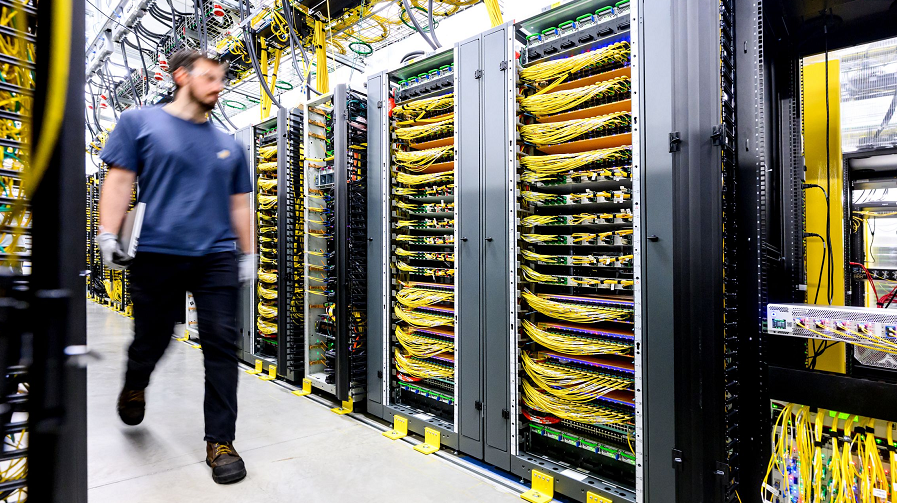
Matt Rehder, vice president of global network engineering at AWS, recently walked journalists through the lab in Cupertino, California, to demonstrate the technologies behind new network, including many that Amazon designed itself. “We’re at the bleeding edge, so we have to do a lot ourselves,” he said. The overarching goal for years has been “how do we get the network out of the way,” he added.
Random network graph is a nod to one of its core design features. The devices in an RNG network are linked together by fiber-optic cables. According to an AWS research paper, some fiber-optic cable segments are configured in a specific pattern while others are placed randomly. That randomness is what makes RNG networks more flexible than fat-tree architectures.
But while AWS’ network design offers several benefits over traditional alternatives, it also creates new challenges. One of them is that the large number of available network paths makes it trickier to find the best route for a given workload. AWS researchers addressed the challenge by developing a custom network protocol called Spraypoint. It enables a router to “spray” traffic to all its neighboring routers, which then transmit the packets to their destination.
The randomness of RNG fiber-optic cable configurations makes them difficult to manage efficiently. AWS developed a custom network device called a ShuffleBox to ease the task. The system, which doesn’t consume electricity, physically links together different fiber-optic cables to facilitate the movement of data.
AWS says its RNG architecture can boost data throughput by 33%. Moreover, it significantly reduces the amount of hardware needed to build data center networks. That lowers not only upfront infrastructure expenses but also ongoing power costs. AWS estimates that RNG can unlock billions of dollars in savings.
The Amazon.com Inc. unit is already using the technology across multiple data centers in Ireland, Germany and Spain. Going forward, the company plans to equip most newly built cloud facilities with RNG networks.
With reporting from Robert Hof
Support our mission to keep content open and free by engaging with theCUBE community. Join theCUBE’s Alumni Trust Network, where technology leaders connect, share intelligence and create opportunities.
Founded by tech visionaries John Furrier and Dave Vellante, SiliconANGLE Media has built a dynamic ecosystem of industry-leading digital media brands that reach 15+ million elite tech professionals. Our new proprietary theCUBE AI Video Cloud is breaking ground in audience interaction, leveraging theCUBEai.com neural network to help technology companies make data-driven decisions and stay at the forefront of industry conversations.