 CLOUD
CLOUD
CLOUD
CLOUD


CLOUD

Sovereign cloud discussions have been a core part of artificial intelligence and infrastructure conversations for the past few years and are now critical to communications.
Historically, the communications sector has been a late adopter of technology trends due to the mission-critical nature of its operations. However, given that customer service is one of the “low-hanging fruit” use cases for AI, the sovereign cloud conversation has come to communications.
The sovereign topic in communications has reached an inflection point, especially in Europe, but it’s also a consideration for many U.S. firms. What began as a niche requirement for government agencies and highly regulated industries has become a mainstream procurement criterion. Boards are asking tougher questions about data residency. Regulators are imposing significant fines for cross-border data governance failures. Enterprises are realizing that “our hyperscaler is compliant” doesn’t answer the question their legal team is asking.
The problem isn’t that vendors don’t understand sovereignty requirements. It’s that most communications platforms treat sovereignty as a deployment option rather than an architectural principle. You can’t bolt governance onto a multitenant infrastructure after the fact and call it sovereign. You need to design it in from the beginning — dedicated environments, documented data residency, managed encryption keys and a vendor willing to share accountability with the customer.
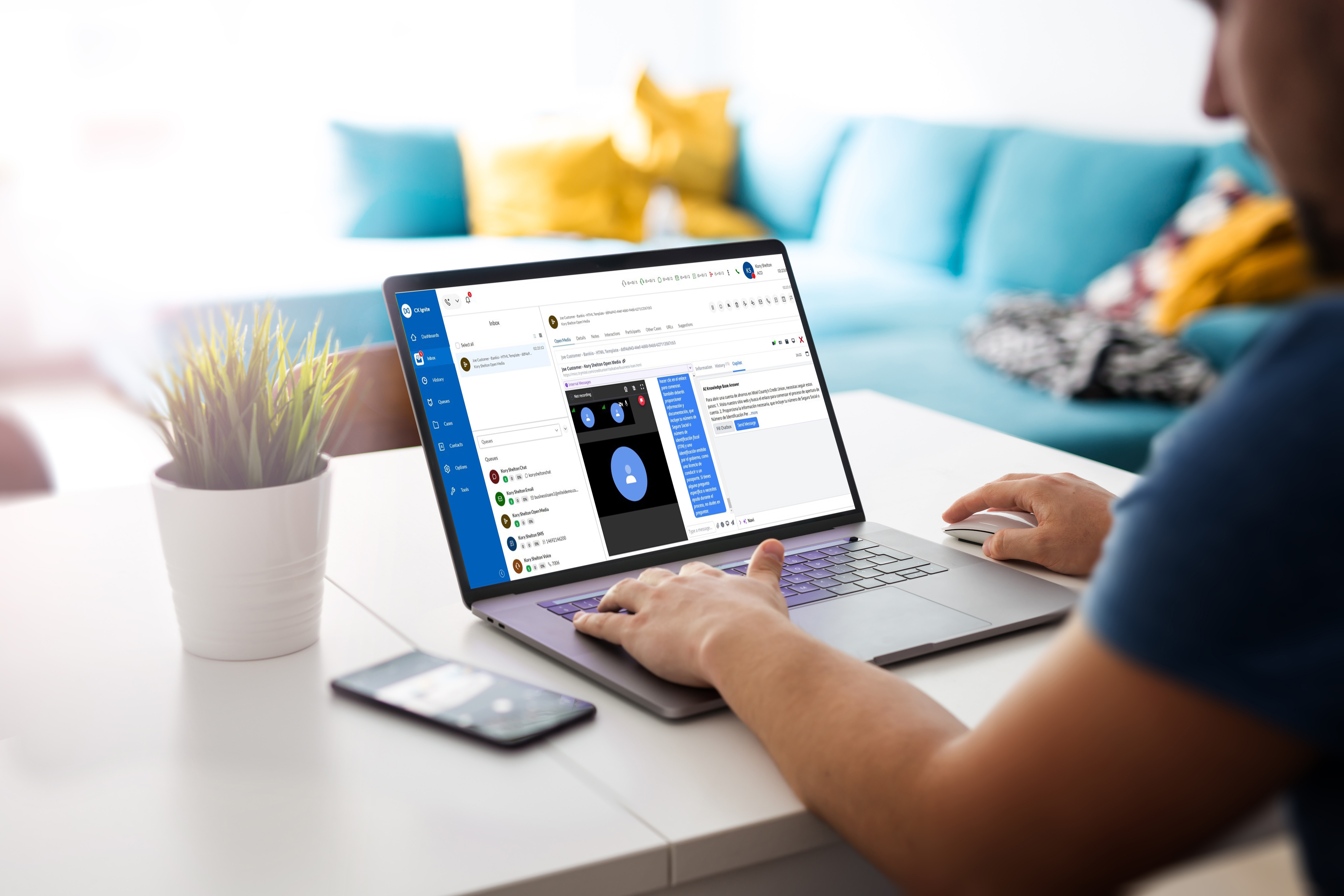
Mitel Networks Corp.’s CX platform is one of the first genuine attempts to solve this problem at the product layer rather than just the infrastructure layer. The timing matters because the market is splitting faster than most vendors realize.
The enterprise communications market has bifurcated into two segments with fundamentally different architectural requirements. On one side are organizations with straightforward compliance needs — well-served by mainstream unified communications-as-a-service platforms. These platforms are good for a large portion of the market, and sovereignty isn’t a meaningful decision factor for them.
On the other side are organizations for which compliance is the architectural requirement. These include financial services firms processing transactions across European markets, healthcare systems managing patient communications under increasingly aggressive data-protection regimes, government agencies facing explicit in-country processing mandates, and hospitality groups operating properties across multiple jurisdictions with guest data residency obligations.
That second segment can’t accept a shared infrastructure model, regardless of how many certifications vendors have accumulated. They need dedicated tenancy, provable data residency and a platform vendor that understands sovereignty isn’t a feature toggle — it’s a governance framework that runs through every layer of the stack.
IDC Europe’s data supports this thesis. Two-thirds of businesses are already adopting hybrid communications solutions, and 60% plan to replace existing platforms to align with evolving compliance requirements. The demand signal is real and accelerating. The challenge is that very few vendors can meet the needs of this segment.
It’s important to note that the decision “to be sovereign or not sovereign” isn’t about fear of the cloud and does not stifle innovation. It’s a business decision. I spoke with Tom Boyle, head of telecom at Sheffield Teaching Hospitals NHS Foundation Trust. “Sovereignty in communications is ultimately about control, reliability and patient safety,” he said. “It’s not about being cloud-avoidant or lacking a desire for innovation — it’s about resilience. In the NHS, we need absolute certainty that a nurse can make a critical crash call, regardless of any macro-environmental issue or geopolitical shift. Maintaining communication sovereignty ensures that our core operational continuity is safeguarded, no matter what happens on the global stage.”
This sentiment has been echoed by many other information technology leaders I have spoken with recently. The world is becoming more uncertain, and having control has never been more important.
Building a sovereign communications platform isn’t primarily a technology problem. The components — private infrastructure, dedicated tenancy, encrypted key management — are well-understood. The hard part is the operations.
Most UCaaS vendors are optimized for multitenant efficiency. Their economics, product development and support models assume shared infrastructure. Offering a truly sovereign deployment requires dedicated environments and a cost structure that doesn’t destroy unit economics. Most vendors won’t do it because their business models don’t support it.
Generic managed service providers can run dedicated infrastructure, but they lack the communications-specific expertise to manage the experience with depth. They’ll keep the platform available. They won’t tell you why call quality degraded during a distributed contact center shift change, how to configure AI-assisted routing to align with a compliance workflow, or what your data governance exposure looks like when an agent uses an unsupported endpoint. That gap between infrastructure management and communications experience management is where most sovereign cloud offerings fail in practice.
Mitel CX was designed to solve the sovereignty problem at the platform level, and its architectural choices are worth examining. First, deployment agnosticism isn’t marketingv— it’s structural. MCX runs across private cloud, on-premises and hybrid environments without requiring organizations to surrender control of their infrastructure to access modern capabilities. That matters because sovereignty isn’t just about where data lives. It’s about who controls the environment where processing occurs.
Second, the platform integrates generative AI virtual agents and unified workspace capabilities without requiring a clean-room cloud environment. Most AI-embedded contact center platforms assume you’re running in a hyperscaler environment where the AI tooling can access shared compute resources. MCX brings AI into the workflow within the governance architecture that regulated industries require — not as an afterthought, not as a separate module that breaks the sovereignty model, but as part of the core platform that respects the data residency boundaries the customer has defined.
Third, the tiered governance model, which includes hosted, trusted and sovereign tiers, allows organizations to align their spend with their actual regulatory posture rather than forcing everyone into the most restrictive architecture. A multinational financial services firm with operations across GDPR, U.K. data protection and APAC residency requirements needs full sovereignty. A midmarket healthcare provider with regional compliance obligations may need only enhanced data protection within a dedicated environment. MCX lets customers choose the governance tier that matches their risk profile without replatforming.
That flexibility is uncommon in the contact center market, where most vendors offer a single architecture and expect customers to adapt their compliance strategy to fit it.
Mitel’s extension of MCX into hospitality shows why platform-level sovereignty matters in ways infrastructure-only solutions can’t address. Large hotel groups and cruise operators face a structurally complex version of the sovereign cloud problem. They process high volumes of personal guest data across multiple jurisdictions. European properties are subject to the GDPR, while properties in certain APAC markets face local data residency mandates. The guest communications infrastructure, integrated into property management systems, staff mobility tools and in-room experience platforms, is both a regulatory surface and a differentiator.
Most communications vendors pitch hospitality as a vertical use case for a horizontal platform. Mitel built a communications platform specifically for this sector. The property management integrations, in-room communications architecture and staff workflow tooling aren’t generic UCaaS features adapted for hotels — they’re purpose-built capabilities that understand the operational context of running a global hospitality operation. Layering MCX’s sovereign governance capabilities onto that operational depth creates something competitors can’t easily replicate: a contact center and communications platform that delivers AI-enhanced guest experience management within a governance framework that respects per-property data residency requirements.
That’s not a product feature. That’s a multiyear institutional capability that would take most vendors years to build.
Geographic expansion will determine how much of this market Mitel can capture. MCX and Secure Cloud are live in the U.K. and Europe (Austria, Belgium, France, Germany, Italy and Spain), but the sovereign cloud demand signal is global. APAC markets, in particular, are tightening data residency requirements, and how quickly Mitel extends platform availability across those regions will shape its competitive position.
The multivendor management story also needs clearer articulation. Mitel’s ability to manage heterogeneous communications environments, not just its own stack, is a differentiator, but enterprises with mixed infrastructure are skeptical by default. More proof points for buyers who haven’t seen it in practice would strengthen the positioning.
Then there is execution. Amazon Web Services Inc., Microsoft Corp. and specialized providers are all moving into enterprise communications with sovereignty-aligned offerings. Mitel’s advantage lies in the combination of communications platform depth and governance architecture, but that combination must be visible in the sales conversation rather than buried in product documentation.
The sovereign cloud conversation has shifted from theory to procurement reality. Enterprises with genuine data governance obligations can no longer accept “secure” as a substitute for “sovereign.” The number of vendors that can deliver both the platform capability and the governance architecture is smaller than the market noise suggests.
Mitel CX represents a serious attempt to solve this problem at the product layer — building sovereignty into the platform design rather than offering it as an infrastructure add-on. The more relevant question is whether it executes well enough to capture a market opportunity that may not remain open indefinitely. That is one worth watching closely.
Zeus Kerravala is a principal analyst at ZK Research, a division of Kerravala Consulting. He wrote this article for SiliconANGLE.
Support our mission to keep content open and free by engaging with theCUBE community. Join theCUBE’s Alumni Trust Network, where technology leaders connect, share intelligence and create opportunities.
Founded by tech visionaries John Furrier and Dave Vellante, SiliconANGLE Media has built a dynamic ecosystem of industry-leading digital media brands that reach 15+ million elite tech professionals. Our new proprietary theCUBE AI Video Cloud is breaking ground in audience interaction, leveraging theCUBEai.com neural network to help technology companies make data-driven decisions and stay at the forefront of industry conversations.