 AI
AI
AI
AI





AI

Enterprise AI is forcing companies to rethink where their most sensitive workloads should live, and private cloud is moving deeper into the center of that decision.
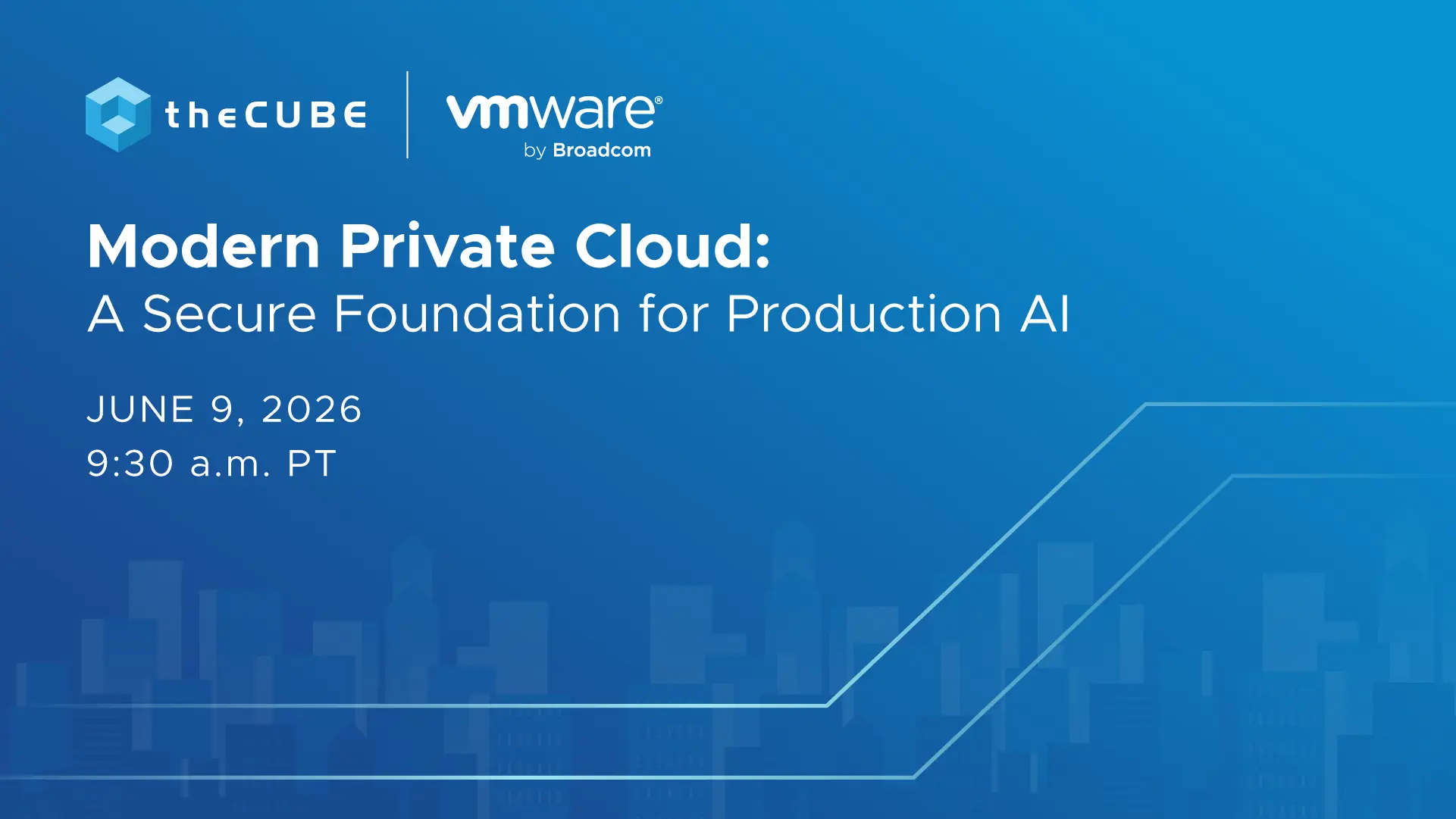
For many organizations, the cloud conversation is no longer about public versus private as opposing strategies. It is about control, cost predictability, security, compliance and whether infrastructure can support AI workloads that are shifting from experiments into production. That is the backdrop for the Broadcom “Modern Private Cloud: A Secure Foundation for Production AI” broadcast, a June 9 event presented by theCUBE, SiliconANGLE Media’s livestreaming studio.
“It’s been a wild couple years … this has really been an amazing time for private AI, guardrails and secure AI,” said John Furrier, executive analyst at theCUBE Research. “You’re seeing the models getting better and better. And security’s key. You’re hearing about governance … AI infrastructure.”
The event will reveal findings from Broadcom’s second annual “Private Cloud Outlook 2026” report and examine how customers are using VMware Cloud Foundation to turn private cloud infrastructure into a secure, high-performance foundation for enterprise AI. TheCUBE’s coverage will focus on private cloud momentum, the evolution of private AI and the value of modern private cloud with VCF. (* Disclosure below.)
That enterprise focus is becoming more practical as AI deployments put new pressure on data location, workload performance and infrastructure economics. Broadcom’s preview of the 2026 private cloud report found that more than half of surveyed organizations are running or planning to run production inferencing in a private cloud. The same preview also pointed to rising concern around generative AI infrastructure costs and new data protection, privacy, security and risk management requirements tied to AI adoption.
Broadcom’s recent VMware Cloud Foundation 9.1 release is positioned directly at those production AI requirements. The company describes VCF 9.1 as a secure and cost-effective infrastructure platform for AI and Kubernetes-native private cloud environments, with support across AMD, Intel and Nvidia hardware.
That flexibility matters because production AI is not a single-workload problem. Enterprises need infrastructure that can handle inferencing, agentic workflows, containerized services and traditional applications without forcing teams into separate operating models. VCF 9.1 is designed to bring those workloads under one platform while adding observability, governance and data sovereignty controls for AI deployments.
“As more enterprises turn to AI for driving competitive advantage, they face three critical challenges: data and IP privacy concerns, surging infrastructure costs, and their readiness for the world of agentic AI,” said Krish Prasad, senior vice president and general manager of the VMware Cloud Foundation Division at Broadcom. “VCF 9.1 is a single unified platform that addresses all three and delivers one of the most advanced infrastructure for Private AI.”
The June 9 event is expected to dig into that thesis through the lens of production AI. Instead of treating private cloud as legacy infrastructure, Broadcom is framing it as an operating model for enterprises that need AI performance while keeping intellectual property, sensitive data and governance close to the business.
The timing also reflects broader momentum across Broadcom’s AI portfolio. In its most recent quarterly results, Broadcom said demand for custom AI accelerators and AI networking continued to grow sharply, with President and Chief Executive Officer Hock Tan pointing to accelerating AI semiconductor demand as a key driver.
“Broadcom achieved record revenue, operating profit and free cash flow in Q2 driven by accelerating growth in AI semiconductor revenue and strong operating leverage,” Tan said. “Q2 semiconductor revenue from AI of $10.8 billion grew 143% year-over-year, above our forecast, driven by increasing demand for custom AI accelerators and AI networking.”
That context matters for private cloud because AI infrastructure is increasingly a full-stack question. Chips, networking, Kubernetes, security, data governance and workload management all have to come together before enterprises can scale AI beyond pilot projects. Broadcom’s role across both semiconductor infrastructure and VMware enterprise software gives the company a distinctive position in that discussion.
The company has also continued to extend VCF’s cloud-native capabilities. At KubeCon Europe 2026, Broadcom outlined updates to VMware vSphere Kubernetes Service, new open-source contributions and expanded partnerships designed to simplify Kubernetes operations for enterprises running modern applications and AI workloads. Those announcements reinforced a key part of the VCF strategy: helping platform teams support containers and virtual machines through a more consistent private cloud foundation.
Security will likely be one of the most important threads during theCUBE’s “Modern Private Cloud” coverage. As AI workloads move closer to production, organizations are paying more attention to where models run, how data is protected and how quickly infrastructure can recover from disruption.
That aligns with Broadcom’s recent security messaging around lateral threat prevention and AI-driven attacks. As enterprises run more distributed applications and AI-enabled services, lateral movement inside infrastructure becomes a larger concern. VCF 9.1 includes zero-trust lateral security, compliance enforcement, recovery capabilities and live patching features designed to protect sensitive workloads without relying on fragmented bolt-on tools.
The event’s private AI focus should also connect security with business control. For regulated industries, government agencies and enterprises with valuable intellectual property, the ability to run AI inference in a private cloud is not simply a performance choice. It is becoming part of the governance model.
That is where use-case examples will be especially important. During the event, customers will discuss how they are transforming infrastructure into a secure, high-performance springboard for enterprise-wide AI. Their experiences should ground the broader private cloud discussion in practical deployment lessons, showing how organizations are moving from AI ambition to production-ready infrastructure.
Don’t miss theCUBE’s coverage of Broadcom’s “Modern Private Cloud” event, June 9. Plus, you can watch theCUBE’s exclusive content on demand after the event broadcast.
We offer you various ways to watch theCUBE’s coverage of Broadcom’s “Modern Private Cloud” event, including theCUBE’s dedicated website and YouTube channel. You can also get all the coverage from this year’s events on SiliconANGLE.
SiliconANGLE’s “theCUBE Pod” is available on Apple Podcasts, Spotify and YouTube, which you can enjoy while on the go. During each podcast, SiliconANGLE’s John Furrier and Dave Vellante unpack the biggest trends in enterprise tech — from AI and cloud to regulation and workplace culture — with exclusive context and analysis.
SiliconANGLE also produces our weekly “Breaking Analysis” program, where Dave Vellante examines the top stories in enterprise tech, combining insights from theCUBE with spending data from Enterprise Technology Research, available on Apple Podcasts, Spotify and YouTube.
During theCUBE’s coverage of Broadcom’s “Modern Private Cloud” event, don’t miss insights from company executives and industry experts who will explore how private cloud is becoming a secure foundation for production AI, from infrastructure modernization and VCF adoption to governance, inference workloads and enterprise data control.
(* Disclosure: TheCUBE is a paid media partner for Broadcom’s “Modern Private Cloud” event. Neither Broadcom, the sponsor of theCUBE’s event coverage, nor other sponsors have editorial control over content on theCUBE or SiliconANGLE.)
Support our mission to keep content open and free by engaging with theCUBE community. Join theCUBE’s Alumni Trust Network, where technology leaders connect, share intelligence and create opportunities.
Founded by tech visionaries John Furrier and Dave Vellante, SiliconANGLE Media has built a dynamic ecosystem of industry-leading digital media brands that reach 15+ million elite tech professionals. Our new proprietary theCUBE AI Video Cloud is breaking ground in audience interaction, leveraging theCUBEai.com neural network to help technology companies make data-driven decisions and stay at the forefront of industry conversations.