 INFRA
INFRA
INFRA
INFRA


INFRA

The networking industry loves inflection points. Over the years, we have had many new compute models that require the network to evolve. For as long as I can remember, the holy war between InfiniBand and Ethernet was fought on a relatively simple battlefield: throughput versus ubiquity.
But as artificial intelligence workloads scale from tens of thousands of processors to massive clusters approaching the million-graphics-processing-unit mark, the network is fundamentally changing. It is no longer just a standalone infrastructure layer; it has become the critical backplane of a tightly integrated AI supersystem.
The InfiniBand vs. Ethernet debate has been interesting, as data center engineers have always preferred Ethernet if all things were equal, but that wasn’t the case, as InfiniBand continually outperformed Ethernet. But over the past couple of years, that gap has been closing to the point where the performance is negligible in most use cases.
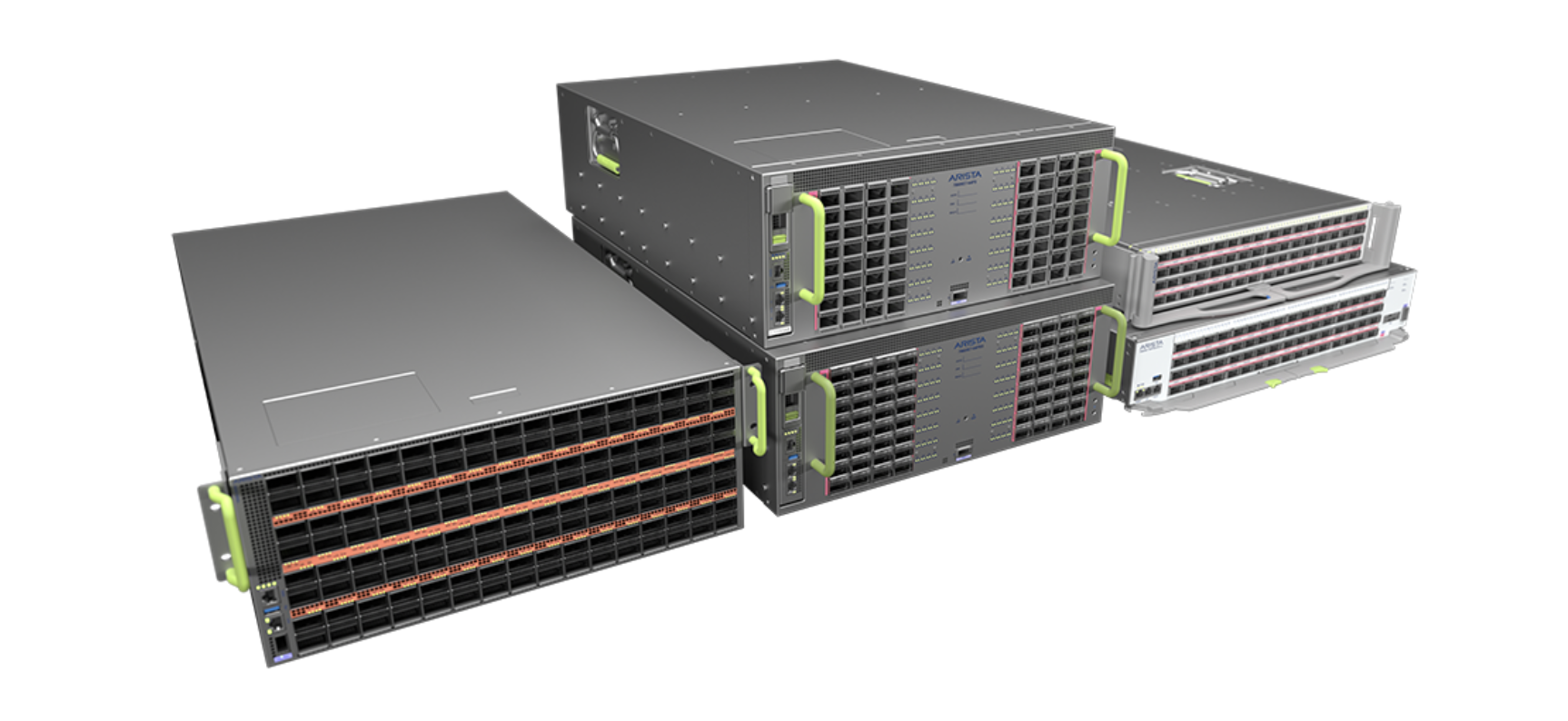
Today Arista Networks Inc. made its next move by announcing its Arista 7060XE7 Series of switches (pictured), based on Broadcom Inc.’s Tomahawk 6 silicon. The 1.6Tb portfolio, powered by the Arista 7060XE7 Series, delivers a whopping 100 terabits per second of switching capacity and 224G SerDes technology. However, though the speeds and feeds tend to grab headlines, the real innovation is the architectural pivot toward rack-scale integration, the operationalization of open standards, and what these signals for the enterprise and Tier-2 market segments.
Historically, networking vendors sold switches as discrete, fixed boxes or standalone chassis. If customers needed to scale, they built out traditional leaf-spine topologies. However, the physical constraints of generative AI, specifically power density and extreme thermal demands, have made the individual switch a suboptimal unit of scale.
With the 7060XE7 Series, Arista is leaning heavily into comprehensive, rack-scale system design. This shift is most clearly demonstrated by its specialized liquid-cooled platform, the 7060XE7-64PRS-RV3-L. Optimized for Open Rack v3 or ORv3 specifications, this 2OU system has no internal fans and draws DC power directly from the rack bus bar. It is designed to sit directly within liquid-cooled XPU server environments, matching inlet and outlet fluid dynamics to maximize compute density per kilowatt.
Eliminating internal fans removes a significant share of power overhead. In standard air-cooled environments, power usage effectiveness or PUE overhead can account for 30% to 50% of power just to move air. By shifting to a unified liquid-cooled rack architecture, the operational overhead drops to 5% to 15%. In a world where data center capacity is severely power-constrained, saving that energy isn’t just an environmental victory; it means a customer can redirect that power to run more revenue-generating GPUs.
One of the most fiercely debated topics in high-performance networking is co-packaged optics versus pluggables. Proponents of CPO argue that moving the optical engine closer to the silicon is the only way to manage power at ultra-high speeds. However, CPO introduces a massive serviceability nightmare: If a single optical lane fails, an entire 100-terabit system could go down.
Arista is doubling down on linear pluggable optics, or LPO, for this 1.6T generation. By leveraging advanced signal-integrity engineering and removing power-hungry DSPs from the optical modules, Arista claims LPO can slash interconnect power consumption by roughly 60%.
This directly affects the total cost of ownership in two ways:
Every fractional percentage point of network downtime stalls an expensive training job. By engineering a system that pairs the low-power benefits of CPO with the serviceability of pluggables, Arista is protecting utilization rates for the most expensive assets in the data center.
When debating LPO versus CPO, there are pros and cons on both sides, and neither is better in every situation. Customers should do their homework and choose the configuration that works best in their environment.
To understand where the market is headed, we must look at how Arista is splitting the architectural responsibilities for these platforms between scale-out (the traditional back-end fabric connecting thousands of nodes) and scale-up applications (the tight interconnect inside the compute complex).
A significant piece of news tucked into this launch is Arista’s formal entry into the scale-up domain. For proprietary architectures, scale-up has been dominated by NVLink. However, as the non-Nvidia Corp. ecosystem, consisting of Advanced Micro Devices Inc., Intel Corp. and custom hyperscaler silicon, continues to gain momentum, there is demand for an open, Ethernet-based scale-up architecture.
Arista’s scale-up solutions are co-developed and custom-engineered to match the specific GPU blade characteristics and mechanical layouts of their ecosystem partners. By using Broadcom’s Tomahawk 6 silicon to unlock massive on-chip radix, Arista is providing a unified, open-standards alternative to proprietary compute fabrics.
For scale-out architectures, Arista is pushing the limits of physical tier reduction. By combining its high-density 7060XE7 leaf switches with its deeply buffered 7800 AI Spine chassis, it can build a two-tier network that supports up to 4.5 times more GPUs than standard fixed-box configurations while maintaining a flat, low-latency topology. This architectural flexibility is critical for mitigating the “packet microbursts” that inherently plague AI collective communication patterns.
Although hyperscalers and frontier AI labs remain the primary consumers of 1.6T bandwidth, we are seeing early signs of a broader market shift. Arista’s historical enterprise footprint has always skewed toward the ultra-high end — financial hedge funds, automotive simulation, biotech research and sovereign government clouds.
These verticals are acting as a leading indicator for mainstream enterprise AI adoption. They aren’t building million-GPU clusters, but their workloads are rapidly scaling to thousands of nodes. These organizations lack the massive internal engineering teams of a Meta Platforms Inc. or a Microsoft Corp.; they cannot build custom network transport protocols from scratch.
This is where software execution matters. Features such as dynamic load balancing, multipath reliable connection fabric resiliency and hardware-level congestion signaling are built directly into Arista EOS. By taking performance optimizations codeveloped with cloud giants and packaging them into validated enterprise designs, Arista is simplifying the operational complexity of deploying high-performance AI fabrics.
InfiniBand has been widely adopted in AI networking systems for its performance, and it has also become a bundled, turnkey system. Ethernet is a tried-and-true technology that has stood the test of time. In fact, Bob Metcalfe, the co-inventor of Ethernet, famously stated that “What’s next after Ethernet is Ethernet,” meaning it’s not a static technology but one that continually evolves to meet current challenges.
I do believe InfiniBand will be around for a long time, but it will be used primarily in high-performance environments, while Ethernet is the high-growth networking technology. Customers are increasingly deploying hybrid environments that mix XPU vendors for training and inference, and they want a networking fabric that remains entirely agnostic to the underlying compute silicon.
In networking, open standards have historically won out, and Arista’s 1.6T announcement shows that Ethernet is not merely playing catch-up; it is actively delivering the density, power efficiency and operational software needed to support the next era of infrastructure.
Zeus Kerravala is a principal analyst at ZK Research, a division of Kerravala Consulting. He wrote this article for SiliconANGLE.
Support our mission to keep content open and free by engaging with theCUBE community. Join theCUBE’s Alumni Trust Network, where technology leaders connect, share intelligence and create opportunities.
Founded by tech visionaries John Furrier and Dave Vellante, SiliconANGLE Media has built a dynamic ecosystem of industry-leading digital media brands that reach 15+ million elite tech professionals. Our new proprietary theCUBE AI Video Cloud is breaking ground in audience interaction, leveraging theCUBEai.com neural network to help technology companies make data-driven decisions and stay at the forefront of industry conversations.