 BIG DATA
BIG DATA
BIG DATA


BIG DATA

Couchbase Inc. is trying to solve one of the hardest problems in enterprise artificial intelligence today: turning brittle, chat-style pilots into production-grade agents capable of remembering, reasoning and acting on live operational data. With the launch of its AI Data Plane, the company is betting that the real bottleneck for “agentic” AI isn’t the model — it’s the underlying data architecture.
Industry discussions about what’s holding back AI often focus on security, graphics processing unit availability and other infrastructure-level issues, but in most cases, data is what keeps chief information officers up at night. At the recent HPE Discover event, I asked Dallas Cowboys CIO Matt Messick about the challenge of bringing disparate data sets together, and he said it’s a major challenge and the thing he thinks about most right now – all day, every day, as he put it.
Couchbase’s announcement aims to address this headache with a scalable data platform.
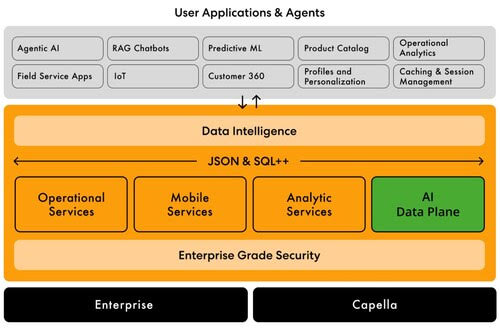
Couchbase’s AI Data Plane is a unified data infrastructure layer for enterprise AI agents across cloud, edge and lakehouse environments. It combines persistent Agent Memory, an Agent Catalog of discoverable tools, and an enterprise-supported MCP server to standardize how models access context and tools. The offering consolidates prior Couchbase deployment models into a single architecture spanning Couchbase Capella and self-managed environments. It is paired with Enterprise Analytics 2.2 for Apache Iceberg lakehouse federation, along with a Trino adapter expected in the third quarter of 2026.
At a high level, Couchbase is positioning the AI Data Plane as an operational data foundation for the agentic enterprise. These are organizations where AI agents are woven into front- and back-office workflows rather than operating as isolated pilots. The goal is to consolidate today’s separate vector databases, caches, document stores, and operational databases into a single governed layer that can feed AI agents at sub-millisecond latency and at scale.
The subtext of this launch is that, like the Dallas Cowboys, most enterprises are finding that their first wave of generative AI projects doesn’t fail because of model quality; it fails because the data plane can’t keep up. Though Messick’s comment can be viewed as anecdotal, in the press release IDC’s Devin Pratt noted that roughly 80% of agentic AI use cases will require real-time, contextual and widely accessible data — exactly the opposite of how most enterprises’ fragmented data stacks evolved.
In today’s architecture, a typical agent pipeline includes:
Every new AI project tends to bolt on yet another specialized store, increasing integration tax and governance risk. Couchbase’s argument is that you can’t scale agents across the business if every workload requires stitching together bespoke data stacks with inconsistent latency, security and observability.
By making agent memory and context retrieval core capabilities of the database, Couchbase is drawing a line between AI infrastructure designed for agents and the rest of the market, which still treats memory as an afterthought. For CIOs and heads of platform engineering, that’s a meaningful differentiation: memory, context and retrieval become shared services rather than per-project plumbing.
The most interesting part of the announcement for practitioners is Couchbase Agent Memory. In many enterprises, early agents work well within a single interaction but fail when they need to carry state across sessions, understand historical context, or coordinate with other agents and systems over time. Couchbase frames this as the gap between what agents can “reason” about and what they can “remember,” and it has become a critical bottleneck as teams move beyond prototypes.
Agent Memory aims to close this gap by providing a unified persistence layer that:
That combination matters because agentic workloads are far more demanding than traditional request/response applications. Each agent action typically triggers context retrieval, memory writes and state synchronization across thousands of concurrent sessions. Without an integrated data plane, these operations introduce unpredictable latency and failure modes that directly degrade the user experience.
For organizations building complex workflows, it’s important to consider multi-agent systems that orchestrate customer journeys, field operations or financial processes. Having a single place to manage memory and state can dramatically shorten time-to-production and simplify compliance.
Couchbase is also targeting the edge, where much of the inferencing will take place. Agents don’t just live in the browser or the data center; increasingly, they operate on mobile devices, in stores, factories, stadiums and other distributed environments where connectivity may be intermittent. In fact, I recently ran a survey that found 60% of generative AI transactions occur on mobile devices, a trend many information technology organizations have ignored.
The AI Data Plane is designed to meet this full set of requirements by:
For scenarios such as retail associates using AI copilots on mobile devices, field technicians working in low-connectivity environments, or stadium operations relying on local AI agents for crowd management, this edge-aware data plane is a differentiator. It ensures agents can retain memory and context near where the work occurs and then sync back efficiently when connectivity resumes.
From an industry perspective, this aligns with the broader shift toward distributed, event-driven architectures for AI: data doesn’t just flow into a central lake; it circulates through a mesh of devices, microservices and agents. Platforms that can push trusted, governed data and memory to the edge while keeping analytics and governance consolidated will be better positioned as AI becomes part of the operational workforce.
Couchbase is also refreshing its analytics stack to align with how enterprises are standardizing on open lakehouse technologies. Enterprise Analytics 2.2 introduces Apache Iceberg lakehouse federation, enabling teams to query real-time operational analytics from Couchbase alongside existing Iceberg tables without complex ETL or data duplication. This gives organizations adopting Iceberg for its governance and ecosystem benefits a way to treat operational and analytical data as a single logical layer for AI workloads.
The roadmap goes further with a Trino adapter expected in Q3, providing in-place SQL access to Couchbase operational data from Trino-based platforms, including AWS Athena, Amazon EMR, Google Dataproc and Starburst. This eliminates the need to replicate live data into separate analytical stores just to make it accessible to AI and analytics workflows, a persistent source of cost and complexity.
Additional analytics enhancements, such as Google Cloud Storage support, JWT authentication, Oracle and SQL Server change data capture, asynchronous queries, index advisor, index-only plans, and SQL++ UPDATE support across multiple SDKs, round out the platform by giving teams more governed analytics within their existing tools and languages. The implicit message is that AI agents shouldn’t require a parallel analytics stack; they should be able to tap into the same operational-analytical fabric the business already uses.
For organizations trying to measure and optimize AI value, this matters. If agents can read and write to both the operational system of record and the analytical lakehouse without duplication, it becomes much easier to:
In other words, it tightens the feedback loop between AI experimentation and business outcomes.
Finally, Couchbase is bringing governance and cost control into the conversation with Capella iQ enhancements. The natural-language query assistant now supports multi-model provider selection across AWS Bedrock and OpenAI, governed by organization-level policies that determine which models are available to which teams. This allows administrators to keep inference costs, compliance, and data residency within guardrails while still giving developers the flexibility to choose the right model for each workload.
Together, the AI Data Plane, Agent Memory, edge extensions, lakehouse federation, and policy-controlled model access form a broader thesis: enterprises will unlock AI value at scale only if they treat the data plane as a shared, governed platform rather than a sprawl of point solutions.
From an industry perspective, we should expect the following over the next few years:
Couchbase’s AI Data Plane is an early example of this trajectory. If it delivers on the promise of a single governed data layer with integrated memory, context, and analytics from cloud to edge, it will give organizations a way to move from pilot to production faster — and, more importantly, to measure and scale AI value with far less integration friction.
Couchbase’s AI Data Plane is well timed as enterprises move from isolated generative AI experiments to agentic systems that sit directly in the path of revenue and operations. The company is betting that the winning architectures will treat data as a first-class capability for agents, not a bolt-on, and that CIOs will favor platforms that turn memory, contex, and retrieval into shared services rather than bespoke integrations.
For IT leaders, the takeaway is that the AI conversation has to move beyond models and GPUs to focus on the data plane design that will either unlock or limit value from age.
Zeus Kerravala is a principal analyst at ZK Research, a division of Kerravala Consulting. He wrote this article for SiliconANGLE.
Support our mission to keep content open and free by engaging with theCUBE community. Join theCUBE’s Alumni Trust Network, where technology leaders connect, share intelligence and create opportunities.
Founded by tech visionaries John Furrier and Dave Vellante, SiliconANGLE Media has built a dynamic ecosystem of industry-leading digital media brands that reach 15+ million elite tech professionals. Our new proprietary theCUBE AI Video Cloud is breaking ground in audience interaction, leveraging theCUBEai.com neural network to help technology companies make data-driven decisions and stay at the forefront of industry conversations.