 AI
AI
AI
AI










AI

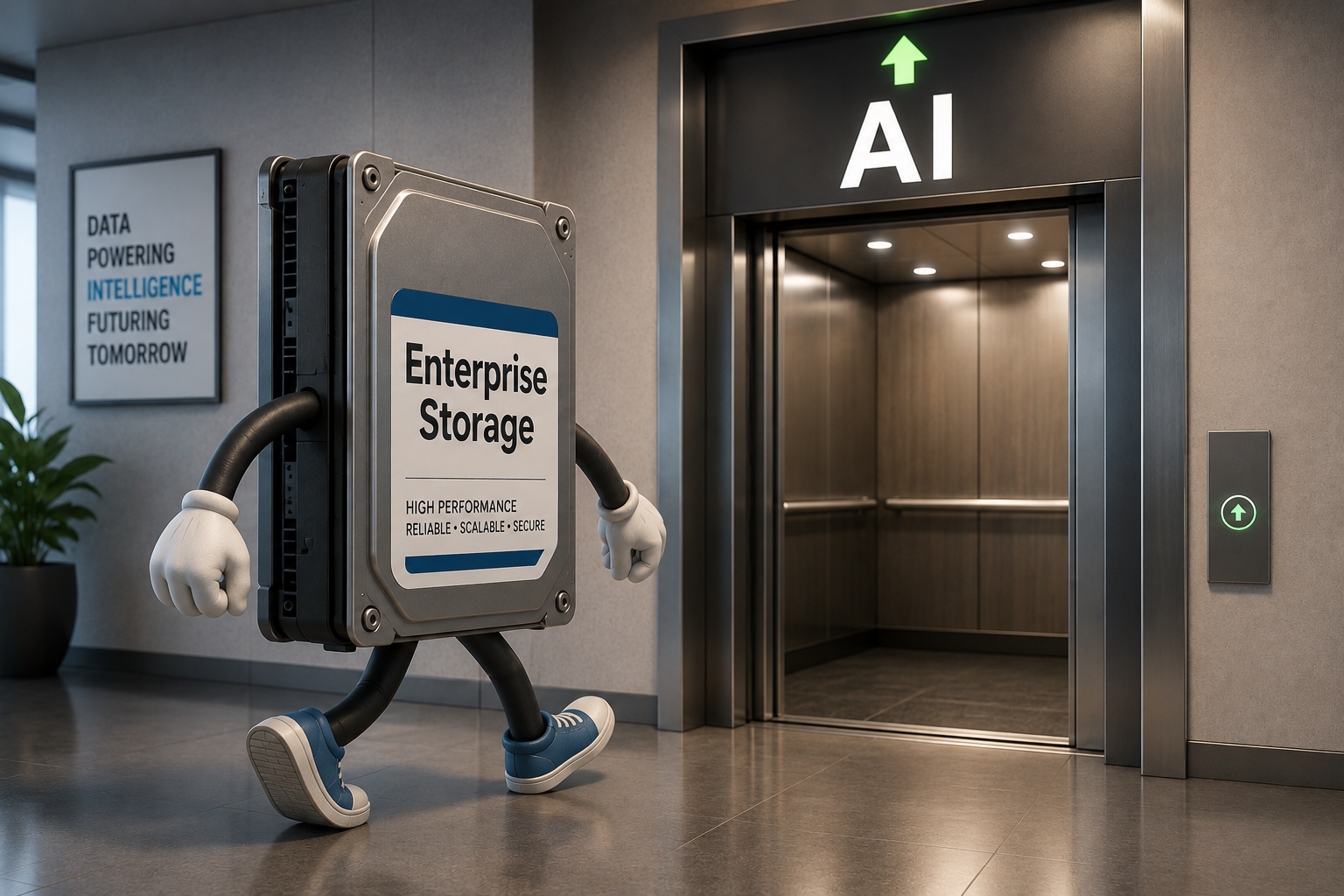
The year 2026 could be remembered as the moment when storage technology received a massive promotion.
The reason is that the current transition from simple chatbots to agentic AI systems has raised the stakes for context memory, the relevant information autonomous systems needs to understand and process a task. Supplying agents with data to support contextual working memory requires storage architecture with greater token throughput and improved efficiency.
Storage’s support of AI clusters has traditionally been confined to GPU servers or over a network in shared environments. Now, the ballgame has suddenly changed, according to Ace Stryker, director of AI and ecosystem marketing at Solidigm Inc.
“It feels like storage kind of got a promotion,” Stryker said, during a recent interview with theCUBE, SiliconANGLE Media’s livestreaming studio. “What’s new now is the third job. And that third job is new dedicated nodes specifically for storing context memory or KV cache. That’s a completely new tier of storage in an AI cluster. We’re going to have to come to terms with a whole lot more data and be able to store that with a combination of world-class hardware and software.”
This feature is part of SiliconANGLE Media’s exploration of the architectural shifts powering continuous, production-grade AI. Be sure to check out SiliconANGLE’s extensive coverage of RAISE Summit in Paris, July 8–9, featuring interviews with Solidigm executives and industry experts from d-Matrix, AMD, Neo4j, Tensordyne, Argentum AI, Cerebras, DDN and Canva, among others. (* Disclosure below.)
One market catalyst for storage’s new assignment was the announcement of Nvidia Corp.’s BlueField-4 STX storage architecture in March. The release introduced Context Memory Storage, or CMX, a high-performance context layer that expanded GPU memory across the rack.
The architecture’s key engine is the BlueField-4 data processing unit, or DPU, that Nvidia unveiled in January. DPUs facilitate the offloading of infrastructure management tasks from a server’s main processor, freeing more capacity for applications. BlueField-4 also handles tasks such as processing data traffic between GPUs and flash storage.
“As AI infrastructure moves from proof of concept to production at enterprise scale, storage is becoming a strategic differentiator rather than a supporting component,” said Paul Nashawaty, practice lead and principal analyst, application development, at theCUBE Research. “Organizations are discovering that GPU performance alone does not determine AI success. The ability to feed models with high-quality data, sustain throughput across distributed environments, and optimize infrastructure economics is equally important.”
STX sets the table for enterprises to store and reuse the massive key-value, or KV, cache that large language models and agentic AI inference can generate. AI workloads are moving from single prompts to agentic sessions with million-token context windows, increasing the volume of data into petabytes that exceed what standard GPU and DRAM memory tiers can handle.
“You have to vectorize all this data and make it quickly searchable and accessible by AI models. All that has a storage cost, it’s got to live somewhere,” Stryker explained. “These models with these context windows that are just growing and growing, and these longer loops, more iterations … all of that has incredible storage implications. It does not appear that this is a cyclical thing, that this is likely to wane anytime soon. That’s where we find ourselves in 2026.”
The storage industry’s pursuit of solutions that address AI’s quest for context highlights the growing need for backend systems and databases that work really well with autonomous technology. This will require an ability to cluster things together in ways that AI can use.
One of the emerging tools for making this possible is the context graph, an accumulated structure of decision traces woven among entities and time so that precedent is searchable. Two researchers from Foundation Capital recently posted an analysis that suggested that the context graph could be AI’s “trillion-dollar opportunity.”
One company seeking to capitalize on this architectural trend is Neo4j Inc. The company provides a command-line interface tool for generating full-stack applications with AI agents backed by graph databases for contextual memory.
“In 2026, I think the big light bulb went off within the VC community,” said Stephen Chin, vice president of developer relations at Neo4j, in an interview with theCUBE. “Basically, what they realized is that the reason why agents can’t be successful is because they don’t have the right context, they’re so split on different data sources, on all of this tribal knowledge. And if you can bring those together and actually give agents full knowledge of the entire system, you get better decisions, you get better outcomes.”
One of the key factors driving the need for contextual memory is inference, the process of using a trained AI model to make real-time predictions or decisions on data. As theCUBE Research has noted, this is an area where the transformation of storage has become particularly significant.
Large language models rely on KV cache to store intermediate data and maintain context, making it an essential ingredient in the inference process. It has also been a headache because the expansion of context windows can make KV cache expensive and slow down performance.
The transformation of storage architecture disaggregates the need for data to reside in expensive GPU memory or move through less efficient CPUs. Storage is becoming part of the inference engine itself, and STX “is making storage workload-aware with specialized intelligence to make AI run better,” according to theCUBE Research’s Dave Vellante.
The market implications for this are significant. A forecast from Deloitte notes that inference will account for approximately two-thirds of AI compute in 2026.
“There is clear acknowledgement that the next big wave of AI computing is going to be around inference,” said Sid Sheth, founder, president and CEO at d-Matrix Corp., in a recent conversation with theCUBE. “And I think people are just trying to figure out what does that really look like because it’s not one size fits all. You can’t really leverage a single computing platform for all of inference, because inference is done at different points in the network. You do it in big data centers, small data centers. We do it in edge applications. It’s just going to be really spread out.”
With the current emphasis on inference and the significant shifts taking place in IT infrastructure, where does this leave today’s developer?
Findings from theCUBE Research show that developer experience directly impacts business outcomes. Organizations with high-quality developer experiences are 33% more likely to achieve their business goals and 31% more likely to improve software delivery flow.
Yet, the tech industry is moving into a heterogeneous world where there will be a coexistence of different forms of compute and varying types of architectural solutions. In the past, developers didn’t really need to worry about what the underlying hardware looked like. Now they do.
“It’s changing, you’re seeing a very quick and dynamic shift that is happening in the underlying infrastructure, the underlying compute, which basically means if you want to write applications for that type of infrastructure, you really need application developers and programmers to understand what the underlying infrastructure looks like and how to program for it,” Sheth noted.
AI’s rapidly developing ability to write code is also changing the equation. This is changing the very definition of developer responsibility when AI agents make changes and fixes. It is something that the developer community must come to terms with, according to Chin, and he believes the answer is clear.
“It’s the human who’s accountable and responsible, but it’s a human with a lot more capabilities, with a lot more tools at their disposal to actually participate and be an effective contributor,” Chin told theCUBE. “Us humans, we’re the community. But we are more capable, more empowered humans who have a lot of agents and tools at our disposal.”
(* Disclosure: TheCUBE is a paid media partner for RAISE Summit coverage. Neither Solidigm, the headline sponsor of theCUBE’s event coverage, nor other sponsors have editorial control over content on theCUBE or SiliconANGLE.)
Support our mission to keep content open and free by engaging with theCUBE community. Join theCUBE’s Alumni Trust Network, where technology leaders connect, share intelligence and create opportunities.
Founded by tech visionaries John Furrier and Dave Vellante, SiliconANGLE Media has built a dynamic ecosystem of industry-leading digital media brands that reach 15+ million elite tech professionals. Our new proprietary theCUBE AI Video Cloud is breaking ground in audience interaction, leveraging theCUBEai.com neural network to help technology companies make data-driven decisions and stay at the forefront of industry conversations.