 AI
AI
AI
AI









AI

An exclusive report by Reuters today has surfaced evidence that suggests Chinese artificial intelligence firms have been leveraging the outputs of American frontier models developed by OpenAI Group PBC and Anthropic PBC to train their own AI systems for defense applications.
The review by Reuters included a detailed examination of more than 80 academic papers and patent applications published by Chinese researchers, and found that multiple institutions linked to the military have been harvesting the outputs of U.S. models. The report claims that China is doing this to get around Washington’s aggressive export controls, which have prevented its startups from accessing the advanced chips needed to create more sophisticated AI models from scratch.
Reuters said it conducted the review with the Washington D.C.-based defense policy thinktank Jamestown Foundation. Its findings suggest that Chinese researchers are increasingly hijacking the work of America’s best known AI startups in order to build advanced systems that power military applications.
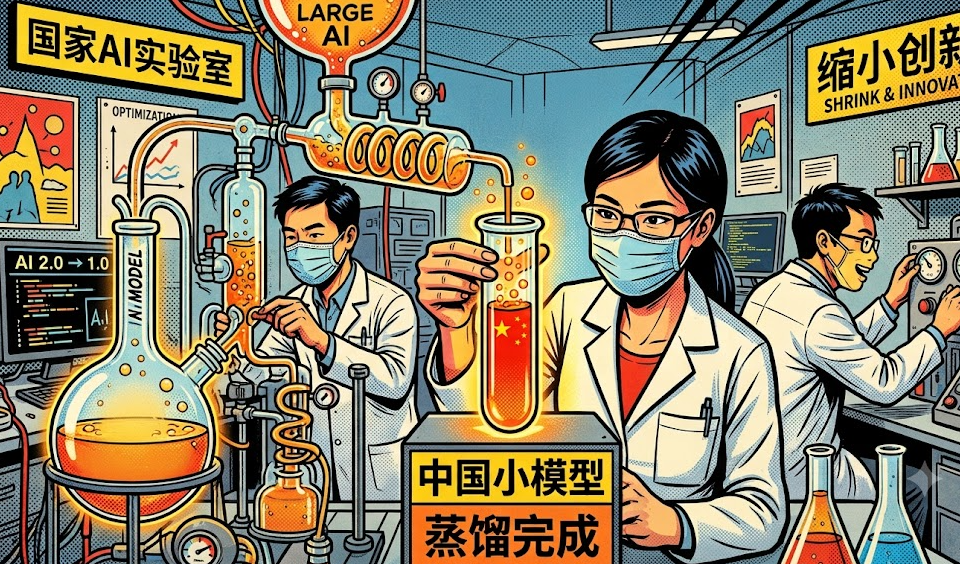
The report accuses Chinese researchers of misusing a technique known as “model distillation,” which refers to a process that involves taking the outputs, reasoning steps and data from powerful “teacher models” and using them to train smaller, more specialized “student” models. Through model distillation, it’s possible to create smaller models that can run more efficiently on less powerful hardware. The result is that China has been able to develop numerous models that match the performance of OpenAI’s and Anthropic’s most advanced frontier models despite using far less computational resources.
Although distillation does have legitimate uses, such as in optimizing models for specific workloads, there’s a lot of controversy around the technique, especially as Chinese models continue to surprise with their frontier-level capabilities. Last month, Alibaba Group Holding Ltd. launched a preview of Qwen3.8, releasing benchmarks that suggest its performance is second only to Anthropic’s Claude Fable 5, surpassing OpenAI’s best model, GPT-5.6. That came after the Chinese startup Moonshot AI made headlines when it released the world’s largest open-weights model to date in Kimi K3, with similar claims about its performance.
In response to those developments, U.S. officials and AI startups have cried foul, accusing Chinese firms of distilling American models to advance the capabilities of their own. U.S. Treasury Secretary Scott Bessent has even threatened to sanction any Chinese AI firms it deems guilty of the distillation practice, even though others, such as Microsoft Corp. Chief Executive Satya Nadella, have pointed out the irony of the accusations, given how Anthropic’s models were trained on massive amounts of internet data without asking permission.
Reuters provided a number of examples of how China has been distilling U.S. models. For instance, it claimed that PLA Unit 96941, the main cyberwarfare group in the People’s Liberation Army, distilled OpenAI’s GPT-3.5 to process and summarize sensitive military source code. From those outputs, the unit was able to develop a lightweight model that specializes in safely processing sensitive data on Chinese military networks.
The report also points fingers at researchers at the North University of China, an institution believed to have close ties to the country’s weapons manufacturing industry. It said they used Anthropic’s Claude 3 Haiku to create synthetic training data to build a text classification system for social media monitoring. Meanwhile, at the National University of Defense Technology, researchers are alleged to have distilled a U.S.-made image processing model so it can be installed directly on unmanned aerial vehicles. Using this lightweight version of the model, drones can analyze live video feeds in real time to aid their navigation and weapons targeting systems.
The revelations are likely to increase tensions ahead of upcoming talks between U.S. and Chinese officials on AI governance and safety. The White House is concerned that distillation undermines its export controls and infringes on the intellectual property rights of U.S. model makers, while Beijing accuses the Americans of pursuing “AI hegemonism.”
However, any concerns that China might use model distillation to one day surpass the U.S. in AI are likely to be unfounded, said SapienX Inc. co-founder Trevor Koverko. “It is best understood as transferring selected capabilities into a cheaper, locally controlled system,” he explained. “It doesn’t mean achieving independence from frontier AI.”
In other words, while Chinese researchers might be able to devise systems that can match the capabilities of U.S. models in a narrow range of applications, they’ll still have to come up with their own original breakthroughs to outperform their U.S. rivals.
Support our mission to keep content open and free by engaging with theCUBE community. Join theCUBE’s Alumni Trust Network, where technology leaders connect, share intelligence and create opportunities.
Founded by tech visionaries John Furrier and Dave Vellante, SiliconANGLE Media has built a dynamic ecosystem of industry-leading digital media brands that reach 15+ million elite tech professionals. Our new proprietary theCUBE AI Video Cloud is breaking ground in audience interaction, leveraging theCUBEai.com neural network to help technology companies make data-driven decisions and stay at the forefront of industry conversations.