 APPS
APPS
APPS
APPS








APPS

OpenAI Group PBC today rolled out reusable cloud environments for its Codex coding agent, giving developers a saved project configuration they can work from across devices.
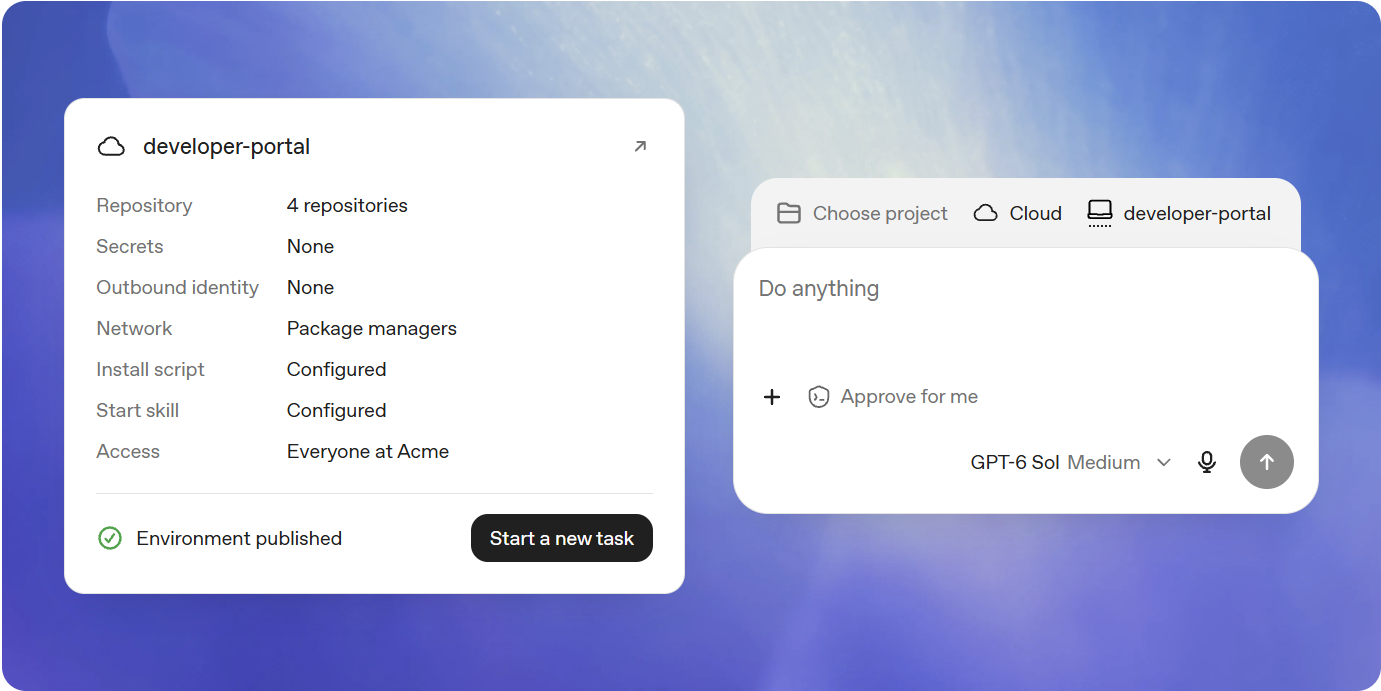
Announced at the company’s DevDay conference, the release targets the preparation that comes before an agent writes a line of code. A cloud environment does that work once. Each new task starts from that saved setup, with the project’s dependencies already installed.
Developers begin by connecting a repository from GitHub Inc. Codex reads the code to see which software versions the project relies on and drafts the install script from what it finds. Startup checks for the project’s services come out of the same pass, and OpenAI’s documentation says any changes are made in conversation with Codex.
Once an environment is published, each task launched from it gets its own virtual machine and keeps working while the developer’s computer sleeps. Changes not yet sent back to the repository stay with the task, so it can be reopened later from a phone or a browser without losing them. Dependency caches survive the background refreshes that keep the repository current.
OpenAI is also pitching the environments at teams that want every developer working from the same approved configuration. After one is shared with a ChatGPT workspace, colleagues can run their own tasks from it. Access to a shared environment does not extend to anyone else’s tasks or to editing the setup. Enterprise administrators hand out that editing permission separately.
For the credentials a project needs, cloud environments support standard environment variables and a second type OpenAI calls network secrets. A program that uses a network secret sees only a placeholder, with a proxy inserting the real value as traffic heads to a domain on the allow list. Individual users of a shared environment can be asked to supply their own values from a personal account. Internet access defaults to a preset of common package registries, and developers can open it wider.
Codex has handled tasks in the cloud since it debuted as a research preview inside ChatGPT in May 2025. Codex Security Cloud, another DevDay launch, takes the same approach to security work. It scans GitHub repositories on a schedule and prepares fixes while the developer’s machine is off.
Access to cloud environments is rolling out to ChatGPT Plus and Pro subscribers, and Business, Enterprise, Edu and Healthcare workspaces get it too. Plus accounts run on the smallest virtual machines, with half the processors and memory of the Pro, Business and Enterprise tiers.
By default, a task’s state can be recovered for up to seven days after it was last used. Codex cannot yet work with repositories on GitLab Inc. or on self-hosted GitHub Enterprise Server, and computer and browser use are also unsupported in cloud environments.
Support our mission to keep content open and free by engaging with theCUBE community. Join theCUBE’s Alumni Trust Network, where technology leaders connect, share intelligence and create opportunities.
Founded by tech visionaries John Furrier and Dave Vellante, SiliconANGLE Media has built a dynamic ecosystem of industry-leading digital media brands that reach 15+ million elite tech professionals. Our new proprietary theCUBE AI Video Cloud is breaking ground in audience interaction, leveraging theCUBEai.com neural network to help technology companies make data-driven decisions and stay at the forefront of industry conversations.