 AI
AI


AI

For most of its 30-year history, Cisco Partner Summit has focused on how partners sell Cisco Systems Inc. technology. This year’s event in Vancouver was about something different: how partners make money in a world where the transaction is no longer the main event.
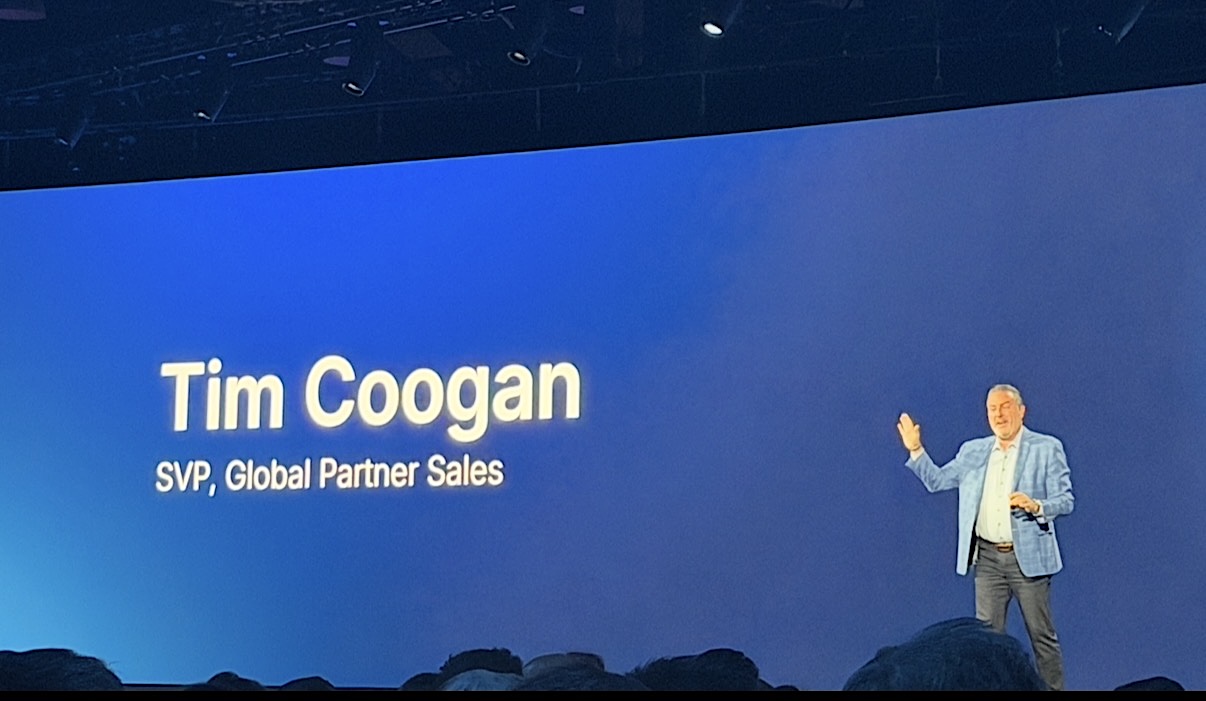
Cisco entered the event with tremendous momentum, as its stock was up more than 50% over the past 12 months. Tim Coogan (pictured), senior vice president of global partner sales, told the 2,000 partners in attendance that channel bookings accounted for about 90% of Cisco’s total in fiscal 2026 and that global channel growth was just over 17%. Chief Executive Chuck Robbins called fiscal 2026 “the absolute best year that Cisco’s ever had.” Good years can mask structural change, though, and the announcements in Vancouver signal a real rethink of how value moves through Cisco’s partner ecosystem.
Here are my five takeaways that should matter to Cisco partners.
The most significant change in Vancouver may also be the least flashy. Ecosystem Deal Registration gives advisers, consultants and developers formal credit for helping Cisco win a deal, even when they don’t execute it. This group of partners hasn’t received the same level of attention as traditional reseller partners, yet they are now critical in the AI era.
Today, that credit takes the form of marketing support and promotion alongside Cisco sellers. Starting next spring, preferred advisers and developers will be eligible for referral incentives. Cisco is also introducing dedicated Partner Value Indexes for advisors and developers, with a unified distributor index planned for 2027.
Coogan emphasized the importance of the change. “Our traditional programs were transaction-based,” he said during his portion of the keynote. “This is a unique way to bring the entire ecosystem of partners together into a single solution for the benefit of our customers.”
The data presented supports this change. Cisco cited Omdia research showing that customers rely on six to seven partners and pass through 28 moments of influence before buying. A program that pays only the partner holding the paper ignores most of what shapes the decision. The risk is channel conflict, and resellers will want proof that rewarding influence grows the pie rather than splitting it.
Robbins addressed the bumpiness of the Cisco 360 rollout and the company’s willingness to take corrective action. “We’re not perfect. We’ll screw it up, but we’ll fix it,” he said. This is a great example of his statement, and partners should continue to hold him to it.
If one announcement could change partner economics, it would be Cisco IQ Partner Branded Support Standard. Partners can now deliver Cisco IQ under their own brand, through their own experts, with role-based access to customer installed bases, application programming interfaces, IT service management integrations, and a Model Context Protocol server.
“For too long, partners entered customer conversations without the same view as Cisco. That changes today,” said Liz Centoni, executive vice president and chief customer experience officer. “It’s their name, their customer relationship and their services practice. Cisco IQ is the engine. Partners are the business.”
Centoni presented several compelling proof points. More than 16,000 customers and nearly 20 million devices are now on Cisco IQ. Generali reduced the time to assess a single security advisory across 16,000 devices from four days to 10 minutes. Georgetown University transformed two months of manual renewal work into a 20-minute view.
On stage, Centoni gave an example that quantified the opportunity. In her example, a partner who walks in to refresh 75 switches books about $625,000 and walks away. A partner who starts with Cisco IQ, identifies uncovered devices, sells hardening services, designs the refresh, and then runs managed operations across all 175 switches can reach roughly $1.3 million over five years, including incentives. That’s 2.1 times the value. “Basic gives you the map. Standard and Signature give you the GPS,” she said.
Cisco is backing that with a $2,500 adoption incentive per onboarded customer, a 6% deal registration on Standard and Signature support, and a $1 million Builders Challenge for partners who create managed services on Cisco IQ. My take is that Cisco is moving partners from project revenue to recurring revenue, where valuation multiples are higher. Partners who sell Cisco IQ as a support add-on will miss the point.
For years, last-day-of-support conversations felt like a vendor pushing hardware. Robbins said as much. “When we used to stand up and talk about what we call LDOS (last day of support), people would go, ‘OK, that’s just the vendor trying to sell more equipment,’ and you would have been partially right,” he said. “Now the urgency of getting that equipment out of the infrastructure, equipment that can’t be patched and for which there are no spares, is a real emergency.”
Coogan provided the numbers that underscore the urgency. In 2018, more than two years passed between discovery and exploitation of a vulnerability. Last year, it was about three weeks. This year, it’s eight hours or less. Only 3% of partners named AI security a growth opportunity last year. This year, 33% did.
Cisco’s answer includes expanded Live Protect coverage, what it calls the industry’s first quantum-resilient Wi-Fi 7 access point, and Privileged Infrastructure Access, built with Teleport, which provides engineers and AI agents with short-lived, identity-bound access to routers and switches. Robbins framed the architecture this way: “If agents are operating across your infrastructure, the only common denominator they’re going to touch on a daily basis is the network.”
Robbins said only 8% of the installed base has been refreshed to Cisco’s new enterprise portfolio. But, in his words, customers are “overwhelmed.” The winning partners will present a phased plan outlining what to fix first and why. That’s an advisory skill, not a quoting skill.
Mark Patterson, executive vice president and chief financial officer, has attended Partner Summit for more than 20 years, but this was his first time onstage. His session was among the day’s most useful because he discussed what motivates partners most: money. On price increases, he said, “Raising prices is the absolute last resort for us.” He added that the Nov. 7 increase targets memory-intensive products rather than being spread “in a peanut butter fashion.”
His most important point concerned margin. “The big takeaway is that margin follows the platform,” Patterson said. “You might lead with compute, but then you add networking, security, Splunk and observability. That’s where you’ll drive much of the margin.”
The incentives align with that view. The program adds an extra 2% cross-sell bonus for expanding into new Cisco architectures, including Splunk. It increases the reward for annual contract value growth by 50%, doubles adoption incentives, and offers 12% deal registration for Supermicro systems sold as part of full-stack AI infrastructure. Coogan also made an unusual admission about Splunk. “We moved slower on Splunk than we wanted to, than we should have, and that changes this year and it changes now,” he said.
Patterson also highlighted Cisco Capital as underused, noting that “the margins are paid entirely up front,” which helps partners build larger deals for customers with heavy technical debt. The message is that thin-margin compute is the entry point, not where the profit lies. With 91% of surveyed partners reporting that customers are concerned about AI costs, those who can design cost-efficient on-premises inference will capture the attached revenue.
The final insight concerns who builds value. Cisco is putting its own AI tooling directly into partners’ hands. Model Foundry, a new service within Cisco Cloud Control, gives partners first access to Cisco’s purpose-built models, including Deep Network for network troubleshooting. Partners can run these models via an OpenAI-compatible application programming interface and fine-tune them on customer data. Cloud Control Studio lets partners build agents for customers. New MCP servers for networking platforms eliminate the need to build custom integrations, and ThousandEyes synthetic testing is now built into eligible Wi-Fi 6E and Wi-Fi 7 access points at no additional cost.
Cisco is also turning AI on its own channel friction. Its Partner Experience Platform is being rebuilt to connect opportunity, quote, and payout in a single flow. An early agent-to-agent pilot with a distributor cuts the time to build a bill of materials by about 80%.
Coogan spoke about partners in a humble tone. “Our partners don’t owe us anything, and they don’t work for us,” he said. “We earn the right to work with them every day.” That mindset matters at Cisco, where they ask partners to invest in skills many don’t yet have. Partners reported that the AI knowledge gap is closing, but the hands-on deployment gap is widening.
The 2026 Partner Summit marks the Cisco channel’s shift from a resale model to an intelligence-led services model. My advice to partners:
Move as many customers as possible from Basic support. Basic support provides customers with an inventory. Standard and Signature unlock the capabilities that create partner value: vulnerability prioritization, proactive risk intelligence, peer benchmarking, and quantum-readiness assessments. Centoni said Cisco has “far too many critical customers who have basic that should be on standard and signature,” and noted that customers on the higher tiers have net promoter scores 15 points higher, which translates into better retention and stronger renewals. With a $2,500 adoption incentive per onboarded customer and 6% deal registration on Standard and Signature, the economics reward partners who move now. Start by reviewing your installed base, identifying the critical accounts still on Basic, and letting a live Cisco IQ demo make the case.
Lead with resilience, not refresh. Customers know their equipment is old. What they lack is a clear sense of what to fix first. Use Cisco IQ and Cisco’s Resilient Infrastructure playbooks to build a phased, risk-ranked plan. First, address devices with no support. Then harden those staying in service. Finally, modernize gear past its last day of support or that can’t be patched. The new Quantum Safe and software End of Vulnerability Support assessments provide more evidence to scope that work. This approach turns a hardware conversation into a professional services engagement. When the customer says there’s no budget this year, it also gives you a plan to move the refresh into next year’s budget cycle. Customers will buy priorities, not part numbers.
Team up intentionally. Most customers already work with six to seven partners, and Ecosystem Deal Registration gives Cisco a formal way to reward the advisors, consultants, and developers who shape a deal without transacting it. Transacting partners should view this as a pipeline opportunity, not a threat. Identify the advisors who influence your largest accounts, the independent software vendors building on Meraki and Cisco Cloud Control, and the Splunk specialists who can fill gaps in your practice. Splunk is new to many Cisco partners, and for them, Coogan offered some advice. If another partner has the expertise your team needs, team up. Partners who map and formalize these relationships early will see larger, faster deals before competitors catch on.
Invest in builders. The next round of differentiation won’t come from offering a deeper discount. It will come from who can turn Cisco’s data and models into services customers can’t get anywhere else. Model Foundry, Cloud Control Studio, the Cisco IQ MCP Server, and the new MCP servers for networking platforms give partners the building blocks for custom agents, automated troubleshooting, and managed services that run on customer telemetry. Partners told Cisco the AI knowledge gap is closing, but the lack of hands-on deployment experience has become the bigger barrier. Get engineers through Black Belt training and dCloud labs. The $1 million Builders Challenge is also a good reason to put a small team on a new managed service. Partners who can fine-tune models and ship agents will stand out from those who only resell.
For buyers, the partner you hire should arrive with a live view of your environment and a plan, not a quote. If they don’t, find another partner – one that has modernized its own business to help you modernize yours. Robbins concluded that Cisco and its partners defined the internet era and can lead the AI era together. The tools and incentives are in place. Now, execution must keep pace with the threats.
Zeus Kerravala is a principal analyst at ZK Research, a division of Kerravala Consulting. He wrote this article for SiliconANGLE.
Support our mission to keep content open and free by engaging with theCUBE community. Join theCUBE’s Alumni Trust Network, where technology leaders connect, share intelligence and create opportunities.
Founded by tech visionaries John Furrier and Dave Vellante, SiliconANGLE Media has built a dynamic ecosystem of industry-leading digital media brands that reach 15+ million elite tech professionals. Our new proprietary theCUBE AI Video Cloud is breaking ground in audience interaction, leveraging theCUBEai.com neural network to help technology companies make data-driven decisions and stay at the forefront of industry conversations.