 AI
AI


AI

After laying low during the summer while competitors Anthropic PBC and OpenAI Group PBC unleashed powerful new frontier models, Google LLC is hitting back.
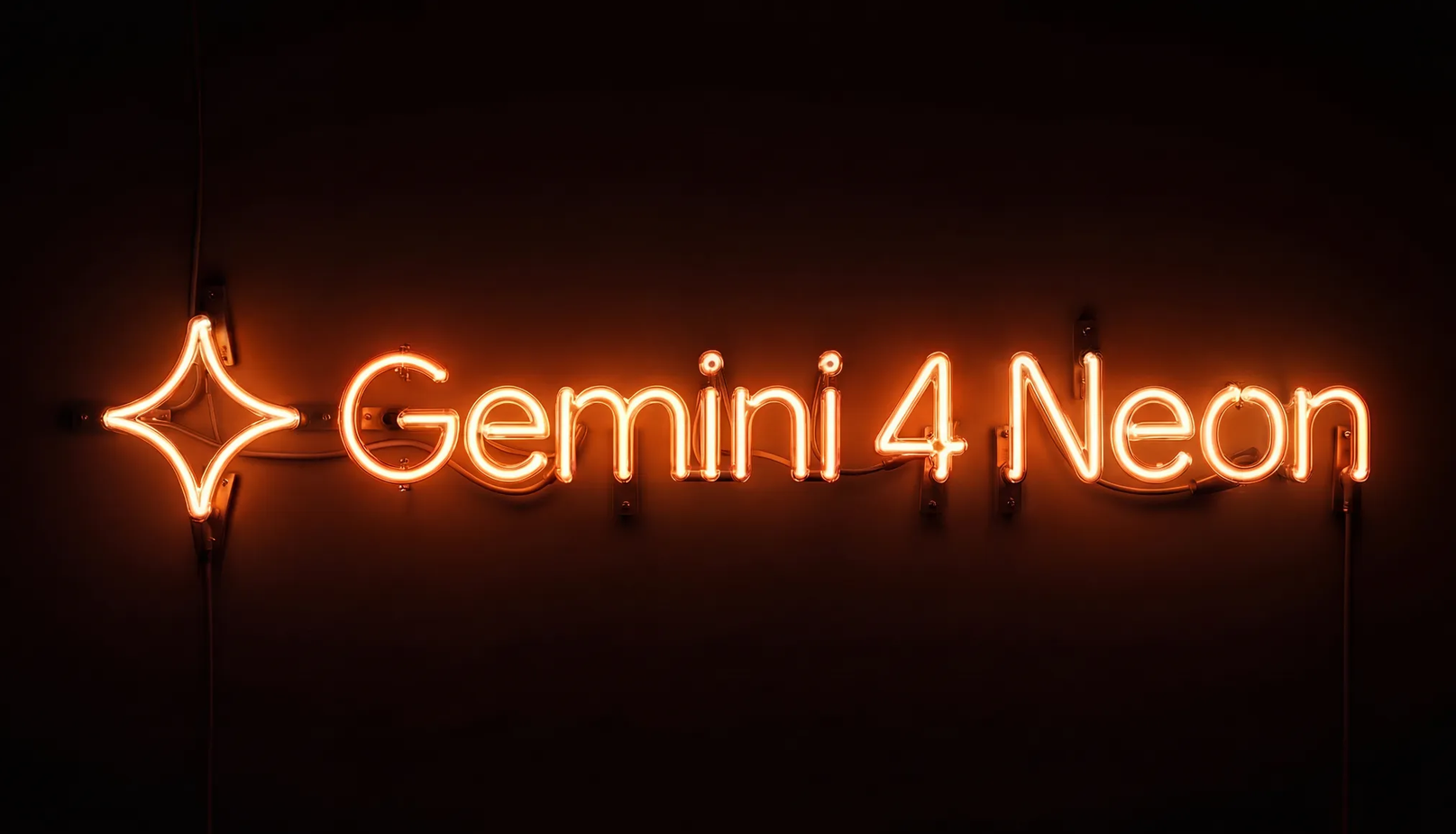
Having released its latest flagship model Gemini 4 Carbon one month ago, followed by the cost-effective Gemini 4 Hydrogen, it’s now striking a balance between the two with Gemini 4 Neon. Google announced its latest artificial intelligence offering in a blog post today, saying that Neon is a general-purpose model designed to handle complex coding tasks, multistep agentic workflows and analytical reasoning.
Surprisingly, though Carbon is positioned as the company’s strongest model, Neon’s performance surpassed it on some tasks, according to benchmarks the company published today. Google also said Neon completes most tasks about three times as quickly as Carbon at costs of about 60% lower, making it “competitive with the leading models in its class.”
Here’s Google’s official benchmarks:
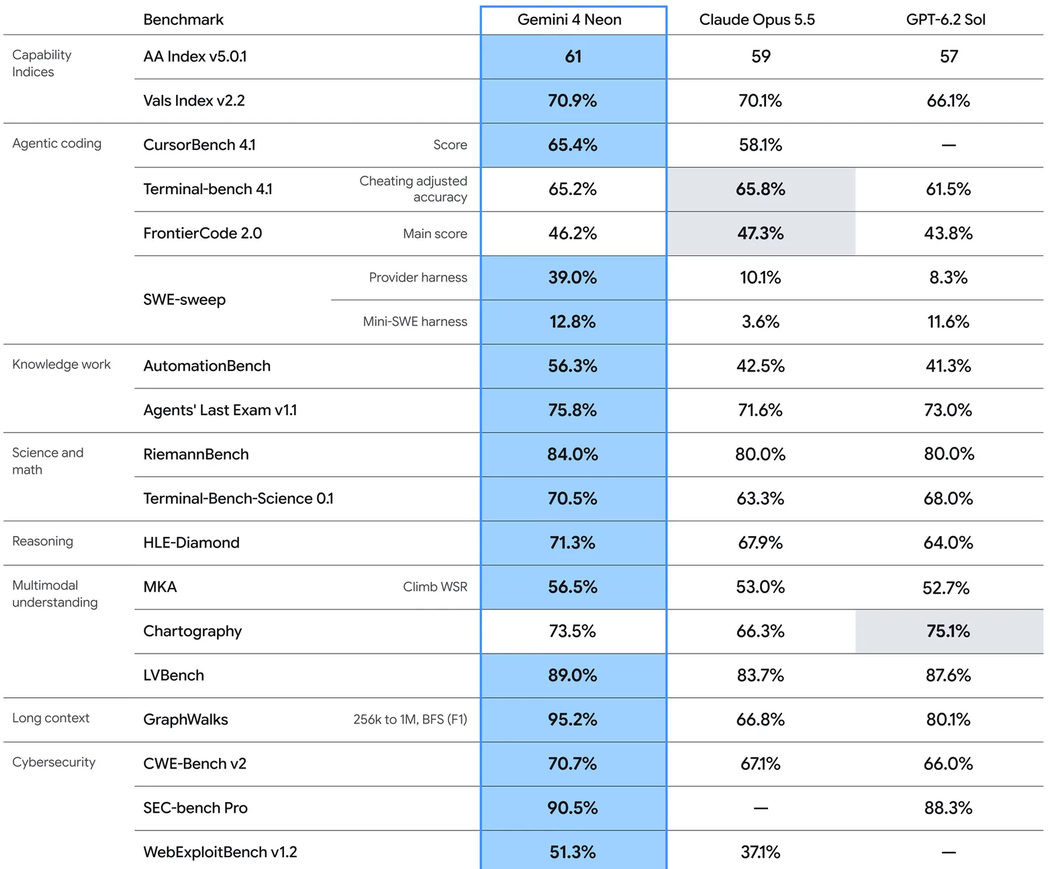
Digging deeper into Google’s benchmarks, the company said Neon outranked the midtier Claude Opus 5.5 and GPT-6.2 Sol models on tests such as knowledge work, reasoning, automation, multimodal understanding, cybersecurity, science and math.
Those numbers were from Google’s own tests, but independent research by Artificial Analysis shows that Neon achieved an impressive score of 61 on the Intelligence Index, putting it third overall, just behind Anthropic’s most powerful model, Claude Fable 5.2, which scored 65, and OpenAI’s leading model GPT-6.2 Astra, which achieved a score of 62.
Google continues to accelerate its release cadence with Gemini 4 Neon, delivering a small Intelligence gain over Gemini 4 Carbon at a ~17% lower Cost per Task@GoogleDeepMind has released Gemini 4 Neon, its fourth model in just seven weeks. Neon (xhigh) scores 61 on the… pic.twitter.com/L76oKwyxXa
— Artificial Analysis (@ArtificialAnlys) November 18, 2026
With regard to cost, Neon isn’t quite so impressive. Google said it’s priced at a cost of $3 per million input tokens, 15 cents per million cached input tokens and $15 per million output tokens. That means it falls right in between GPT-6.2 Sol, which costs $2 per million input tokens, 10 cents per million cached tokens and $10 per million output tokens, and Claude Opus 5.5, which is priced at $4 per million input tokens, 20 cents per million cached tokens and $20 per million output tokens.
Google’s choice of pricing is interesting because there’s a lot of debate around which model provider can achieve a genuine competitive advantage over its competitors. Given that these midtier models are so comparable in terms of performance, cost efficiency is becoming a more significant factor for enterprise customers. Although Neon appears to edge out GPT-6.2 Sol and Claude Fable 5.2 in terms of its ability to process several important workloads, many organizations might decide that’s not really enough to justify paying more to use it.
Google said it’s making Neon available to Google AI Pro and Ultra subscribers from today in the Gemini application. Developers can also access it through the company’s paid application programming interface, the Google Antigravity platform and other business offerings.
Support our mission to keep content open and free by engaging with theCUBE community. Join theCUBE’s Alumni Trust Network, where technology leaders connect, share intelligence and create opportunities.
Founded by tech visionaries John Furrier and Dave Vellante, SiliconANGLE Media has built a dynamic ecosystem of industry-leading digital media brands that reach 15+ million elite tech professionals. Our new proprietary theCUBE AI Video Cloud is breaking ground in audience interaction, leveraging theCUBEai.com neural network to help technology companies make data-driven decisions and stay at the forefront of industry conversations.