

Many free mobile apps display targeted ads based on everything from the other apps you have installed to the items you have in your Amazon wishlist, and now according to a new patent application filed by Snapchat, Inc., those ads could even start looking at the objects that are captured in your pictures.
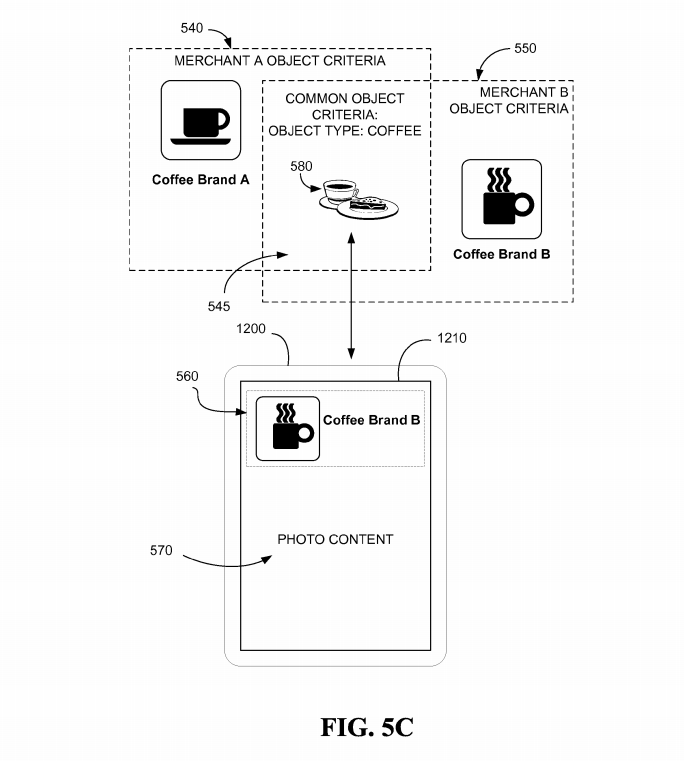
The patent application, which was filed earlier this month, describes a photo filter engine capable of displaying content that “may include associations between an object and a source of image data, for example, a brand of a merchant in which case the associated photo filter may include images associated with the brand of the merchant.” In simpler terms, the engine would look at what is in your picture and offer unique photo filters based on that information.
Snapchat has already offered a branded photo filters in the past, such as Taco Bell’s Cinco de Mayo filter, but the filters described in the patent would only work if the app recognizes certain objects. For example, if you take a picture while holding a coffee cup, the app might suggest photo filters that advertise certain brands of coffee.
Snapchat’s patent may sound like something straight of some science fiction dystopia, but with the recent advancements in artificial intelligence – specifically in computer vision – Snapchat’s idea is not so farfetched, and it could represent a major turning point in targeted advertising.
Of course, this technology has a number of other uses aside from advertising, and while Snapchat’s patent application does make specific references to displaying branded content, it also mentions a few other examples of how its “photo filter engine” could be used. One such example is to add a King Kong overlay to the Empire State Building. Snapchat also noted that merchants, restaurants, individual users and others would be able to submit their own image filters for recognized objects.
Parts of Snapchat’s patent also sound an awful lot like augmented reality, particularly this section: “… a photograph including an object recognized as a restaurant may result in the user being presented with photo filters that overly a menu of the restaurant on the photograph. Or a photograph including an object recognized as a food type may result in the user being presented with photo filters that let the user view information e.g., calories, fat content, cost or other information associated with the food type.”
You can view the full patent application here.
Support our mission to keep content open and free by engaging with theCUBE community. Join theCUBE’s Alumni Trust Network, where technology leaders connect, share intelligence and create opportunities.
Founded by tech visionaries John Furrier and Dave Vellante, SiliconANGLE Media has built a dynamic ecosystem of industry-leading digital media brands that reach 15+ million elite tech professionals. Our new proprietary theCUBE AI Video Cloud is breaking ground in audience interaction, leveraging theCUBEai.com neural network to help technology companies make data-driven decisions and stay at the forefront of industry conversations.