 EMERGING TECH
EMERGING TECH
EMERGING TECH








EMERGING TECH

When a startup realizes its original idea isn’t going to fly, the cliched but often effective solution is a “pivot,” applying the technology in a new direction. Problem is, for a number of reasons, pivoting doesn’t really work for the rising number of startups building their businesses on machine learning.
That’s one reason behind a program Google LLC started earlier this year to work with startups using machine learning and artificial intelligence in their products. Today, the company is announcing the first four startups it will shepherd through a program in Launchpad Studio, which offers startups access to Google mentors, cloud services, data sets and potential customers, among other things.
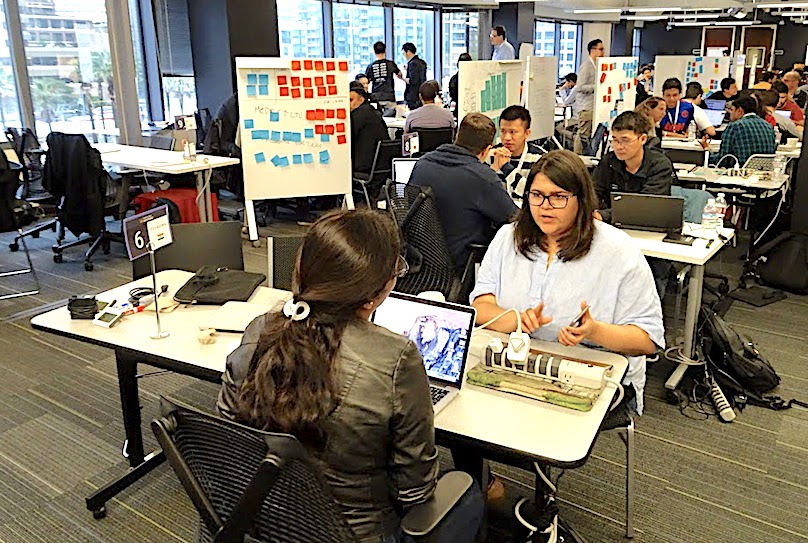
This batch of four startups, all chosen for a focus on applying machine learning to healthcare, will gather at the Launchpad Studio in San Francisco at Google’s Developer Launchpad space (pictured) in mid-November for a week to kick off their six-month mentorship program. The challenges they face explain why machine learning-based startups are a little different from the typical app startup that can turn on a dime.
“Lean startup methodologies don’t really work for companies leveraging machine learning,” Malika Cantor, a developer relations program manager who helps lead the studio program, said in an interview. Mainly, the infrastructure costs — the need to gather lots of data, clean it up, and train the machine learning models — is very high compared with the average startup. “Like biotech companies, it’s hard to pivot,” she said.
So the key is to make experimentation faster, so companies can more quickly determine if their idea is working. For one, the companies will meet with Google staff working on data augmentation as well as other external and internal experts, including staff from the Google Brain AI and cloud units, Google’s Verily healthcare company, and X, its “moonshot factory.” They also will get cloud computing service credits and potential access to hardware and data sets.
One of the four companies is CytoVale, which is developing a new measurement technology that uses biofluidics and high-speed imaging to collect rich video data. Its initial goal is to apply machine learning to provide early detection of sepsis, which kills more Americans than breast and prostate cancer and AIDS combined, said Chief Executive Ajay Shah. He cited the ability to tap a wide range of experts at Google and beyond. “It takes a village to help a startup succeed around here,” he said.
The three other companies in the initial group are Augmedix, which aims to help doctors cut through bureaucracy by using a Google Glass peripheral that can handle voice commands for recordkeeping and enable team collaboration; BrainQ, which is using machine learning and signal processing tools to try to restore paralyzed limbs; and Byteflies, whose wearable collects vital signs that then can make that data useful for clinical trials and healthcare.
After the six months is up, Google will treat the startups as a venture capital firm might treat a portfolio company. There’s a benefit for Google, though not financial, since it specifically isn’t planning to invest in these companies. “What we get on our end is an understanding of how we can create better products to serve these ecosystems,” Cantor said.
“However no-strings-attached the startups’ participation may be, there’s no question that Google chose them for a reason and that in turn, the startups’ founders and funders are eager to get inside Google’s research orbit,” analysts Holger Mueller and Chris Kanaracus of Constellation Research Inc. wrote in a brief report on the studio.
Google plans to have rolling groups of startups participate in the studio, with the next batch, to be announced in the next month, focused on an adjacent industry to healthcare, such as agriculture or insurance.
Google isn’t alone among tech giants looking to help startups apply machine learning. On Tuesday, Nvidia Corp. announced an expansion of its Deep Learning Institute, which trains thousands of students, developers and data scientists on how to use AI techniques.
Support our mission to keep content open and free by engaging with theCUBE community. Join theCUBE’s Alumni Trust Network, where technology leaders connect, share intelligence and create opportunities.
Founded by tech visionaries John Furrier and Dave Vellante, SiliconANGLE Media has built a dynamic ecosystem of industry-leading digital media brands that reach 15+ million elite tech professionals. Our new proprietary theCUBE AI Video Cloud is breaking ground in audience interaction, leveraging theCUBEai.com neural network to help technology companies make data-driven decisions and stay at the forefront of industry conversations.