 AI
AI
AI
AI






AI

As artificial intelligence moves from experiments to everyday use, companies are realizing that making it work at scale within an enterprise AI partner ecosystem is harder than building an isolated demo.
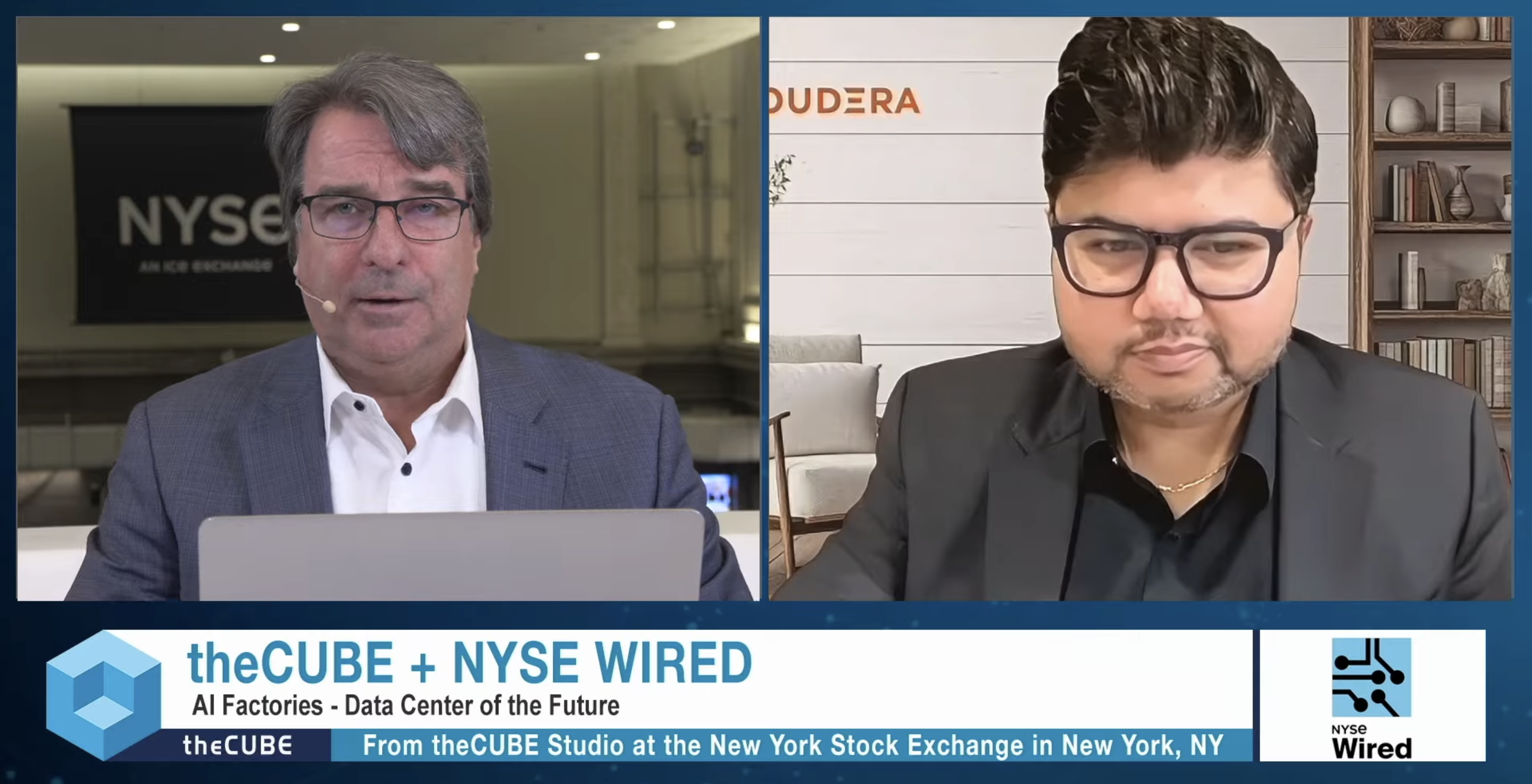
Practical concerns like cost and reliability are now shaping how organizations deploy AI systems in real production environments. What is clear is that success depends on modern ecosystems built around deep collaboration and co-design, where technology partners work together to deliver production-ready AI, according to Abhas Ricky (pictured, right), chief strategy officer of Cloudera Inc. In practice, reimagining workflows requires coordination across data, models and infrastructure — and partners who can help make those pieces work together in production.
“The majority of the organizations are trying to enable different parts of the stack, but also different parts of the workflow itself,” Ricky told theCUBE. “That’s largely because of the fact that I sincerely believe workflows will be reimagined. It won’t just be automated or digitalized.”
Ricky spoke with theCUBE’s John Furrier (left) for theCUBE + NYSE Wired: AI Factories – Data Centers of the Future interview series, during an exclusive broadcast on theCUBE, SiliconANGLE Media’s livestreaming studio. They discussed how deep ecosystem co-design is shaping the enterprise AI partner ecosystem and why inference economics are becoming a defining challenge.
Cloudera’s Enterprise AI Ecosystem, which was launched with Nvidia Corp. as a founding partner, is a major milestone in the company’s AI strategy. The partnership — which includes Nvidia Inference Microservices, a set of packaged inference services for deploying and scaling AI — is aimed at moving models into production with lower costs and higher reliability, Ricky said.
“We take the Nvidia NIM microservices architecture,” he explained. “We add things like model registry, model catalog [and] high availability, so that customers can then get the best [total cost of ownership] advantage for accelerated compute.”
Nvidia often speaks about “radical co-design,” Ricky noted. Because AI is fundamentally a team sport, it’s necessary members in an enterprise AI partner ecosystem to collaborate across the stack to reimagine workflows rather than simply automate or digitalize existing ones.
“We have to look at [how] our largest customers — or anybody’s largest customers — will reimagine workflows, and how do you actually help them on their journey?” Ricky said. “The way we’ve gone about that is we have partnerships at every layer of the stack.”
Cloudera also works with Nvidia and Dell Technologies Inc. on pre-validated, prefabricated reference architectures. That approach can speed deployments and limit integration risk, according to Ricky.
“Customers can now go from zero to production in a matter of days and weeks, which erstwhile used to take six months or more,” he said.
Standardized architectures can speed adoption, but they are also exposing a widening gap in how quickly companies can operationalize AI. Industry leaders, including Jensen Huang, chief executive officer of Nvidia, claim that there will be new ways to learn or tokenize one’s business with intelligence in the future, Ricky explained. Discussions with large enterprises across industries and regions will be crucial in providing clear insights into the biggest challenges facing strategic customers.
“This is the year when we think the agentic workflows will turn into production-grade workflows,” he said. “A lot of the conversation will be, ‘How do I make sure that the AI inside my enterprise can scale?’”
In this new environment, organizations are forced to ask whether they have the right metrics in place to understand AI costs at a granular level — including the cost per query, the graphics processing unit hours consumed per task and the trade-offs of relying on application programming interfaces from public providers. That will lead to new questions being posed, according to Ricky.
“’Do you have the right metrics? Can you actually quantify your cost per query? Can you quantify how many GPU hours per task? Can you quantify what is the margin erosion risk if I stay on my continued path of being on public APIs?'” he said. “These were questions that weren’t necessarily being asked last year or even the year before.”
Here’s the complete video interview, part of SiliconANGLE’s and theCUBE’s coverage of theCUBE + NYSE Wired: AI Factories – Data Centers of the Future interview series:
Support our mission to keep content open and free by engaging with theCUBE community. Join theCUBE’s Alumni Trust Network, where technology leaders connect, share intelligence and create opportunities.
Founded by tech visionaries John Furrier and Dave Vellante, SiliconANGLE Media has built a dynamic ecosystem of industry-leading digital media brands that reach 15+ million elite tech professionals. Our new proprietary theCUBE AI Video Cloud is breaking ground in audience interaction, leveraging theCUBEai.com neural network to help technology companies make data-driven decisions and stay at the forefront of industry conversations.