 AI
AI
AI
AI



AI

Edge AI is becoming a defining telecom trend, as organizations favor lower-cost models that can act on data in real time. Meanwhile, private networks and local infrastructure are giving operators direct control over latency, data governance and service quality — a critical foundation for scaling AI-driven applications.
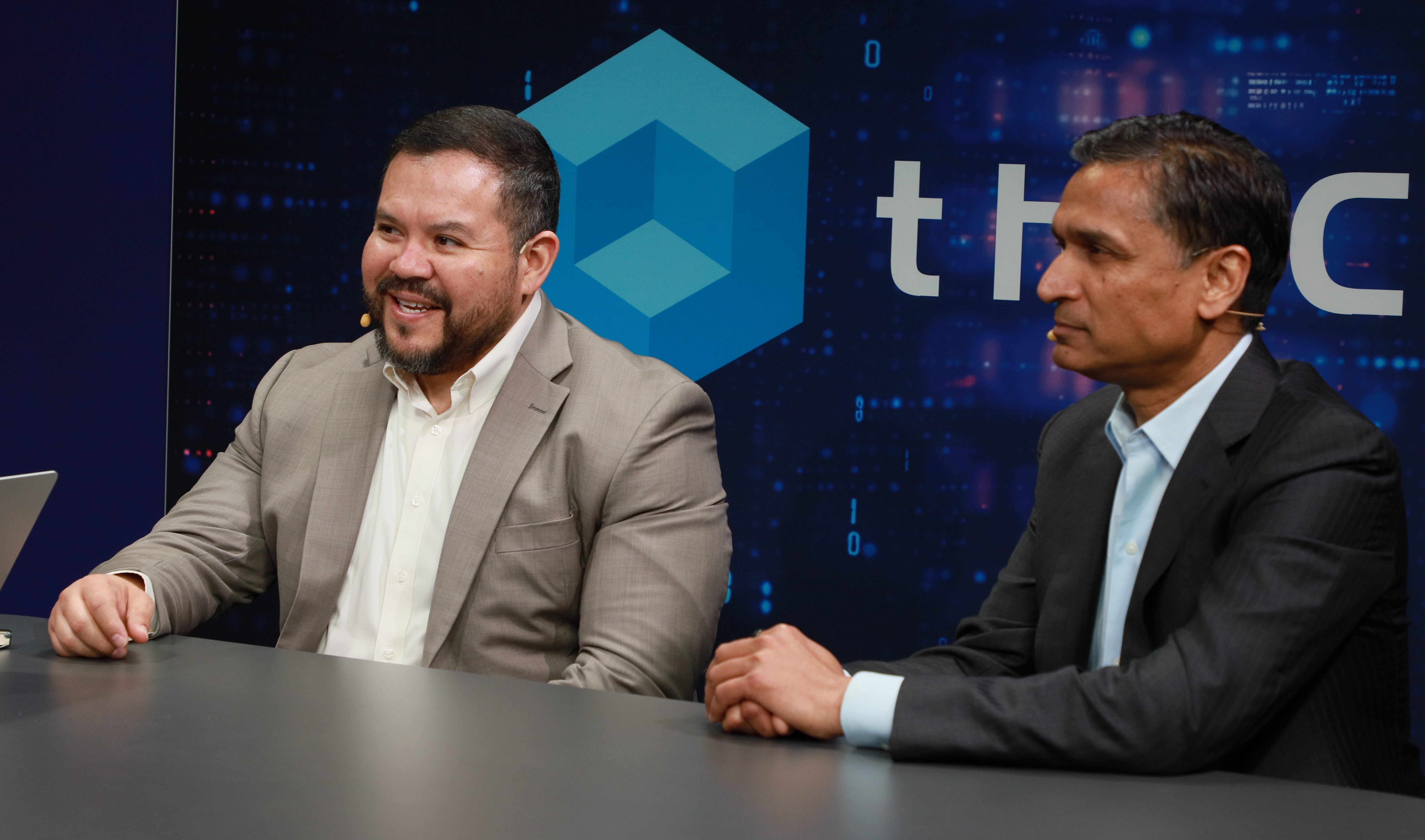
But in the internet of things value chain, costs are measured in cents, with sensors priced around 10 cents and narrowband connectivity even less, according to Shahid Ahmed (pictured, right), global head of edge services at NTT Data Inc., a global information technology services provider. Introducing a full-scale GPU into that environment would quickly undermine the economics, making traditional AI infrastructure impractical for most IoT deployments, he added. The solution for operators is to move closer to where data is generated, a strategy already taking shape in public-sector edge deployments.
“They’ve got all kinds of data [at the edge]. You want to still leverage AI, but you got to get the economics right,” Ahmed said. “So, what do you do? You’ve got to bring the processing [to] the edge, and that’s what we call edge AI.”
Ahmed and Jorge Cardenas (left), chief information officer of the city of Brownsville, Texas, spoke with theCUBE’s John Furrier and Dave Vellante at MWC Barcelona, during an exclusive broadcast on theCUBE, SiliconANGLE Media’s livestreaming studio. They discussed the economics of edge AI and how private, sovereign infrastructure can turn connected-city data into real-time public safety and operational outcomes. (* Disclosure below.)
As telecom providers evaluate edge AI as a way to reconcile performance demands with tight IoT economics, organizations are balancing the need for low latency with growing demands for data sovereignty. The city of Brownsville, Texas has gone from being one of the least-connected cities in the country to building its own in-city AI factory, according to Cardenas. The transformation illustrates how edge infrastructure is evolving from a theoretical telecom strategy into an operational model for public-sector innovation.
“Having all this data and all these sensors everywhere, but without AI at the edge, is pretty much a waste,” Cardenas said. “You just have data that you can’t do anything with. Now, we are really pushing to use AI on the public safety side.”
For Brownsville, converting idle data streams into actionable intelligence means using AI to predict incidents, optimize response times and prevent problems before they escalate — all aimed at improving quality of life and public safety. The technology has helped shift city operations from reactive responses to a more proactive model, Cardenas noted. For example, the approach has taken hold in law enforcement, where predictive insights are informing how officers respond in the field.
“We have sensors in the area that … will predict how and when something’s going to happen, and [the police] can react to it,” he explained. “That’s the level of how beneficial this technology is for us.”
The effort was rooted in a simple reality: Brownsville first had to get connected before it could layer on more advanced technology, according to Cardenas. In 2017, the city was widely recognized as one of the least-connected in the United States, with a majority of homes lacking reliable broadband. Just as important was the reality that cities often lack the funding to hire enough staff to support daily operations, making smarter infrastructure investments essential.
“Bringing fiber, bringing private 5G and then bringing AI to this … allows the city to work [at] a smaller scale when it comes to employees and do a lot more,” Cardenas explained.
The platform was designed to handle everything from workloads and monitoring to processing citywide data in one integrated system. That sets out a concrete goal for the city, according to Cardenas. But solving problems at city scale also underscores a larger industry reality: AI must be built to operate efficiently in constrained, distributed environments, according to Ahmed.
“Anybody can build big frontier AI models,” Ahmed noted. “You get enough capital, you can go build one. Now the challenge is, and I challenge the whole industry, to build smaller models that can run on your computer, on your phone [or] on a little device that connects to sensors on your factory floor. Try doing that. That’s where AI comes with scale.”
Here’s the complete video interview, part of SiliconANGLE’s and theCUBE’s coverage of MWC Barcelona:
(* Disclosure: TheCUBE is a paid media partner for MWC Barcelona. Sponsors of theCUBE’s event coverage do not have editorial control over content on theCUBE or SiliconANGLE.)
Support our mission to keep content open and free by engaging with theCUBE community. Join theCUBE’s Alumni Trust Network, where technology leaders connect, share intelligence and create opportunities.
Founded by tech visionaries John Furrier and Dave Vellante, SiliconANGLE Media has built a dynamic ecosystem of industry-leading digital media brands that reach 15+ million elite tech professionals. Our new proprietary theCUBE AI Video Cloud is breaking ground in audience interaction, leveraging theCUBEai.com neural network to help technology companies make data-driven decisions and stay at the forefront of industry conversations.