 AI
AI
AI
AI





AI

Amazon Web Services Inc. is moving agentic artificial intelligence up the software stack with the launch today of an expanded Amazon Connect portfolio, which has evolved into four distinct offerings that aim to automate complex, industry-specific workflows.
The expansion effectively rebrands the original Amazon Connect cloud contact center service into Amazon Connect Customer AI, while also introducing three entirely new services: Amazon Connect Decisions, Amazon Connect Talent and Amazon Connect Health.
Amazon Connect is one of AWS’ oldest cloud applications, launching back in 2017. It was born out of the internal technology stack created by its parent company Amazon.com Inc. to power its own customer services operations. At the time, it was a challenge to the legacy contact center industry, giving enterprises the choice to adopt a pay-as-you-go, self-service model that could scale to thousands of customer service agents.
The platform was originally little more than a telephony and routing engine designed to manage hundreds of thousands of calls per day and distribute them across available agents. But over the years, it has transformed into a much more sophisticated customer engagement platform that integrates natural language processing and sentiment analysis technologies to automate call center operations and derive more insights from customers.
The newly expanded Amazon Connect was built around a philosophy called “humorphism,” which in AWS’ case refers to autonomous AI agents that behave more like human workers do – learning context, prioritizing tasks and proactively asking for whatever information they need to get jobs done. “We want computers to adapt to people, not the other way around,” Hector Ouilhet Olmos, vice president of design for AWS Solutions, said in an interview.
Amazon Connect Customer is the new identity for the original Connect platform. It introduces enhanced configuration tools that enable businesses to deploy AI-native identity verification and payment processing workflows in weeks, even if they lack real expertise in the underlying technology.
Perhaps the most ambitious of the new offerings is Amazon Connect Decisions, which is built on Amazon’s own operational science and supply chain optimization technologies. It’s designed to help enterprises move away from spreadsheet-based logistics and adopt an “agentic approach.”

So instead of an AI system just flagging an issue with a supplier, it will report exactly what the problem is, triage exceptions and then recommend resolution options, together with the projected costs and a confidence score for each of the suggestions it comes up with. It’s powered by a combination of localized ensemble forecast models, including Amazon’s Chronos2 AI model, which specializes in time-series forecasting to handle both steady demand and “bursty” product launches, AWS said.
Meanwhile, Amazon Connect Talent builds on Amazon’s experience in hiring around 250,000 seasonal workers during periods of peak demand in order to automate volume-hiring processes for enterprises. It uses AI agents to analyze job descriptions and create appropriate interview plans before automating the entire interview with an AI-powered interviewer. Human recruiters will then be able to see each candidate’s results and a competency score, so they can accelerate their hiring decisions.
Finally, Amazon Connect Health is a new service launched earlier this year that aims to tackle administrative problems in the healthcare industry. It offers access to specialized AI agents for patient verification, appointment management and also documentation, which generate clinical notes in real time based on doctor-patient conversations.

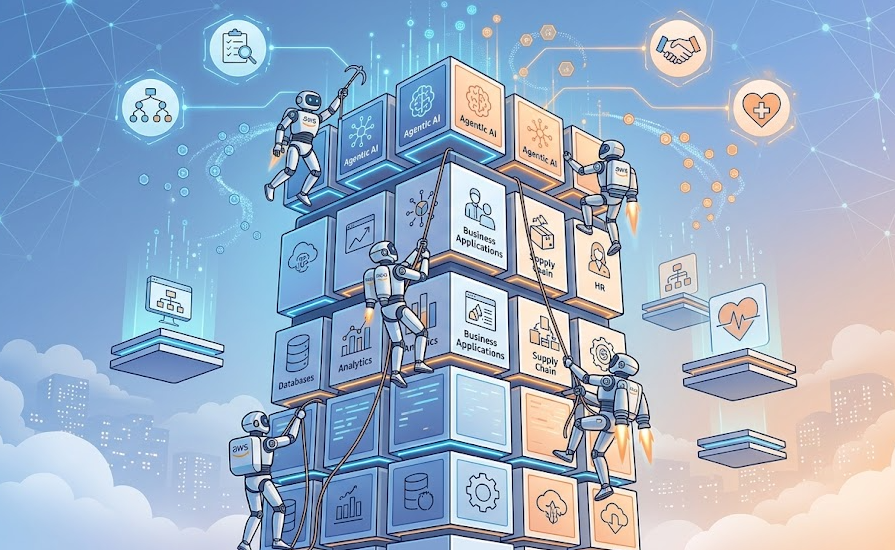
The expansion of Amazon Connect suggests that AWS is finally doing what many analysts have predicted it will do for years – move up the software stack and into the application layer. For years, AWS has always focused on providing the underlying infrastructure, such as the storage, compute power and databases that power software applications, but it’s now beginning to build the apps too.
Colleen Aubrey, AWS’ senior vice president of applied AI solutions, hinted at this in an interview with SiliconANGLE, saying that enterprises are looking for “industry-specific agentic systems” rather than generic chatbots. “We’ve been in the jack-of-all-trades AI era for a little while,” Aubrey said. “But it’s not [like] having an expert that you can work with that brings deep understanding of an area… and that gets better every day.”
Dave Vellante and George Gilbert of theCUBE Research have termed this approach as “worker-bee AGI,” which contrasts directly with the “messiah AGI” that’s championed by companies like Anthropic PBC and OpenAI Group PBC. “The differentiation will not come from shiny agent UIs or narrow features,” they wrote in December following AWS’ re:Invent 2025 event. “It will come from the depth of integration with data systems, workflow systems and the governance and control planes that bind agents to enterprise policy and process.”
Though today’s announcement might be small baby steps, it underscores the powerful advantage that AWS and its cloud infrastructure rivals have in the race to develop the next generation of enterprise AI systems.
Enterprises will certainly be interested in what looks to be a bold new approach to how they should put AI to use, based on a paradigm that forged itself in the call center where systems supervise and enable users to be more efficient, said Holger Mueller of Constellation Research. He said the new Connect works similarly to call center AI in the way it knows, for example, if an agent is busy or not, or if something is going to plan.
“The supply chain use case is no surprise, because Amazon has plenty of in-house expertise in automation in this area, but the talent acquisition scenario is a much bolder move, building on the company’s experience in hiring,” the analyst said. “It’s enabling agents to conduct interviews at a convenient time for prospects, and if that works as flawlessly as Amazon hopes, it can transform talent acquisition entirely. I’d imagine it’s Connect Talent that scares incumbent software vendors the most, but it’s clear that Amazon and AWS are working up the stack in all areas.”
With reporting from Robert Hof
Support our mission to keep content open and free by engaging with theCUBE community. Join theCUBE’s Alumni Trust Network, where technology leaders connect, share intelligence and create opportunities.
Founded by tech visionaries John Furrier and Dave Vellante, SiliconANGLE Media has built a dynamic ecosystem of industry-leading digital media brands that reach 15+ million elite tech professionals. Our new proprietary theCUBE AI Video Cloud is breaking ground in audience interaction, leveraging theCUBEai.com neural network to help technology companies make data-driven decisions and stay at the forefront of industry conversations.