


 AI
AI
AI
AI

AI

As AI adoption accelerates, organizations are shifting their focus from experimentation to large-scale deployment. The challenge now is building secure and scalable systems that can support AI agents, modern developer workflows and the growing demands of enterprise AI architecture.
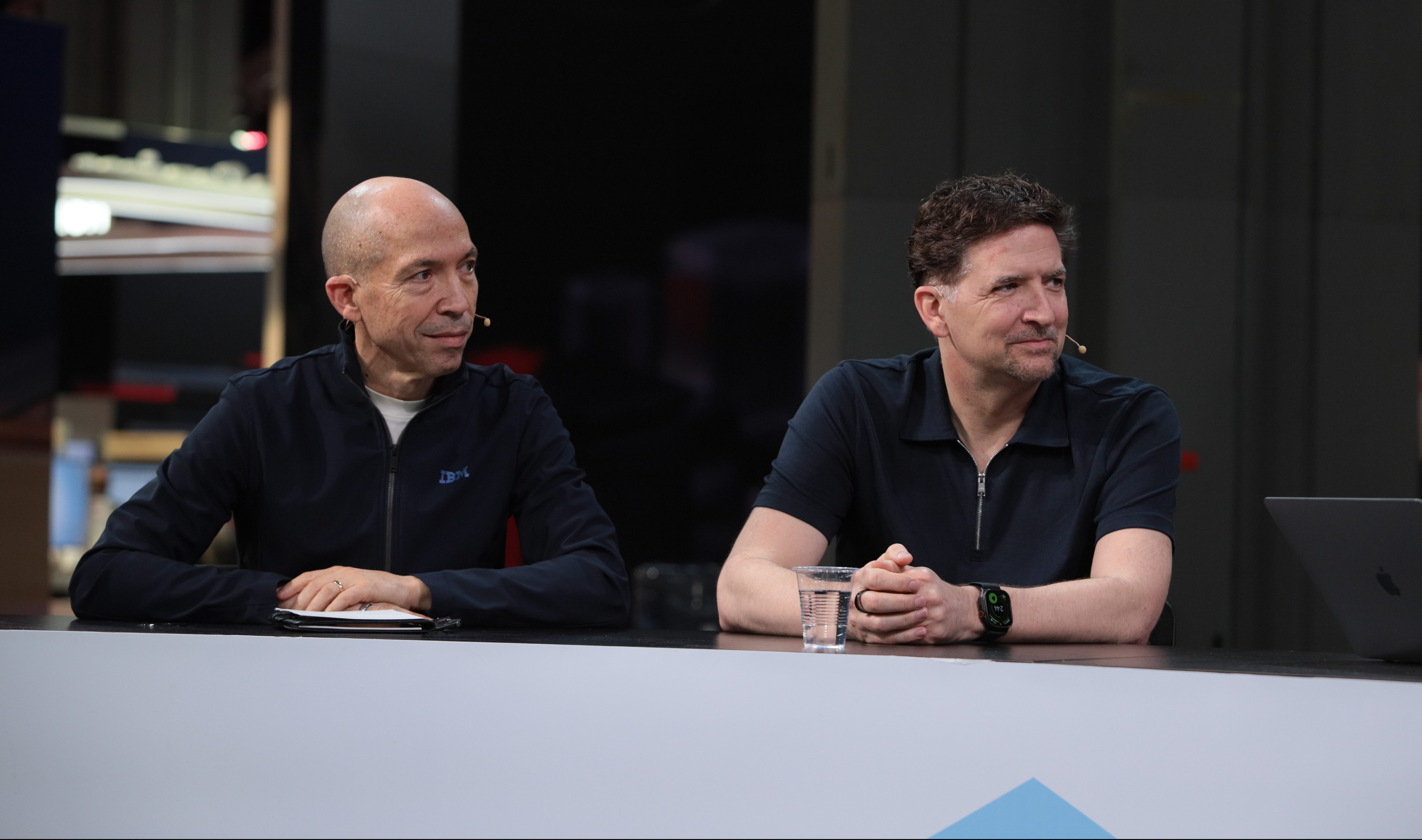
Yet not all of these considerations are created equal, with the urgency behind each one depending entirely on who is bearing the cost of getting it wrong. The challenges AI clearly differ across the enterprise, ranging from developers choosing the right tools, chief information officers focusing on security and DevOps teams figuring out how AI agents will integrate with existing applications, according to Ignacio Riesgo (pictured, left), senior director for developer advocacy, IBM and Red Hat application development, at IBM Corp. The one shared thread running through all of these conversations is the rapid evolution reshaping enterprise priorities.
“If you think about one year ago, we were talking about modernization as one of the critical areas. This year we are completely changing the pace,” Riesgo said. “We are talking about agents, we are talking about LLMs. The conversation has evolved and now the level of complexity is in another level.”
Riesgo and Jason McGee (right), IBM fellow, chief technology officer for IBM Cloud and general manager for cloud platform and common services at IBM, spoke with theCUBE’s Rebecca Knight and Rob Strechay at the Red Hat Summit 2026 event, during an exclusive broadcast on theCUBE, SiliconANGLE Media’s livestreaming studio. They discussed the shift from AI experimentation to enterprise AI deployment and the growing importance of enterprise AI architecture and agentic AI in modern software development. (* Disclosure below.)
Infrastructure has reemerged as a critical factor in successful AI deployment, driven not only by demand for GPUs and accelerators, but also by growing pressure on traditional compute systems. As AI adoption expands, organizations are being forced to rethink how their entire infrastructure stack supports modern workloads, according to McGee.
“I think many people have talked about how even the ratios between GPUs and CPUs are shifting very quickly from maybe eight GPUs for one CPU to one-for-one, and that’s being driven by agents making lots of API calls and tool calls and driving backend systems,” McGee said. “AI is kind of enabling those agents to do the work and all of that is pushing on infrastructure.”
For IBM, that infrastructure imperative spans the full stack — from cloud to on-premise mainframes and power systems — with the goal of making enterprise AI deployments as secure and resilient as they are scalable. The announcement of a fully managed OpenShift Virtualization service on IBM Cloud is a direct response to that need, bridging traditional IT environments with the container-based platforms where agents are increasingly being built and run. That convergence is what separates a compelling proof of concept from a transformation that sticks, McGee noted.
“That’s the difference between a fun pilot and an impactful change to an organization,” McGee said. “Can you deploy [an AI workload] for real with my whole team in a real environment?”
Here’s the complete video interview, part of SiliconANGLE’s and theCUBE’s coverage of the the Red Hat Summit 2026 event:
(* Disclosure: IBM sponsored this segment of theCUBE. Neither IBM nor other sponsors have editorial control over content on theCUBE or SiliconANGLE.)
Support our mission to keep content open and free by engaging with theCUBE community. Join theCUBE’s Alumni Trust Network, where technology leaders connect, share intelligence and create opportunities.
Founded by tech visionaries John Furrier and Dave Vellante, SiliconANGLE Media has built a dynamic ecosystem of industry-leading digital media brands that reach 15+ million elite tech professionals. Our new proprietary theCUBE AI Video Cloud is breaking ground in audience interaction, leveraging theCUBEai.com neural network to help technology companies make data-driven decisions and stay at the forefront of industry conversations.