 INFRA
INFRA
INFRA
INFRA








INFRA

As enterprise AI budgets hit their limits earlier each year, the pressure to fund new agentic and inference workloads without expanding total spend is forcing a fundamental rethink of infrastructure and data center modernization.
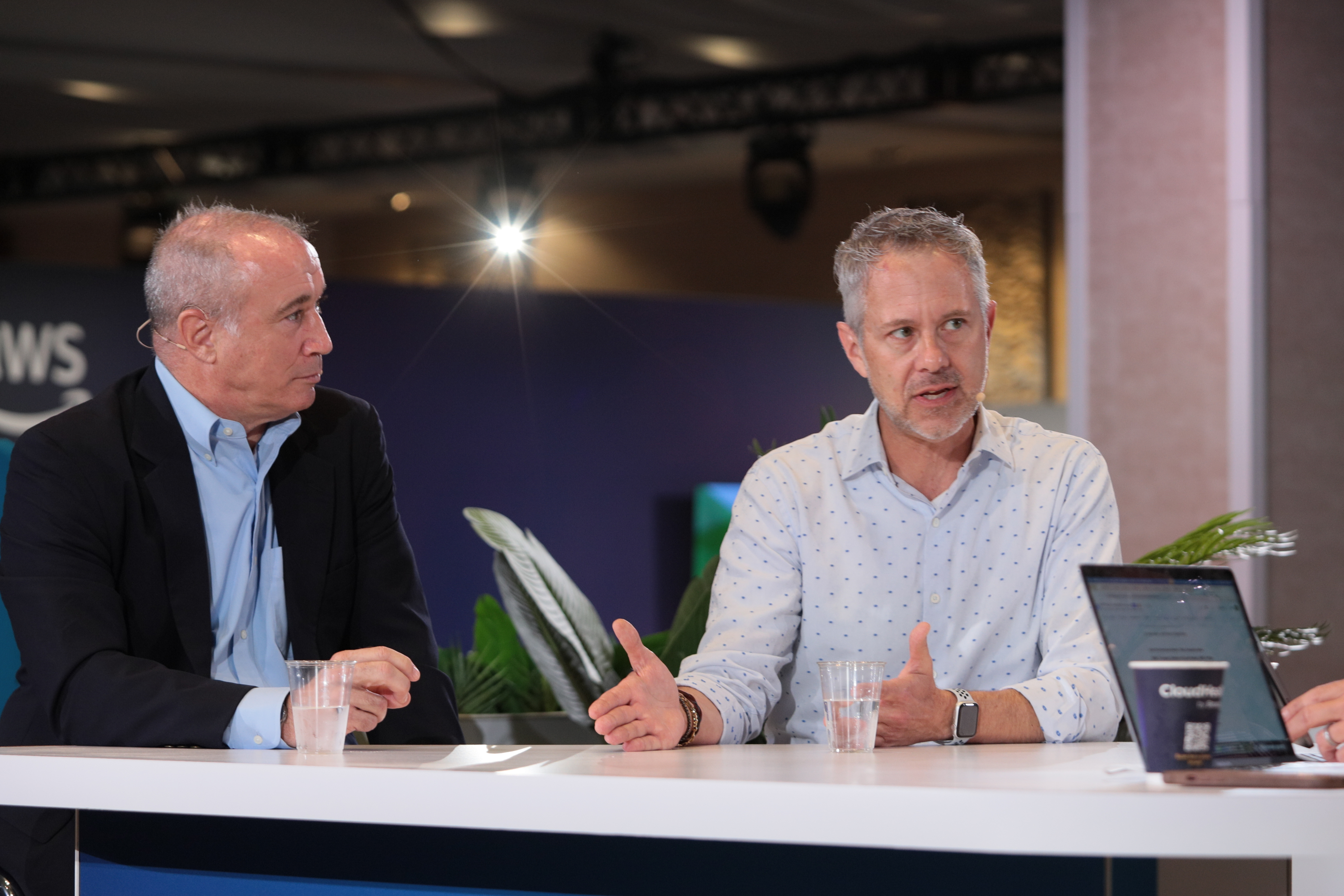
The State of FinOps 2026 Report found that 98% of practitioners now manage AI spend, even as most organizations still overspend on AI workloads by four to five times their original budget. The core tension — more AI demand, constrained budgets and aging hardware — is exactly the problem Advanced Micro Devices Inc. says it is built to solve, according to Mike Thompson (pictured, right), director of cloud product at AMD and FinOps Foundation Project, a Series of LF Projects LLC, governing board member.
“The era of token maxing is kind of over because the spends are going through the roof,” he said. “There’s a period of rationalization that I think the industry is going through now, particularly on AI applications and agentic [workloads], because those … are really practical. … Budgets tend to get spent one to two quarters into the year. There’s so much dynamic development in the AI space that two to three quarters in, budgets are already tapped out.”
Thompson and Jim Greene (left), director of server product marketing at AMD, spoke with theCUBE’s John Furrier and Paul Nashawaty at FinOps X 2026, during an exclusive broadcast on theCUBE, SiliconANGLE Media’s livestreaming studio. They discussed how data center modernization, EPYC processor consolidation and x86 hybrid cloud architecture can unlock the budget headroom enterprises need to fund next-generation AI. (* Disclosure below.)
Enterprise infrastructure waste is the hidden lever in the AI budget equation. Much of the enterprise server base is six or seven years old — hardware that has been extended well past its useful life and can’t support modern AI workloads, making data center modernization essential, Greene noted. Replacing eight legacy servers with a single AMD EPYC-based system can dramatically reduce power draw, rack footprint and software licensing costs, creating room for new AI investment, he explained.
“We can have customers coming in saying: ‘I can replace eight of those old Ice Lake servers or some old prior-generation Intel, and I can replace it with one EPYC server — that’s going to save the power, that’s going to save the space,'” Greene said. “Over time, because it’s so much more energy efficient and so much more license efficient, you save the money, as well.”
Low server utilization compounds the problem. A large share of the market runs central processing units at roughly 10% utilization — leaving 90% of compute power idle and burning power while doing nothing, Thompson noted. As part of its contribution to the FinOps Foundation, AMD is promoting a “shift-left” philosophy in which architecture choices — including processor selection — are treated as financial decisions. The gap between a well-chosen x86 instance and a poorly matched alternative can significantly impact annual operating expenses, Thompson noted.
“There’s a 30 to 40% annual OPEX difference between a couple of compute platforms that look the same,” he said. “A lot of folks don’t consider that nowadays, and particularly when you’re landing the applications, making those wise choices upfront is better. Otherwise, a year or two years later, the FinOps team is going to find this … egregious waste and then force you through a more painful change rather than making a smart choice upfront.”
The x86 architecture also shapes the hybrid cloud equation. Arm-based cloud instances can look competitive on paper, but the hidden costs of porting applications, maintaining dual code bases and managing two to three environments in parallel offset any apparent savings, according to Greene. AMD EPYC’s x86 compatibility means workloads can move between on-premises servers and cloud instances — including bursting at peak demand — with no recompilation and minimal operational overhead.
“If you’re on x86 on-prem, you have a single pane of glass to manage it all,” Greene said. “Spilling over into cloud or bursting into cloud is the push of a button. If you try to do that between Arm and x86, you’ve got to recompile everything, have a whole different environment. Hybrid environments beg for a single architecture.”
Stay tuned for the complete video interview, part of SiliconANGLE’s and theCUBE’s coverage of FinOps X 2026:
(* Disclosure: TheCUBE is a paid media partner for the FinOps X event. Neither the FinOps Foundation, the sponsor of theCUBE’s event coverage, nor other sponsors have editorial control over content on theCUBE or SiliconANGLE.)
Support our mission to keep content open and free by engaging with theCUBE community. Join theCUBE’s Alumni Trust Network, where technology leaders connect, share intelligence and create opportunities.
Founded by tech visionaries John Furrier and Dave Vellante, SiliconANGLE Media has built a dynamic ecosystem of industry-leading digital media brands that reach 15+ million elite tech professionals. Our new proprietary theCUBE AI Video Cloud is breaking ground in audience interaction, leveraging theCUBEai.com neural network to help technology companies make data-driven decisions and stay at the forefront of industry conversations.