For the past two years, the generative artificial intelligence boom has largely been defined by a single market. Hyperscalers have dominated the market with massive capital spending.
According to CreditSights, the five largest U.S. hyperscalers — Amazon Web Services Inc., Microsoft Corp., Google LLC, Meta Platforms Inc. and Oracle Corp. — are on pace to spend roughly $700 billion to $800 billion in capital expenditures this year, with about three-quarters of that spending tied directly to AI infrastructure. An Allianz report also found that hyperscalers and large tech service providers now absorb about two-thirds of all AI spending. The tech giants have spent billions building custom liquid-cooled mega-clusters to train frontier models, leaving everyone else scrambling for access to raw compute.
Though hyperscalers were early drivers of the AI hardware gold rush, the market is shifting. The next phase of AI infrastructure growth is moving beyond the public cloud giants toward “distributed AI builders” — a market that includes sovereign clouds, neoclouds, AI service providers and, increasingly, mainstream enterprise data centers.
However, enterprises and neocloud providers face severe headwinds when building modern AI infrastructure. Massive-scale workloads, such as multi-agent frameworks and trillion-parameter models, require high-density, liquid-cooled environments. At the same time, enterprises face data sovereignty challenges because they cannot simply upload their core intellectual property to public frontier models without risking their competitive advantage. Finally, a persistent shortage of specialized network engineering talent makes deploying bespoke, complex graphics processing unit clusters a high-risk venture.
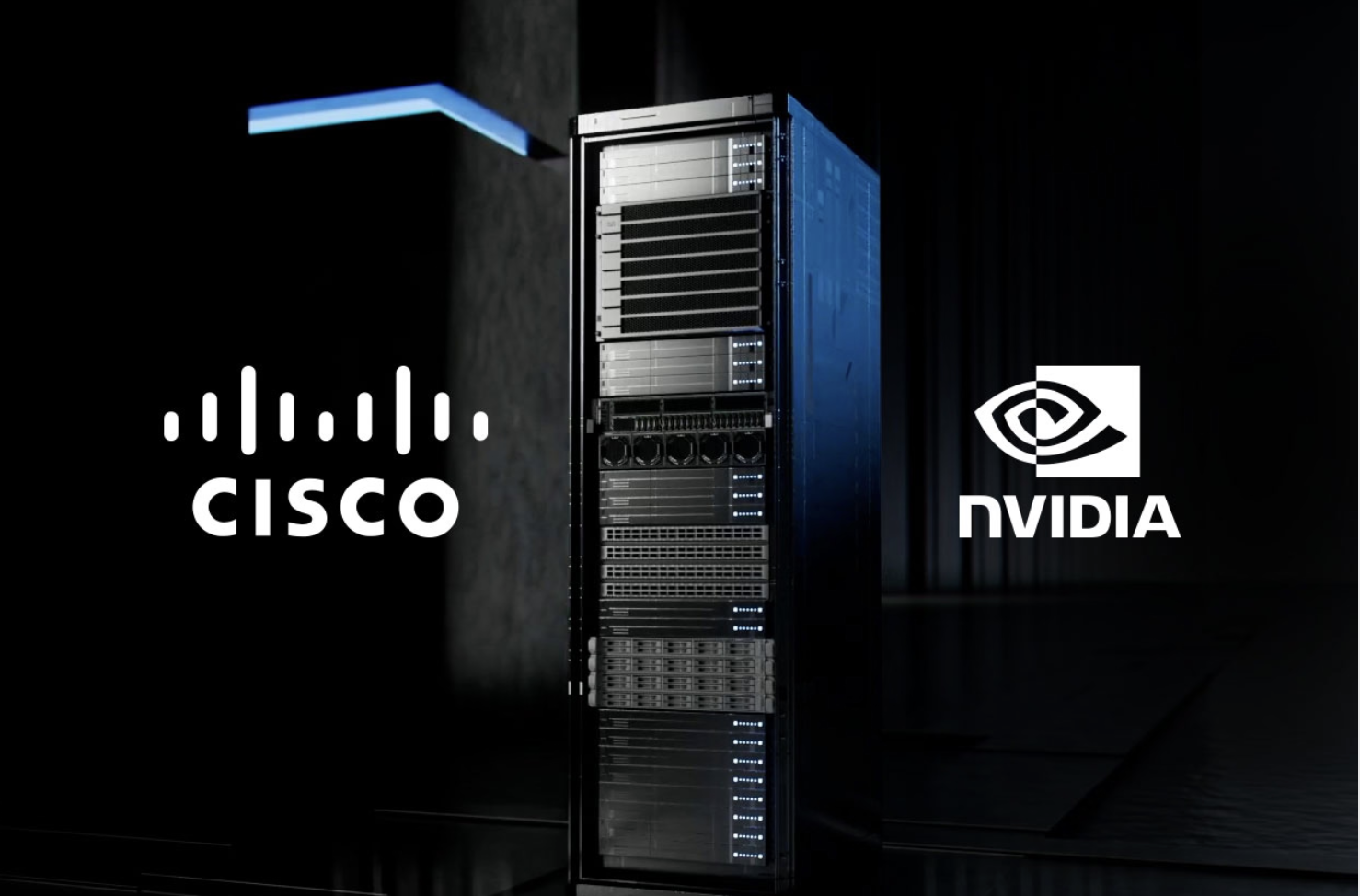
Today, Cisco Systems Inc. announced an expansion of its Cisco Secure AI Factory with Nvidia Corp., directly addressing these friction points. By expanding its partnership with Nvidia to introduce Nvidia-certified rack-scale architectures, Cisco is bridging the gap between hyperscale-grade AI capabilities and enterprise-ready operational simplicity.
Cisco extends the AI factory to rack-scale
Cisco’s announcement expands its core AI strategy in three critical areas:
- Integrated rack-scale infrastructure: To address high-density AI workloads, Cisco is introducing pre-integrated, liquid-cooled rack architectures. To round out its compute portfolio alongside its existing UCS family, Cisco is partnering with Supermicro to deliver high-density, liquid-cooled systems, including support for architectures such as Nvidia’s NVL72. This enables Cisco to offer full-stack, turnkey AI data center pods backed by Cisco’s global supply chain, support and service level agreements.
- End-to-end NCPRA compliance: Cisco announced support for the Nvidia Certified Partner Reference Architecture across front-end and back-end networking fabrics. Operating on its Silicon One and Nexus Spectrum-X switching platforms, Cisco stands out as a primary technology partner capable of delivering unified, NCPRA-compliant fabrics using both its own silicon and Nvidia’s back-end networking components.
- Cisco Validated Infrastructure Services: To address deployment challenges and the global skills gap, Cisco introduced CVIS, an automated toolkit and service framework that accelerates deployment from “months to weeks.” Backed by a new 1,000-GPU internal engineering cluster, Cisco pre-validates full-stack performance before customer hardware even reaches the data center floor.
- Unified operations: The entire infrastructure — from compute sleds to switches and security appliances — is managed via the Cisco Cloud Control platform, which integrates telemetry, observability and day-two operations into a familiar interface for network administrators.
Moving beyond hyperscalers: Bringing AI data centers to the enterprise
For enterprise information technology leaders, this news signals a shift in where and how enterprise AI workloads will run. Hyperscalers build infrastructure for scale-out public tenancy, with hardware disaggregated and managed by proprietary software control planes. Enterprise IT operates under entirely different constraints:
- Extending the enterprise operational model: Most IT organizations lack the specialized engineering teams needed to assemble custom liquid-cooling units, disaggregated fabrics and open-source orchestration engines. By integrating NCPRA-compliant rack-scale architectures into the Cisco ecosystem, IT teams can build standard, repeatable “AI Pods” using the same operational workflows, security policies and Nexus/NX-OS tools they have relied on for decades.
- Protecting data sovereignty and alpha: As agentic AI and localized fine-tuning replace simple, broad queries, enterprises want to bring models to their data, not the other way around. Turnkey, enterprise-class liquid-cooled racks allow IT to run dense, high-performance training and inference in-house or in colocation facilities under their own governance.
- Unified fabric and security: Rather than treating AI clusters as isolated “shadow IT” islands with separate networks, Cisco’s approach integrates backend GPU fabrics directly into enterprise security and observability frameworks. Security is fused into the network stack rather than bolted on after deployment.
Furthermore, as neoclouds and sovereign clouds expand regional AI hosting services on Cisco infrastructure, enterprise IT gains an operational “flywheel.” An enterprise can seamlessly burst workloads from its on-premises Cisco AI Factory to a Cisco-powered sovereign cloud, using identical networking policies, operational standards and security controls on both sides.
Strategic advice for enterprise IT pros
As AI infrastructure shifts from hyperscale science experiments to standard enterprise IT rollouts, tech leaders should consider the following guidance:
- Avoid “DIY” GPU clusters: As GPU densities rise and liquid cooling becomes mandatory, custom-building AI infrastructure by integrating disparate compute, storage and networking layers is high risk. Prioritize pre-validated, reference-architected stacks (such as NCPRA-compliant systems) to drastically reduce time-to-first-token and lower long-term mean time to resolution.
- Leverage existing network and operations skill sets: Do not create isolated, hyper-specialized silos within your IT organization solely to support AI. Focus on architectures that enable your existing network, operations and security teams to manage AI fabrics using familiar control planes (for example, Cisco Cloud Control and Nexus OS). Upskilling your current staff in AI-ready networking is far more sustainable than trying to hire scarce niche specialists.
- Plan for hybrid model mobility: Design your data center architecture with hybrid elasticity in mind. Ensure that whatever stack you deploy on-premises shares management and network lineage with regional neocloud or sovereign cloud providers. This ensures you can burst training or inference workloads externally without rearchitecting your security or networking posture.
- Demand full-stack support and SLAs: Hardware components in high-density AI clusters will fail — whether it is a liquid-cooling loop, a transceiver,or a GPU node. Avoid multivendor finger-pointing by selecting full-stack solutions backed by single-source, enterprise-grade day-two support and global service capabilities.
- Buy the support model, not the spec sheet. Rack-scale AI deployments fail on integration, not benchmarks. Ask explicitly who owns the escalation when a GPU tray, a cooling loop and a fabric link are simultaneously suspect. If the answer involves more than one throat to choke, keep pushing.
Final thoughts
The era when AI computing was limited to hyperscalers is coming to an end. Through partnerships such as those between Cisco and Nvidia, standardized, liquid-cooled, rack-scale architectures are now reaching mainstream channels, giving enterprise IT a blueprint for running high-density AI infrastructure with confidence, security and operational simplicity.
Zeus Kerravala is a principal analyst at ZK Research, a division of Kerravala Consulting. He wrote this article for SiliconANGLE.
Image: Cisco
A message from John Furrier, co-founder of SiliconANGLE:
Support our mission to keep content open and free by engaging with theCUBE community. Join theCUBE’s Alumni Trust Network, where technology leaders connect, share intelligence and create opportunities.
- 15M+ viewers of theCUBE videos, powering conversations across AI, cloud, cybersecurity and more
- 11.4k+ theCUBE alumni — Connect with more than 11,400 tech and business leaders shaping the future through a unique trusted-based network
SiliconANGLE Media is a recognized leader in digital media innovation, uniting breakthrough technology, strategic insights and real-time audience engagement. As the parent company of
SiliconANGLE,
theCUBE Network,
theCUBE Research,
CUBE365,
theCUBE AI and theCUBE SuperStudios — with flagship locations in Silicon Valley and the New York Stock Exchange — SiliconANGLE Media operates at the intersection of media, technology and AI.
Founded by tech visionaries John Furrier and Dave Vellante, SiliconANGLE Media has built a dynamic ecosystem of industry-leading digital media brands that reach 15+ million elite tech professionals. Our new proprietary theCUBE AI Video Cloud is breaking ground in audience interaction, leveraging theCUBEai.com neural network to help technology companies make data-driven decisions and stay at the forefront of industry conversations.
 INFRA
INFRA