 EMERGING TECH


EMERGING TECH

Dream Labs, a startup trying to make robots more intelligent and capable of performing many different tasks, has raised $90 million in seed funding to coincide with the launch of a public application programming interface that provides access to its universal robot foundation model.
Today’s round was jointly led by B Capital and Kindred Ventures and saw the participation of others including A.Capital, Unusual Ventures, Wing VC, SV Angel, Scribble VC and angel investor Adrian Aoun.
Dream Labs is taking aim at the lack of intelligence in today’s robots, which might be fairly numerous in many environments but are also fairly limited. The startup believes there are more than 5 million industrial robots working inside factories and warehouses globally. These robots surely do perform useful work, otherwise their owners wouldn’t have invested in them, but Dream Labs co-founder and Chief Executive Joel Jang believes they should be able to do so much more.
What’s stopping them is a lack of expertise and knowledge. Almost all of those 5 million robots are designed to perform a single task, which they do very well. But they cannot be trained to do any other task, nor can they pass on their acquired knowledge to train other robots and machines.
Though the costs of robotic hardware have fallen dramatically, with extremely dextrous robotic arms now selling for just a few thousand dollars, those products don’t ship with any intelligence. Rather, the onus is on the buyer to teach that robotic arm how to do a specific job, and that’s a process that can take many months, because it involves lots of tedious and highly specialized programming work. Worse, whenever new robotic hardware is introduced, that entire process has to be redone from scratch.
Today, Dream Labs is coming out of stealth with Dream-1, a robot foundation model that controls bimanual robots it has never seen, on tasks it was never shown, in places it has never been, from $3/hour.
Dream API is live for everyone, today. 🧵 pic.twitter.com/MB1snhUOAJ
— Dream Labs (@dreamlabs_ai) October 19, 2026
Jang believes there should be an easier way to train robots to perform new tasks, and his solution is a highly versatile foundation model called Dream-1, which is designed to be a “universal brain” for robots. Dream-1 treats robotic skills as simple video prediction problems. It teaches robots using what Jang calls “human egocentric training data,” which is a fancy term for videos of people performing physical tasks such as stacking shelves and packing items in boxes.
By studying these videos, Dream-1 learns to predict what should logically happen next and based on that, it will then determine the physical action the robot needs to perform to ensure it actually happens. The big advantage of teaching robots this way is that video-based data is much easier to accumulate than specialized machine-specific datasets. It means Dream-1 can quickly amass the data it needs to teach robots new skills, transferring intelligence seamlessly across different types of robotic hardware.
Jang said Dream-1 has been designed to work with any two-armed robot that’s equipped with parallel grippers. The only thing required to get started is a video feed and natural language instructions – basically, someone to tell it what to do.
“The hardware is ready, but what’s been missing is a brain any robot can use,” Jang said. “When you get into a rental car, you don’t relearn how to drive. You find the controls and your past driving experience does the rest. Dream-1 approaches a new robot the same way, so it can do useful work in minutes, not months.”
The next step is making this intelligence universally accessible to developers, and that’s where today’s API launch comes in. Through the Dream API, developers can access Dream-1 and instantly start translating visual inputs and natural language prompts into robotic actions. Dream Labs is charging developers $3 per hour to access the most powerful version of Dream-1, with prices dropping to just 75 cents per hour for a lightweight version.
Dream-1 can also be used to teach robots entirely new skills that the model hasn’t come across before through the startup’s Fine-Tuning-as-a-Service offering. All developers have to do is submit video demonstrating a new task — the more video footage there is, the better — and Dream Labs will turn that into a highly customized version of Dream-1 within a few hours.
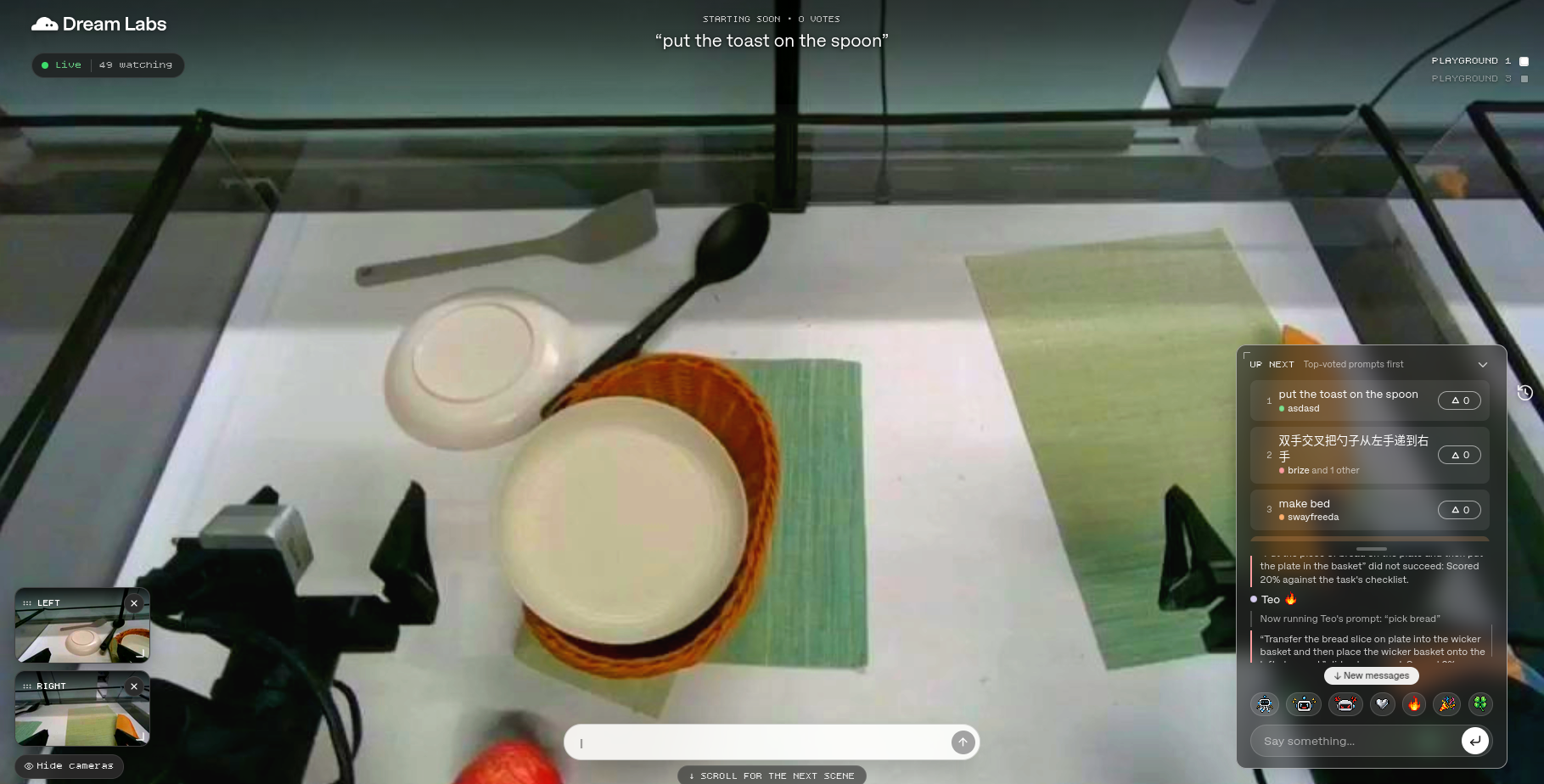
To showcase the capabilities of its model, the company has also launched the Robot Playground, which can be accessed by anyone through a web browser. Simply type a command and watch a live robot respond in real time.
Dream Labs is currently working with more than 20 robotic hardware companies whose machines cost anywhere between $2,000 and $10,000. While Dream-1 is designed to work with any robotic arm, the company works with these partners to optimize the model for their specific hardware. This work gives it a better ‘grasp’ of what each robot can do, enabling better performance.
Jang said Dream-1 is already highly capable at tasks such as picking up and placing objects and folding clothes, but he has much bigger ambitions in the long term. For instance, he plans to teach the model to support mobile robots that use wheels and also robots with fully dextrous or humanlike hands. The money from today’s round will help to pay for the necessary compute power to get this done, he said.
Daisy Cai of B Capital said robotic arms can now be bought for the same price as a high-end laptop. “What they need now is intelligence,” she continued. “This team did some of the defining work in robot learning at Nvidia, and now anyone with an API key can build on it.”
Support our mission to keep content open and free by engaging with theCUBE community. Join theCUBE’s Alumni Trust Network, where technology leaders connect, share intelligence and create opportunities.
Founded by tech visionaries John Furrier and Dave Vellante, SiliconANGLE Media has built a dynamic ecosystem of industry-leading digital media brands that reach 15+ million elite tech professionals. Our new proprietary theCUBE AI Video Cloud is breaking ground in audience interaction, leveraging theCUBEai.com neural network to help technology companies make data-driven decisions and stay at the forefront of industry conversations.