 AI
AI


AI

Despite all of the hype and the multiple millions of dollars invested in artificial intelligence, most of corporate America outside of its biggest technology firms is yet to see any financial payoff, according to an analysis by one of the world’s largest investment firms.
In the analysis published on Saturday, Apollo Global Management Inc. said that the “S&P 493,” which refers to the S&P 500 minus technology firms Alphabet Inc., Amazon.com Inc., Apple Inc., Meta Platforms Inc., Microsoft Corp., Nvidia Corp. and Tesla Inc., has not yet benefited from its investments in AI.
Apollo analyst Torsten Slok said that while the Magnificent Seven has seen real profits from AI, the profit margins and revenue per worker of other companies remains flat, with no evidence that the technology is enhancing productivity. “Mainstream corporate America is pulling back and starting to view token spending not as a source of growth but as a cost center that weighs on margins,” Slok wrote.
Slok drew his conclusions from a series of graphs that measured three key metrics: revenue per worker, profit margins and productivity growth. Though AI has sent these metrics sky-high for the seven tech giants, there’s no indication of that happening with anyone else, he said.
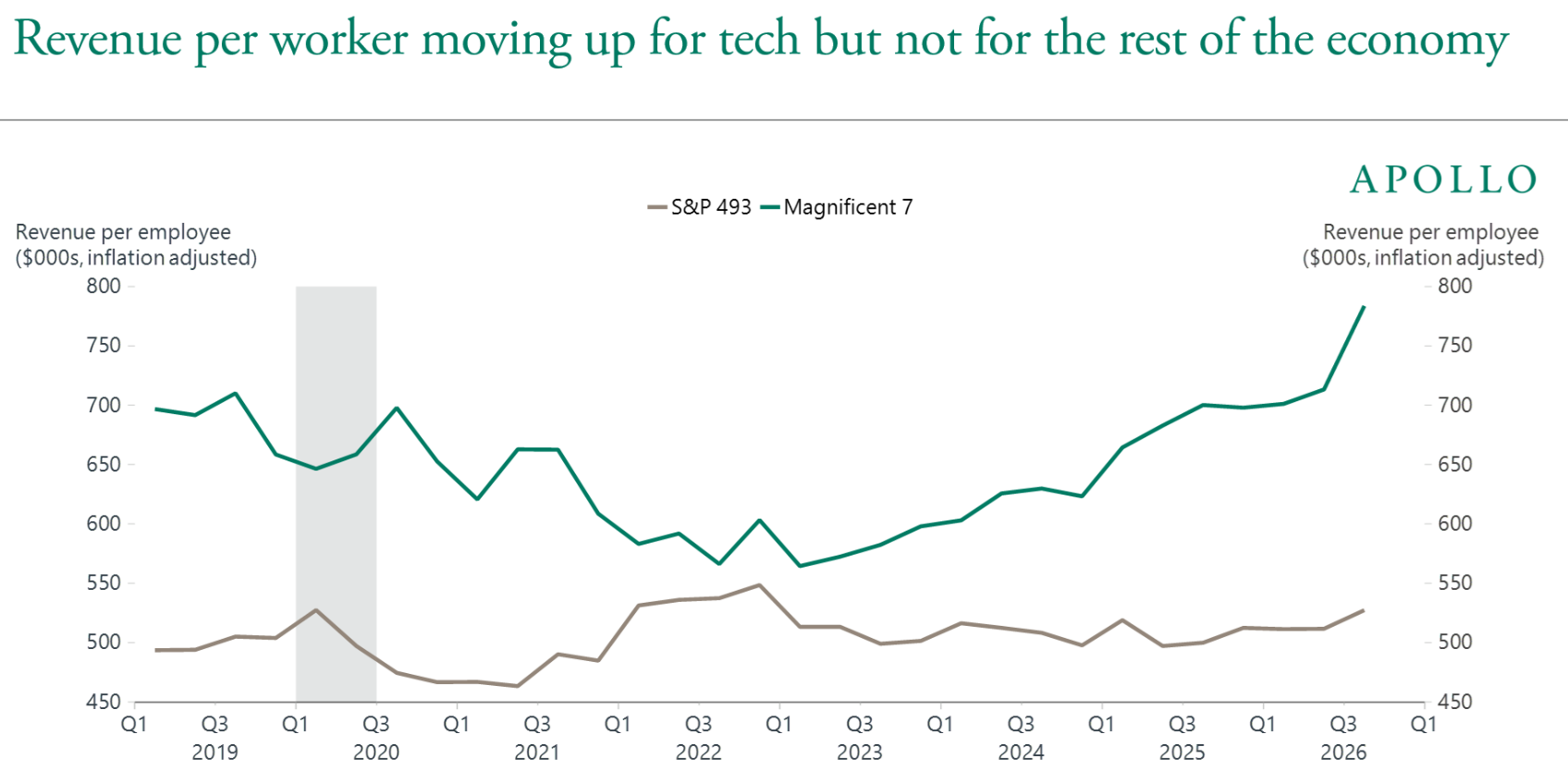
At the tech firms, revenue per employee has jumped from an average of $550,000 in 2022 to almost $800,000 this year, Apollo’s analysis shows. But that figure has remained flat within the S&P 493, lingering at about $550,000 since 2019:
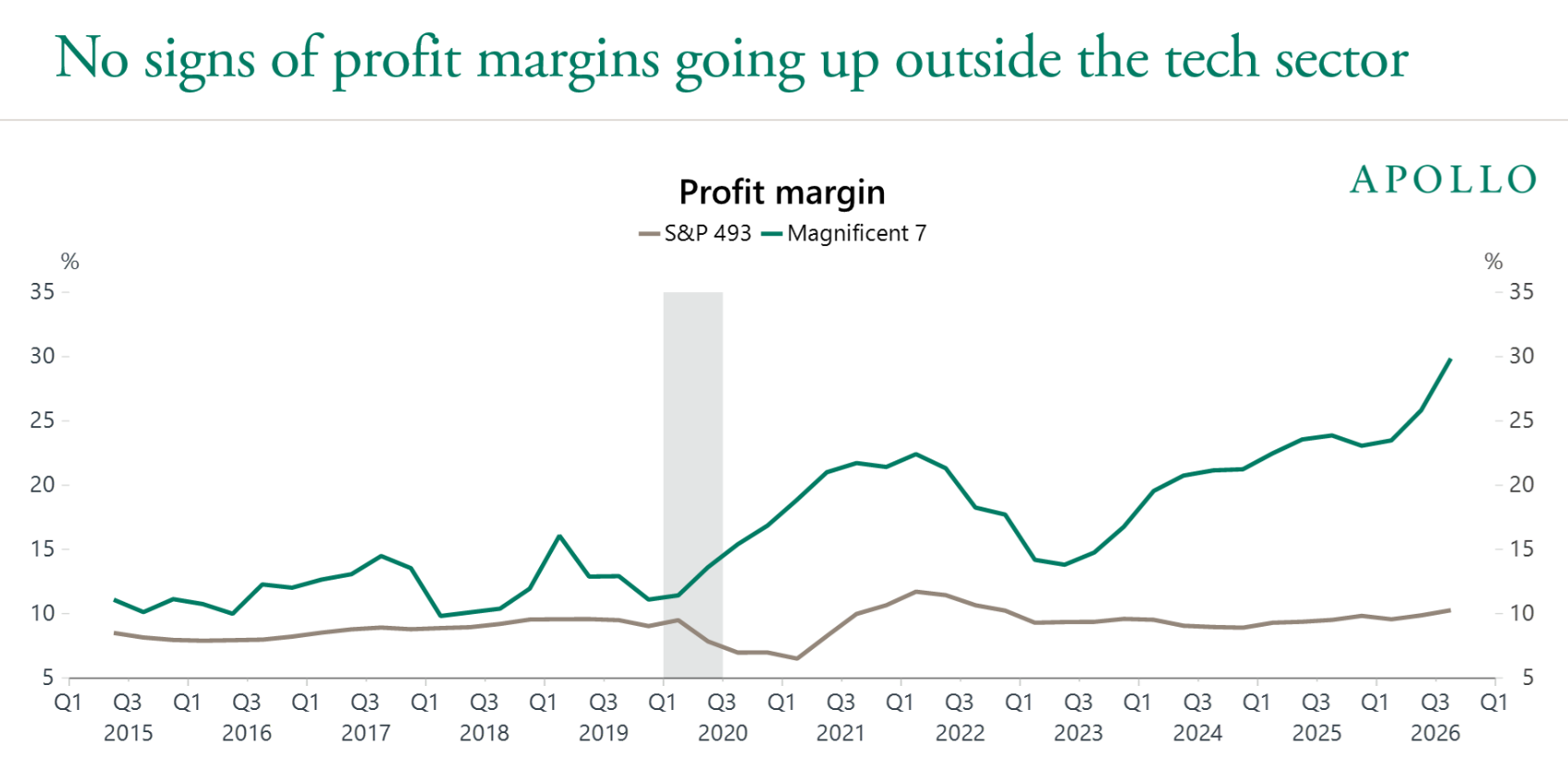
A look at profit margins reveals a similar story, with profit margins at the tech firms soaring since the third quarter of 2023, while remaining more or less flat for everyone else:
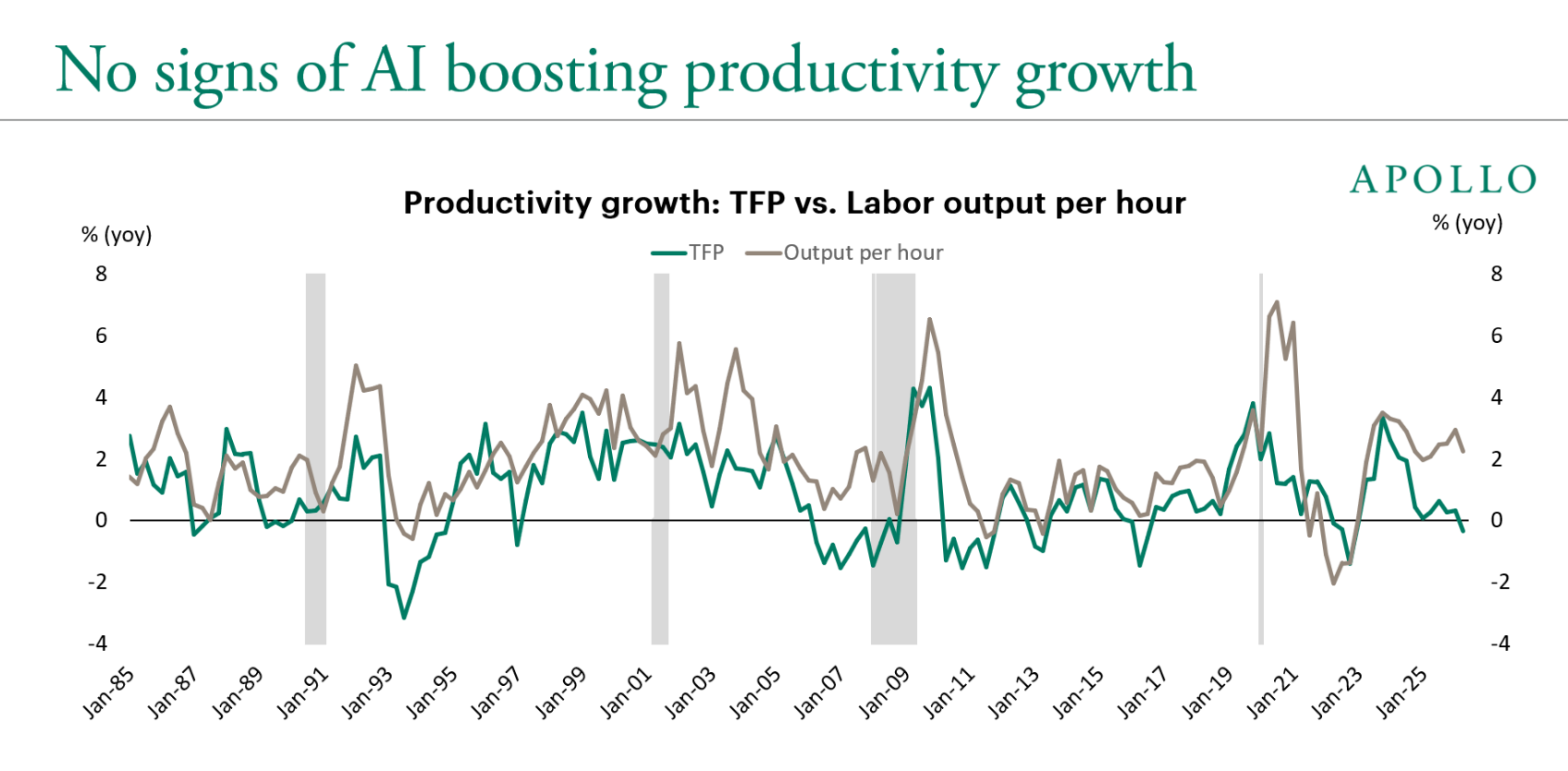
The chart tracking productivity growth is a little messier, but shows that AI has had little impact in terms of helping the average company to get more work done with the resources at its disposal, despite the predictions of many AI optimists:
The research calls into question the claims of those who have predicted that AI will lead the world into an “age of abundance,” where everyone is able to spend less time on working and more time pursuing their interests outside of it. While some venture capital-backed startups are going against the grain and increasing their spending on AI tokens, more established firms are shying away from this, Slok said.
“Mainstream corporate America does not need the latest model and is unwilling to pay for it,” he wrote. “As long as agentic AI and token spending are confined to a small part of the economy, the macroeconomic effects of AI will be very limited.”
Some may argue that it’s simply a matter of non-technology firms lagging behind their innovation-oriented counterparts, but Slok said it’s not simply a matter of throwing money at AI and reaping the rewards. “The question looking ahead is whether, even as models become commoditized, mainstream corporate America can turn increasingly cheap intelligence into higher revenue growth and higher profit margins,” he wrote. “That may be harder than it sounds.”
The problem AI, according to Slok, is that intelligence in the business world is mostly related to judgment. And though AI is great at calculating and researching and generating things, judgment requires much more context, and the answer will often vary depending on which human or model is asked the question. AI still has to overcome significant challenges before it can be trusted, Slok explained, including its inability to understand business culture, accountability, ethical trade-offs, fairness and trust, which all factor into reputational risk and drive revenue and profit growth.
“The bottom line is that the AI story will be decided in the S&P 493, not the Magnificent Seven, and so far there is no evidence that revenue growth or margins are improving outside of the tech sector,” Slok wrote.
Support our mission to keep content open and free by engaging with theCUBE community. Join theCUBE’s Alumni Trust Network, where technology leaders connect, share intelligence and create opportunities.
Founded by tech visionaries John Furrier and Dave Vellante, SiliconANGLE Media has built a dynamic ecosystem of industry-leading digital media brands that reach 15+ million elite tech professionals. Our new proprietary theCUBE AI Video Cloud is breaking ground in audience interaction, leveraging theCUBEai.com neural network to help technology companies make data-driven decisions and stay at the forefront of industry conversations.