 AI
AI



AI

The hubbub at the New York Stock Exchange was audible on theCUBE Pod last Friday, with concerns rising over the artificial intelligence bubble.
Several tech companies, including Intel Corp., Alphabet Inc., Amazon.com Inc., CoreWeave Inc. and Fortinet Inc., saw their stock fall, suggesting that investors may have doubts about all that AI infrastructure spending. At the same time, Anthropic PBC filed for an initial public offering with the U.S. Securities and Exchange Commission, which looks to be a grand debut for one of the biggest AI developers out there (despite the company still not turning a profit).
Also causing a stir is the announcement that NYSE parent company, Intercontinental Exchange (ICE), will partner with Trade[XYZ] to bring perpetual futures markets built on cryptocurrency trading platform, Hyperliquid, to the U.S., subject to regulatory approval.
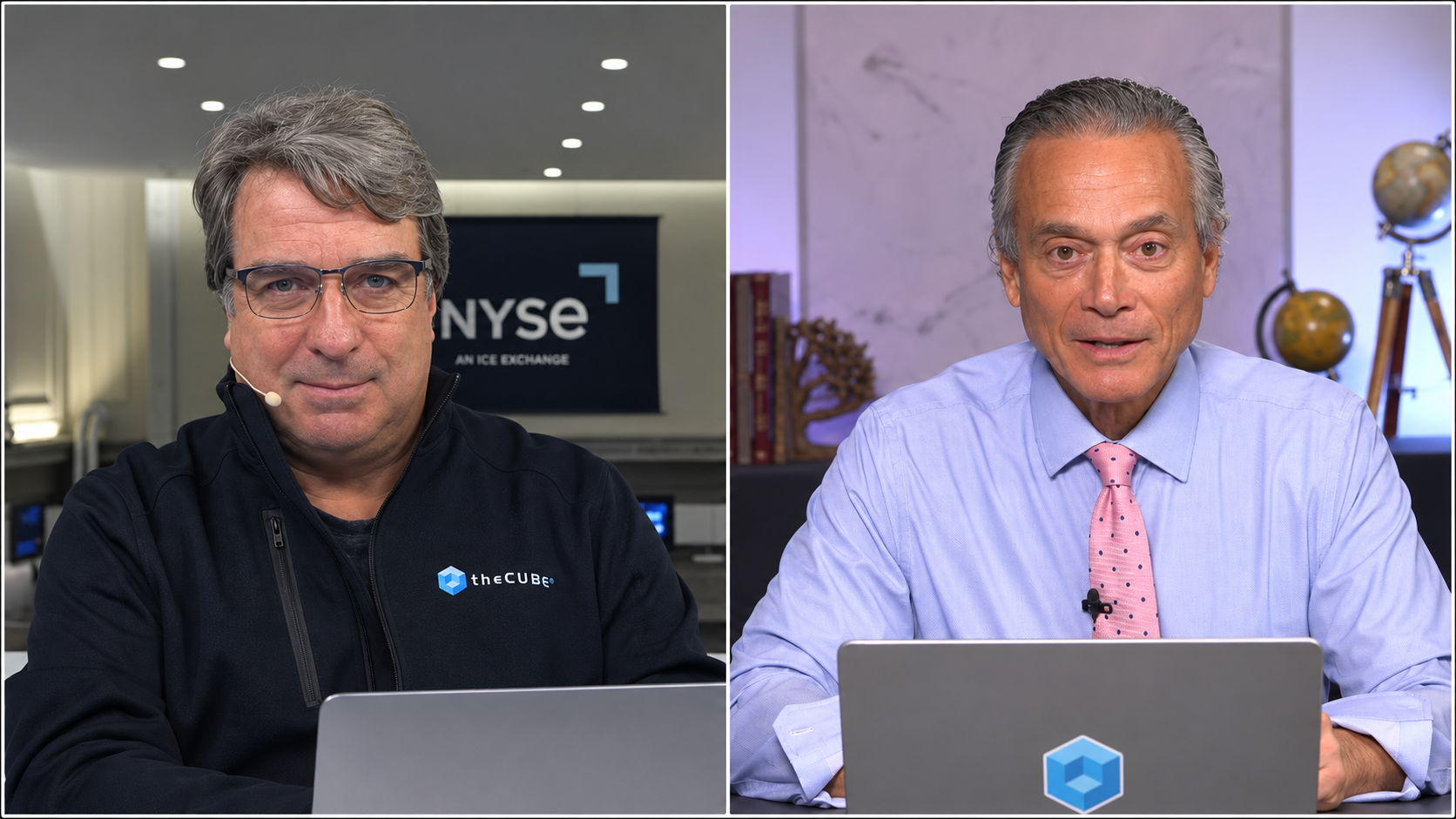
“The whole idea of exchange is going to change,” said John Furrier (pictured, left), executive analyst at theCUBE Research. “It reminds me of cloud computing, how it re-leveled the data center. NYSE is the cathedral of capitalism. Nasdaq started as an over-the-counter bulletin board. Tech was early there and then only listed there. But now the game has changed. It’s very interesting to see how the competition between the NYSE and the Nasdaq is going to play out.”
On the latest episode of theCUBE Pod, Furrier and Dave Vellante (right), chief analyst at theCUBE Research, discussed what Anthropic’s IPO and Friday’s stock market jitters suggest about a potential AI bubble. They also explored Intel’s missteps and the opportunity for full-stack infrastructure companies.
Last week, Alphabet’s stock fell more than 12% after it reported slower growth in search revenue, presumably because chatbots are drawing people away from the browser. Amazon also had a disappointing Friday, with its stock falling 7% as the company continues to dump money into an AI infrastructure buildout.
Despite investors’ concerns, Vellante sees the AI bubble letting out a little air. He views this as a healthy sign for the AI market’s future.
“Think of the tulip bubbles in the 1600s,” Vellante said. “Think about the Japanese real estate bubble in the 1980s. And you think about the dot-com. That dot-com was actually different. Dot-com, they were all … overhyped. They drove massive valuations. But the dot-com actually played out. It actually exceeded expectations. And I think there’s some things that we can learn from there.”
Furrier sees evidence for a positive growth cycle, starting with cloud growth, which is needed to support the AI expansion. He also suggested that the infrastructure boom could coexist with the neocloud shakeout, as enterprise AI starts to create jobs rather than taking them away. Last week isn’t necessarily indicative of the AI bubble popping any time soon, he argues.
“Rationale is kicking in, common sense,” he said. “You’re starting to see the beginning of a transition. Wall Street is trying to figure it out. I think they don’t yet get it. But if you look at the language of the experts on the inside and how all the IPOs are being positioned, the value of these IPOs — they want durability. That transition from Silicon Valley tech ecosystem platforms is going to move into the markets. This is a platform game.”
Intel stock saw the steepest drop last week, almost 30% after its Thursday earnings report. The company has leaned into CPUs over GPUs, which Vellante thinks is missing the mark; the real game is not CPUs versus GPUs, but rather AI platforms. Nonetheless, he and Furrier predict Intel will make up some ground.
“Lip-Bu Tan and Intel have an opportunity,” Furrier said. “You basically lost the hyperscaler market that they once had a foothold in. You still run x86 on some clusters. But they got to look at other footprints. I think he’ll turn it around. It’s a multiyear journey, as he says. But the fact of the matter is why I don’t think it’s a bubble, is companies like Alphabet dropping major, major action, $500 billion, in a day.”
Intel is just one component in a rapidly changing ecosystem. Although the AI boom draws comparisons to the bubbles of yore, theCUBE concluded that this is still a unique phenomenon the market has to grapple with, and one that will play out over decades.
“This is just a natural adoption phase,” Vellante said. “What’s different is a lot of things. Like you said, tech is suddenly deflationary. We’re trading CapEx for labor, and that hasn’t really kicked in yet. We’re seeing individual productivity gains but it hasn’t shown up at the firm level yet. These things just take time. And, of course, Wall Street’s like, show me the money.”
Here’s the full episode of this week’s theCUBE Pod:
Support our mission to keep content open and free by engaging with theCUBE community. Join theCUBE’s Alumni Trust Network, where technology leaders connect, share intelligence and create opportunities.
Founded by tech visionaries John Furrier and Dave Vellante, SiliconANGLE Media has built a dynamic ecosystem of industry-leading digital media brands that reach 15+ million elite tech professionals. Our new proprietary theCUBE AI Video Cloud is breaking ground in audience interaction, leveraging theCUBEai.com neural network to help technology companies make data-driven decisions and stay at the forefront of industry conversations.