 INFRA
INFRA


INFRA

Staera Semiconductor Inc., a startup that develops technology for linking together chiplets, launched today with $4.6 million in pre-seed funding.
Singaporean fund Openspace Capital led the investment. It was joined by SGInnovate, Black Kite Capital, 28 Holdings, In Group and financial software company Decimus Technologies.
High-end artificial intelligence accelerators comprise multiple chiplets, silicon dies that each perform a narrow set of tasks. They’re linked together by a kind of miniature network that also functions as the host accelerator’s base layer.
That miniature network takes the form of an interposer, an advanced device that sometimes includes computing circuits, or a bridge. A bridge is essentially a small interposer that costs less to make.
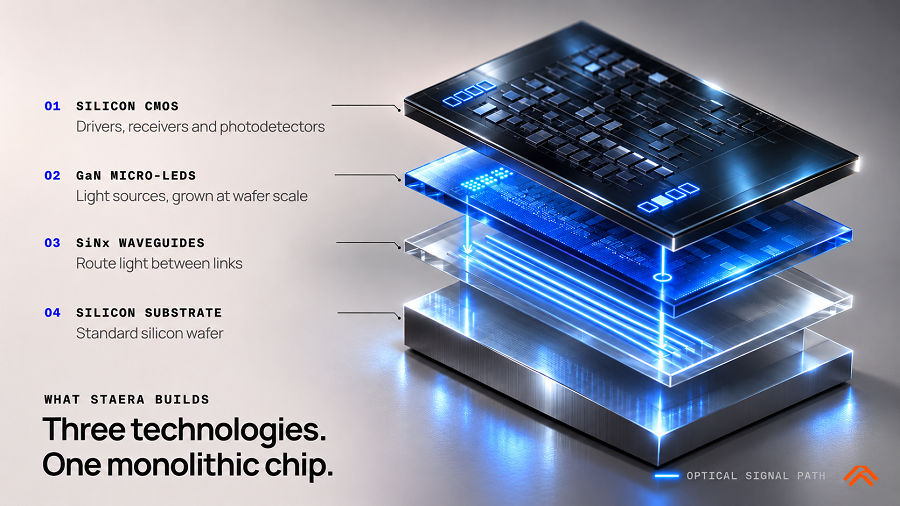
Interposers and bridges both use tiny copper wires to move data between the chiplets they connect. San Francisco-based Staera hopes to replace those copper wires with optical links. According to the company, optical technology is faster and uses less power. It can also transmit data over longer distances without slowing down, which enables chipmakers to build bigger accelerators.
“Copper performance plummets over the millimeter-to-meter distances that matter most in AI accelerators, and bolt-on optics add power and complexity.” said Chief Executive Officer Andrew Kim. “We build the light into the chip, the entire optical link inside a chip, so the connection gets smaller, cooler and faster with each generation.”
Staera’s first product is called Lightwire. It transmits data over optical links, or waveguides, made of a transparent material known as silicon nitride. Light beams can only travel through a transparent material if their wavelengths fall within a specific range. Silicon nitride supports a larger range of wavelengths than many alternatives and causes less light loss, which boosts connection speeds.
The light beams into which Lightwire encodes data traffic are produced by miniature LEDs. Those devices are made of gallium nitride, a compound that is widely used in optical systems because it has a direct bandgap.
The electrons that orbit an atomic nucleus have different energy levels known as bands. Light is produced when an electron jumps from one band to one another and then collides with a quasiparticle called an electron hole.
Usually, the process also involves a second quasiparticle known as a phonon. Direct bandgap materials such as gallium nitride don’t require a phonon, which makes the light generation process more efficient.
Staera says Lightwire transmits data between an AI accelerator’s chiplets at a rate of up to 8 gigabits per second. The technology can provide more than 600 optical links per square millimeter. In practice, that means a Lightwire-powered HBM4 memory stack can move up to 24 terabits of data per second instead of the 2.8 terabits supported by current technologies.
Staera’s funding round will advance its commercialization efforts. It will enhance Lightwire, grow its U.S. team and build out a manufacturing supply chain. The company hopes to begin commercial shipments in 2030.
Support our mission to keep content open and free by engaging with theCUBE community. Join theCUBE’s Alumni Trust Network, where technology leaders connect, share intelligence and create opportunities.
Founded by tech visionaries John Furrier and Dave Vellante, SiliconANGLE Media has built a dynamic ecosystem of industry-leading digital media brands that reach 15+ million elite tech professionals. Our new proprietary theCUBE AI Video Cloud is breaking ground in audience interaction, leveraging theCUBEai.com neural network to help technology companies make data-driven decisions and stay at the forefront of industry conversations.