INFRA
INFRA


INFRA

Cisco Systems Inc. opened fiscal 2027 with a quarter that should put any question about whether artificial intelligence will act as a massive tailwind for it to rest. Revenue and earnings hit records, growth rates were the best Cisco has posted in more than 15 years, and management raised its full-year outlook and AI infrastructure revenue target.
While Cisco has delivered a string of solid quarters, some investors are concerned about the durability of the growth. After listening to the analyst call, I maintain that accelerated growth is what Cisco watchers should expect, as AI will act as a catalyst for several years. Here are my five thoughts, plus the one metric I think investors should care about most:
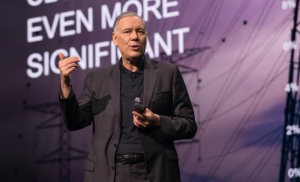
Asked why this isn’t simply the top of a hyperscaler spending cycle, Chief Executive Chuck Robbins (pictured) cited five growth drivers: hyperscale AI, the campus refresh, the “post-Mythos” security upgrade cycle, sovereign infrastructure and enterprise hybrid data centers. “All five of these are multiyear, multibillion,” he said. “And they’re all in relatively early stages.” In particular, the enterprise opportunity is in its infancy. Using the baseball analogy for “what inning” we’re in, the pitchers are still warming up, and enterprise is what Cisco does best.
Though hyperscalers have been driving AI growth across the industry, only one of the five trends Robbins highlighted was related to that group of companies. Chief Financial Officer Mark Patterson reinforced the point by breaking down the guidance raise, noting that a large share came from Cisco’s core, non-hyperscale business. “It’s not just campus,” he said. “It’s broad-based, and the core continues to do quite well.”
The market still views the enterprise as a slow-refresh business. The call made a strong case that it’s about to become the bigger part of Cisco’s AI story.
During the investor Q&A, a data point was worth highlighting. Robbins said that of the campus switching Cisco sold this quarter, “only 9% was really coming from the new portfolio.” Despite multiple quarters of strong campus growth, the installed base has barely moved to the next generation.
Two forces will push this base to accelerate an upgrade. One is agentic AI, which Robbins said is driving “modernization for bandwidth reasons” because agents generate traffic that campus networks were never designed to handle. The other is the security fallout from frontier models such as Anthropic’s Claude Mythos — the Mythos moment. “We’re beginning to hear from customers who are attributing orders to early Mythos implications,” Robbins said, noting that European service providers are upgrading managed customer premises equipment.
Robbins added that customers “got to get the architecture exactly right.” That suggests a long, deliberate redesign rather than a buying spree, which is characteristic of a multiyear cycle.
Cisco has long been criticized for building its own silicon as the industry shifted to merchant silicon. Robbins said that outside of optics, the hyperscale AI business is “100% Silicon One-based platforms.” The P200 continues to win scale-across deals, and the G300 is now in customer labs.
Asked why Cisco keeps winning those deals, Robbins kept it simple: “It’s really about performance and power. And there’s just this whole focus on diversity of silicon in the space.” The second point is the more strategic one. No hyperscaler wants a single supplier for any critical layer of its AI fabric, and Cisco is the credible second source.
The bigger long-term play is the enterprise. Silicon One is already shipping across parts of the enterprise portfolio, and Robbins said the target to convert all of it by fiscal 2029 “is still on track.” That gives Cisco a single silicon architecture from the hyperscale data center to the branch, with cost and roadmap control competitors can’t match.
The reality is that at Cisco’s volumes, it makes no sense to buy merchant silicon. Not only can it build it cheaper, but it can also optimize it specifically for its own features and capabilities.
A theme running through the call is that AI is decentralizing. “Our enterprise customers will be running AI applications in the cloud, but they’re also investing heavily in private data centers,” Robbins said. “They want to run open-weight and open-source models in their own data centers. They want to train on their own data in their own data centers.”
Sovereignty is driving in the same direction, with Cisco extending its Sovereign Critical Infrastructure portfolio from Europe to Canada and preannouncing India. Robbins noted that Cisco is “one of the few companies that has maintained a robust on-premises portfolio.” For years, analysts treated that on-premises focus as a liability. In a world where countries and regulated industries want operational control, it has become an advantage.
Equally important is what Cisco isn’t chasing. Robbins called neocloud exposure “relatively immaterial,” adding that “we’ve been very conservative relative to the credit situations.” That’s a disciplined choice. Cisco is growing into the safest parts of the AI build-out rather than financing its riskiest buyers.
Given the number of neoclouds, one could look at them as a massive pot of gold, but they often required vendor financing. If the neocloud isn’t successful, it’s the financing organization left holding the bag. This was the case with CLECs in the Internet days. Cisco was conservative then and will continue to be.
Security has been the weak spot in Cisco’s story, so this quarter’s progress matters. Robbins said core security orders, excluding Splunk, were “the best it’s been in three years,” with firewalls, Zero Trust secure access, and AI Defense all gaining customers. Patterson said Cisco is “a little bit above the expectations that we set out” and feels “good about turning the corner.”
The refresh cycle drives near-term numbers, but the strategic prize is trust for AI agents. Robbins said enterprise conversations now center on “agentic security, agentic identity, agentic observability, as well as the new security architecture needed for the AI era.” The network is where agent traffic flows, making it the natural enforcement point. Cisco owns more of that network than anyone.
Investor concerns received clear answers. On margins, Patterson said, “gross margins are pretty much right on target,” and on supply, “we’re seeing not a lot of issues at all.” Robbins added that Cisco is growing revenue “with less headcount than we had at the beginning” two years ago.
The number I’d watch most closely isn’t AI revenue, campus orders, or gross margin. It’s the growth of Cisco Cloud Control. Robbins mentioned it almost in passing, noting thousands of sign-ups and integrations with AI Canvas, Cisco IQ and Cisco Model Foundry. Most people will think of Cloud Control as a network management tool, but that badly understates its potential.
Cloud Control is now Cisco’s core product. The best analogy is VMware vCenter, the data center’s control point that turned a collection of products into a sticky platform. Cheaper, sometimes free hypervisors never made a dent in VMware’s share because the operational control gained from vCenter far outweighed the few bucks saved on hypervisor licenses. Cloud Control is broader and potentially more impactful because Cisco is positioning it as the control point for enterprise AI, not just the network through the following capabilities.
Cisco’s numerous network and security competitors have their own agentic operations platforms, and many beat Cisco to market. However, Cisco played the long game. In my conversations with Chief Product Officer Jeetu Patel, he has been emphatic about how important Cloud Control is to Cisco’s vision of shifting to a platform company. It enables customers to manage the underlying infrastructure, including third parties, through a single dashboard.
If Cloud Control becomes the enterprise IT console for managing AI-era infrastructure, Cisco stops competing on boxes and starts competing on control. Hardware cycles always ebb and flow, so always being best of breed is impossible. Whether this one becomes a transformation for Cisco depends on whether customers run their environments on Cloud Control. My advice to Cisco is to start disclosing active usage, partner integrations, and attach rates for the platform.
My advice to investors is to start asking for them. That number will tell you what Cisco is worth five years from now.
Zeus Kerravala is a principal analyst at ZK Research, a division of Kerravala Consulting. He wrote this article for SiliconANGLE.
Support our mission to keep content open and free by engaging with theCUBE community. Join theCUBE’s Alumni Trust Network, where technology leaders connect, share intelligence and create opportunities.
Founded by tech visionaries John Furrier and Dave Vellante, SiliconANGLE Media has built a dynamic ecosystem of industry-leading digital media brands that reach 15+ million elite tech professionals. Our new proprietary theCUBE AI Video Cloud is breaking ground in audience interaction, leveraging theCUBEai.com neural network to help technology companies make data-driven decisions and stay at the forefront of industry conversations.