 APPS
APPS


APPS

Intelligent sales software startup Dreamteam AI Inc. said today it has raised $53 million in early-stage funding to try to flip the narrative around customer relationship management platforms, which often seem like more of a hindrance than a help, by actually getting work done for sales teams.
The funds come by way of a seed and Series A round led by Accel Partners with participation from Together Fund and Premji Invest.
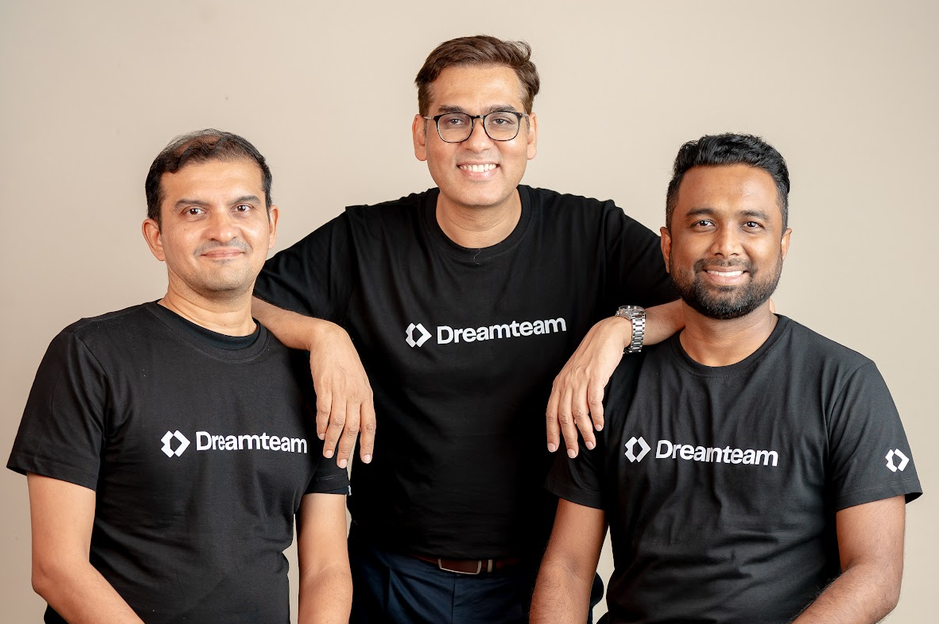
CRM platforms such as Salesforce and Hubspot have served as vital cogs in the wheel sales-focused enterprises for more than a quarter of a century. But these days they often create just as much work as they save, says Dreamteam co-founder and Chief Executive Anand Venkatraman (pictured, center, alongside co-founders Ramesh Parthasarathy and Senthil Kanthaswamy). While organizations are striving to use artificial intelligence to automate more of their business processes, CRMs are holding them back, he believes.
The problem with legacy CRM platforms is that they’re totally reliant on manual data entry, Venkatraman explained. Because their architectures are built around structured data fields and rigid, hand-coded workflows, they create a tight bottleneck that makes it almost impossible for autonomous AI agents that feed primarily on semantic data to get anything done.
“When a sales prospect expresses price hesitation or mentions a competitor, a salesperson registers it immediately,” he said. “But a legacy CRM, starving for unstructured nuance, misses it entirely, leaving AI agents without the vital context needed to reason effectively.”
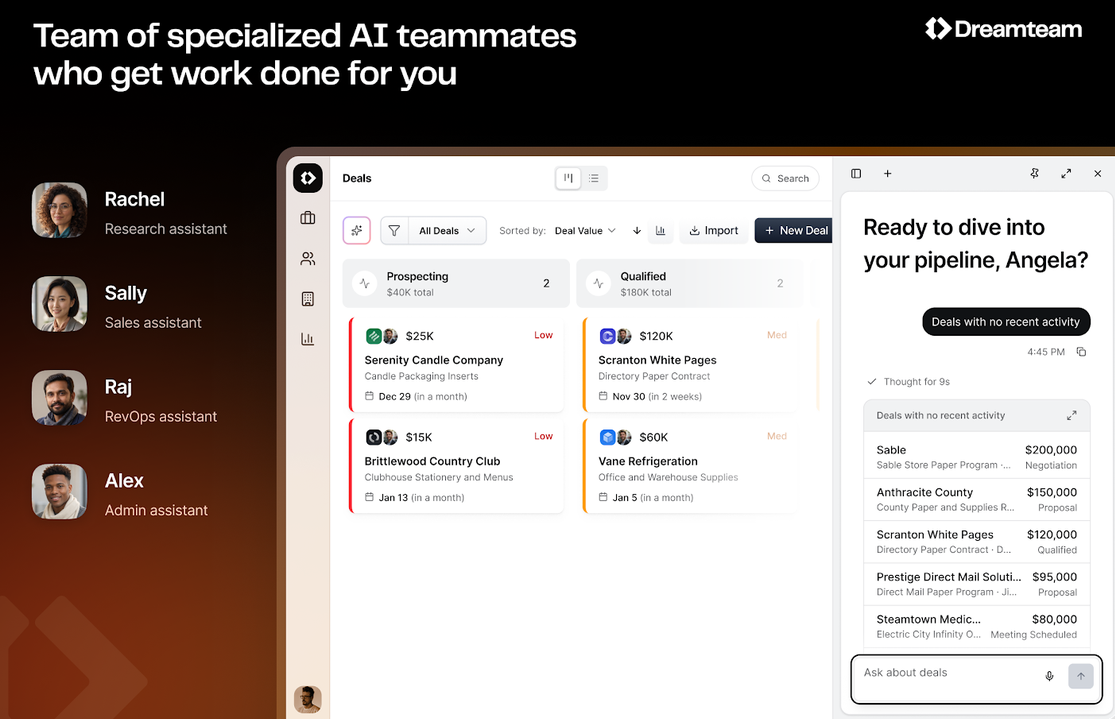
To provide this context, Dreamteam has rebuilt the CRM from the ground up around the idea of a “company brain,” or a living memory of the business that constantly updates itself by ingesting new information from meetings with clients, prospects and team members, emails and other connected tools. As with all AI-native platforms, there’s also a generous dose of automation in the shape of four AI agents, or teammates, which specialize in different tasks.
The agents include Rachel, which handles account research; Sally for meeting preparations and follow-ups; Raj, which monitors for pipeline risks; and Alex, which serves as the CRM administrator, keeping the platform ticking over without any human intervention.
Venkatraman said he and his co-founders designed Dreamteam’s architecture specifically to address the historic shortcomings of legacy CRM platforms, which struggle to dig up the most vital business intelligence, leaving teams flying blind. “When a CEO asks why the quarter’s three biggest deals were lost, RevOps spends two weeks building a partial answer from whatever the reps happened to type,” he said. “The richest signals from meetings, emails, and calls were never captured, so the answer is always incomplete and always late.”
Legacy CRMs also fail to capture institutional knowledge, which means that everything a senior sales representative knows about the clients they work with leaves when they depart the company. There’s also a heavy administrative tax, with users forced to waste valuable time entering data to keep the platform up to date.
“CRMs don’t have a shortage of features,” Venkatraman said. “But they have a shortage of context and trust, and they lack the ability to get actual work done.”
Dreamteam does things differently. By capturing the unspoken context around each deal an organization does, it says, its platform can help to prevent new leads from going stale. Monitoring everything that’s said and agreed to in meetings, via chats and emails and other tools, the platform can pick out the most important signals, such as pricing sensitivities, objections and stakeholder dynamics.
It remembers all of the fine details of each specific deal. That way, even if the main sales rep involved suddenly leaves, it will retain all of the context so whoever takes over the account knows what needs to be done next.
The platform also employs humanlike reasoning. “When a prospect says, ‘The board is pushing hard on costs,’ it knows the proposal should lead with ROI, not features,” Venkatraman explained. “The CRM was supposed to give companies a complete picture of their customers, yet the richest parts of that picture have always lived outside the CRM.”
The startup has already witnessed significant traction with its agentic, contextual approach: It’s used by hundreds of organizations across the AI, healthcare, manufacturing, consulting and online media sectors. Dreamteam has enabled those early adopters to transform the way they handle sales.
Because the CRM continuously self-updates its records following daily customer interactions, it means sales people have much more time to focus on actually selling rather than data entry. Senior leaders have more visibility into deal pipelines, and can immediately find out why deals are stalling or how their customer’s sentiments are shifting.
Scott Olechowski, chief product officer at the video streaming service Plex Inc., said he was especially taken with the tight level of integration with Dreamteam and the company’s existing information technology stack. “The combination of simplicity and power hits the sweet spot for us,” he said. “The ability to integrate with the AI tools we are using across our organization is a game-changer.”

Venkatraman believes Dreamteam can have an even greater impact in future by expanding its shared intelligence layer beyond sales operations. His ambition is to build a platform that spans the entire customer lifecycle, from onboarding to customer success, renewals and upselling, to ensure that organizations can squeeze the most value out of the deal context it captures.
“Much of what’s learned during sales is lost or fragmented when a customer moves into implementation or customer success,” he pointed out. “But the same company brain that knows why a customer bought should also help teams onboard them, spot risks and find ways to grow the relationship.”
One way Dreamteam intends to pursue this vision is through what it calls “Magic Apps,” which is a capability that lets users build custom dashboards and tailored CRM workflows using natural language prompts. “The apps live inside Dreamteam, inherit its data permissions and action-level authorizations, and stay connected to customer records, workflows and the Company Brain, so you can customize without rebuilding the foundation,” Venkatraman said.
Premji Invest’s Saravanan Nattanmai has already bought into this vision, stressing the need for CRM systems to become more than just a system of record. He characterizes what Dreamteam is building as a “system of intelligence.”
“Dreamteam sets out to intuitively understand user intent, build deep contextual intelligence and execute workflows seamlessly through autonomous AI teammates,” he said. “We believe the future of enterprise software lies in AI-native systems that don’t just augment existing workflows but fundamentally reimagine how work gets done.”
Support our mission to keep content open and free by engaging with theCUBE community. Join theCUBE’s Alumni Trust Network, where technology leaders connect, share intelligence and create opportunities.
Founded by tech visionaries John Furrier and Dave Vellante, SiliconANGLE Media has built a dynamic ecosystem of industry-leading digital media brands that reach 15+ million elite tech professionals. Our new proprietary theCUBE AI Video Cloud is breaking ground in audience interaction, leveraging theCUBEai.com neural network to help technology companies make data-driven decisions and stay at the forefront of industry conversations.