







 INFRA
INFRA
INFRA
INFRA
INFRA

After seeing its stock rise more than 7% during the regular trading session earlier today, Advanced Micro Devices Inc. saw all of those gains wiped out in extended trading after narrowly beating expectations in its latest financial results.
The chipmaker reported second-quarter adjusted earnings of $1.66 per share, edging past Wall Street’s forecast of $1.62 per share, while revenue jumped 50% to $11.54 billion, ahead of the $11.28 billion target. Profitability was up too, with AMD’s net income coming to $2.3 billion at the end of the quarter, up from just $872 million in the year-ago period. The impressive revenue growth can be taken as a sign of the company’s growing importance as a secondary supplier for artificial intelligence chips. AMD is the world’s biggest supplier of graphics processing units after Nvidia Corp., and it also sells central processing units under its EPYC brand which are now enjoying a renaissance of sorts amid the rise of AI agents.
AMD’s data center unit was responsible for much of its growth during the quarter, with sales rising 107% from the same period one year earlier to $6.7 billion. The company attributed this growth to sales of both its GPUs and the EPYC CPUs.
Looking ahead to the current quarter, AMD forecast revenue of around $13 billion at the midpoint of its guidance range, ahead of the Street’s $12.52 billion target. However, it’s notable that there’s a lot of differing opinions among analysts, with some guiding for AMD to top $14 billion in third quarter sales.
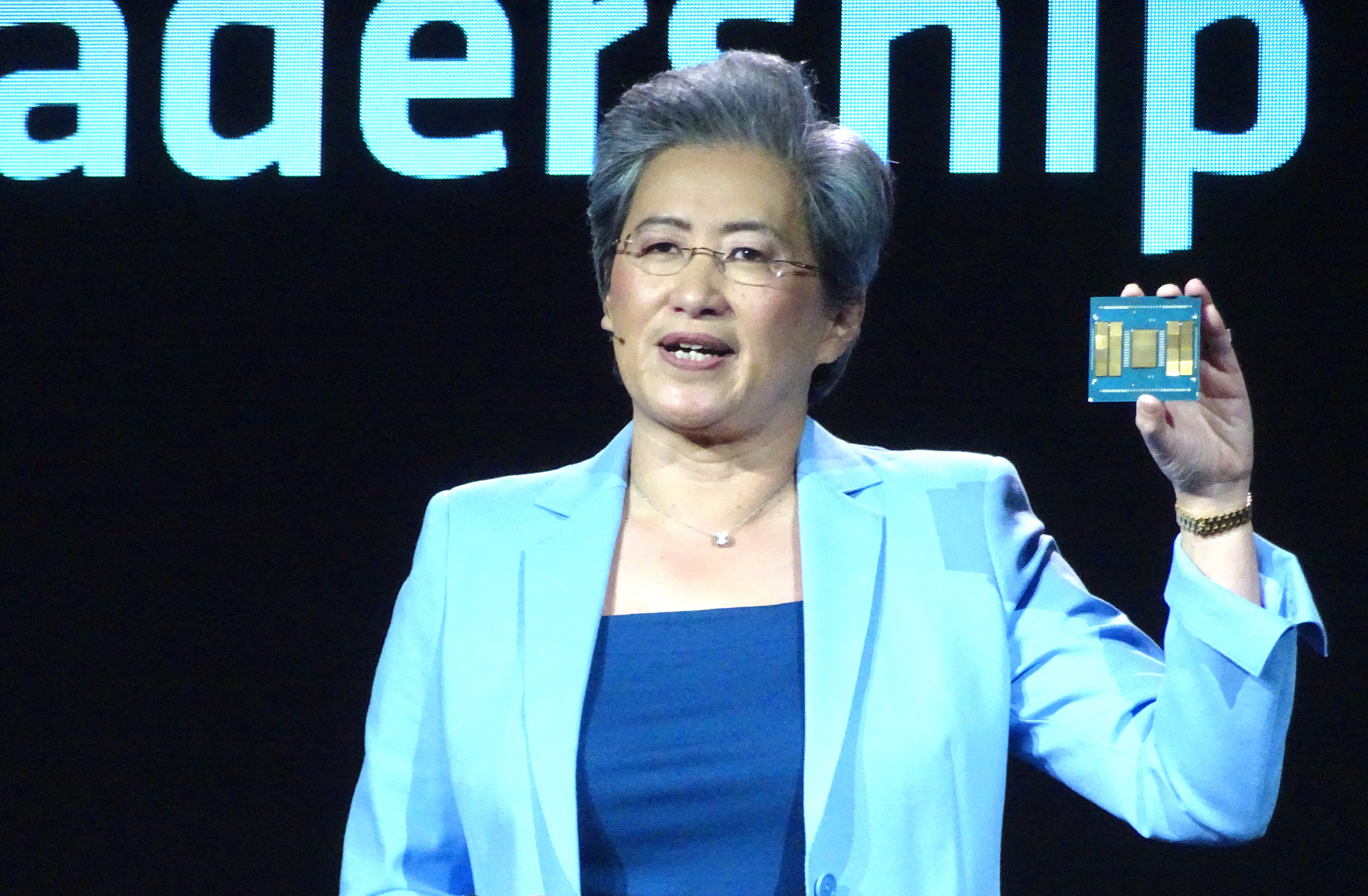
Last month was a big one for AMD, as it announced the imminent launch of the next generation of its GPUs and CPUs at its Advancing AI event. This included its next-generation AMD Instinct MI400 Series GPUs, which are engineered for high-volume inference workloads, AI training and fine-tuning, and the sixth-generation AMD EPYC CPUs for running demanding agentic AI applications. At the event, AMD Chairperson and Chief Executive Lisa Su told attendees that the company believes the size of the semiconductor industry will expand to more than $2 trillion by 2028. Of that, it believes at least $1.4 trillion will be spent on AI accelerators, up from a previous estimate of just $500 billion.
AMD also announced the upcoming launch of its new Helios AI rack system, and said it will start shipping this to customers like OpenAI Group PBC, Oracle Corp. and Meta Platforms Inc. in the current quarter. It’s the company’s first-ever rack-scale system, designed to house its GPUs, CPUs and networking chips, and marks the first time the company is trying to compete not only with Nvidia’s silicon, but also its complete data center systems.
Emarketer Inc. analyst Jacob Bourne said this is the obvious next step for AMD, which has already established itself as a meaningful competitor to Nvidia in the AI accelerator industry. But he said it will be much harder for the company to compete with its rival’s full-stack infrastructure.
“Nvidia’s CUDA moat remains formidable, but the Helios ramp, expanding deployments with OpenAI, Anthropic, Microsoft, and Meta, and continued investment in ROCm suggest AMD is evolving from a chip challenger into an AI infrastructure competitor,” Bourne said. “Those strong data center results reinforce that opportunity, even as investor expectations increasingly shift from rewarding AI spending to demanding AI returns.”
On a conference call with analysts today, Su said the company anticipates that its data center unit sales will double in 2027, with server revenue set to grow more than 80% on an annual basis in the second half of fiscal 2026. “Demand for both accelerators and CPUs is growing well above our prior expectations,” she insisted.
Su added that the EPYC CPUs have managed to wrestle away market share from the company’s biggest rival in that segment, Intel Corp., which has also enjoyed a strong renaissance over the last year. “Hyperscalers continued expanding Epyc across their internal infrastructure and public cloud offerings, including AWS, Microsoft, Google, Oracle, and others,” she told analysts.
AMD’s other main business is the client and gaming segment, which sells GPUs and CPUs for consumer devices including personal computers, laptops and games consoles. Revenue there rose just 6% to $3.8 billion. “Our first half performance has been very strong and although we are expecting that the market will decline in the second half, it has actually held up better than most people would have thought,” Su said of the company’s PC chip sales.
The chipmaker also operates a smaller embedded segment that sells chips for industrial applications, which generated sales of $977 million, up 19% from a year earlier.
The chipmaker said its capital expenditures rose to $808 million during the quarter, which was a steep increase from the $282 million in capex it recorded one year ago. This increase was likely one of the factors that prompted the after-hours sell-off in AMD’s stock, said Zacks Investment Research analyst Andrew Rocco. “Over the past few weeks, investors have been punishing select companies that have exhibited little capex discipline,” he said. “But I wouldn’t look hard into it for now. As AMD works to launch its new product lines and secure hard-to-find memory, its capex needs to rise.”
Holger Mueller of Constellation Research said AMD is becoming less of a chipmaker and more of a data center hardware vendor, especially with the imminent launch of the Helios rack-scale system for deploying huge clusters of AI chips. “AMD’s numbers would have been unthinkable a few years ago, with revenue up 50%, gross margin up 60% and net income growing more than 160%, and it’s all thanks to AI,” the analyst said. “It could never have done this with its traditional server and desktop business and the once-hopeful gaming business. AMD has gotten a lot of people excited about its 6th generation EPYC chips, the new Instinct GPUs and the Helios rack, and now it’s up to Lisa Su and her team to execute and keep up the momentum.
Dave Vellante of theCUBE Research, SiliconANGLE’s sister division, indicated that the Helios ramp is a key factor investors are watching. “A rack like Helios is non-trivial to not only engineer but also to manufacture in volume at high yields. The complexity of this product, its extensive use of high bandwidth memory and associated supply constraints are weighing on margins and likely adding to investor concerns.” According to AMD, its Helios rack uses fifty percent more HBM than competitive products.
Support our mission to keep content open and free by engaging with theCUBE community. Join theCUBE’s Alumni Trust Network, where technology leaders connect, share intelligence and create opportunities.
Founded by tech visionaries John Furrier and Dave Vellante, SiliconANGLE Media has built a dynamic ecosystem of industry-leading digital media brands that reach 15+ million elite tech professionals. Our new proprietary theCUBE AI Video Cloud is breaking ground in audience interaction, leveraging theCUBEai.com neural network to help technology companies make data-driven decisions and stay at the forefront of industry conversations.