 AI
AI
AI
AI








AI

The momentum behind full-stack AI infrastructure reflects a broader shift in enterprise thinking. The value of AI now comes from integrated systems — not isolated accelerators — and from the ability to shape intelligence around how people actually work.
That shift was a central theme at the AMD Advancing AI event, where discussions focused on how enterprises are moving toward architectures that unify compute, networking, memory and software into cohesive systems. Organizations are increasingly evaluating alternatives that give them more flexibility in how they build and scale full-stack AI infrastructure, according to Dave Vellante, co-CEO of SiliconANGLE Media Inc. and co-host of theCUBE Research.
“[AMD] spent $60 billion in M&A, $49 billion of which was on Xilinx, and they seeded the ecosystem with software like ROCm,” Vellante said. “They are now in the systems business. They’re no longer in just the chips business, and it’s a complete transformation and a reinvention. My premise is that they don’t have to take out Nvidia — they just have to become the essential second player, the second source in this AI wave.”
During the event, Vellante, Bob O’Donnell, president at TECHnalysis, and theCUBE Research’s John Furrier spoke with Advanced Micro Devices Inc. executives and ecosystem partners about the broad architectural changes shaping enterprise AI. Their conversations explored how organizations are rethinking infrastructure design, workload placement and the economics of scaling intelligence across heterogeneous systems.
Here’s the complete day 1 event wrap-up discussion with Dave Vellante and John Furrier:
AMD’s shift toward full-stack AI infrastructure is reshaping how enterprises think about AI deployment. As the company integrates Xilinx and AMD Pensando into a unified architecture and pushes an open, chiplet-driven philosophy, it’s enabling a more flexible model where workloads can be intelligently routed to the most appropriate — and cost-efficient — resource, according to Furrier.
“You start to see the software intelligence coming in to support the end-user, bottoms-up experience,” he said during the event. “This model goes to that [central processing unit]. It’s not that expensive, it’s not a high priority, but we need to have a good-enough answer. Don’t use the expensive [graphics processing unit] for that — go to the right AI resource.”
Analysts also pointed to the growing importance of AMD’s software strategy as competition in AI hardware intensifies. ROCm’s evolution is becoming a meaningful factor in how enterprises evaluate long‑term platform openness, according to O’Donnell.
“With ROCm AI, they’re saying, ‘Why don’t we use AI to allow GPU programs to be rewritten from CUDA into ROCm format?'” O’Donnell told theCUBE. “That, as well as things like what OpenAI has done with Triton, is starting to make that moat become less of a factor.”
Here’s the complete video interview with Bob O’Donnell, who was joined by Sarbjeet Johal, principal at Stackpane:
The full-stack AI infrastructure buildout is reshaping how enterprises design and deploy AI systems at scale. AMD’s open approach aligns with that shift, according to Derek Dicker, corporate vice president of the Enterprise Business Group at AMD.
“At the end of the day, no enterprise has really come to me and said, ‘Hey, I want to buy a CPU,’” he said during the event. “They’re looking for a business outcome. A big focus of ours is identifying what are those business challenges that they’re facing, and how do we build it with the best-of-breed technology we have here or with partners in the industry?”
That approach also depends on giving enterprises greater flexibility in where and how workloads run on full-stack AI infrastructure. AMD’s open ecosystem is designed to support consistent software across cloud, hybrid and on-premises environments, according to Steve Berg, CVP and general manager of the Server CPU Cloud Business Group at AMD.
“It’s the enterprises that run in the cloud that want to have that open ecosystem, and they don’t want the lock-in,” he told theCUBE. “They want to be able to run the same software and ecosystem that they do on-prem in a hybrid environment as they do in the cloud.”
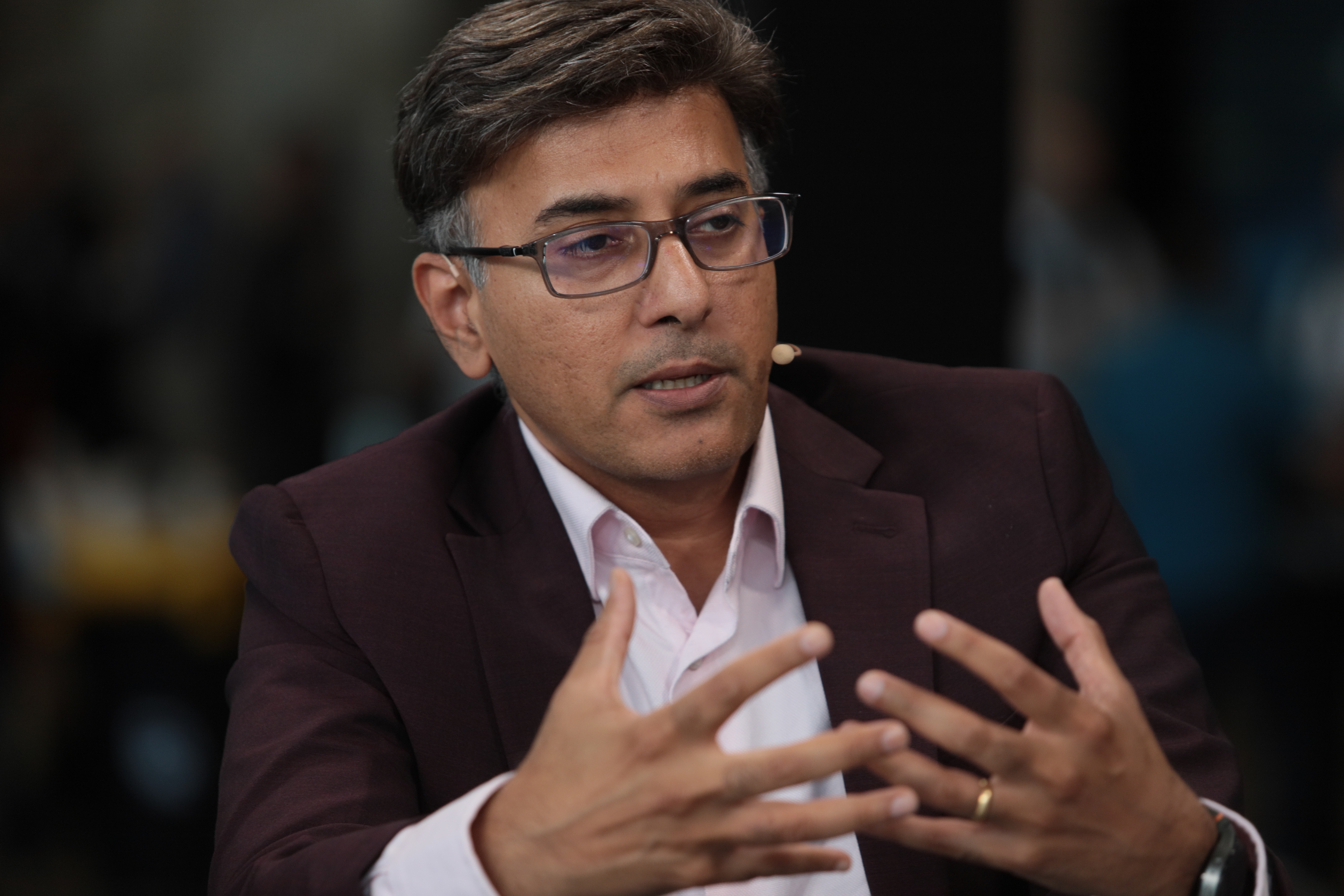
That focus extends to deployment strategy, as well. Enterprises are increasingly balancing frontier models in the cloud with open-weight models running on-premises, allowing them to optimize cost, performance and governance for different workloads, according to Suresh Andani (pictured), CVP of compute and enterprise AI at AMD.
“As a provider of AI compute, we want to make sure that we are enabling those enterprises to not only run their AI tasks through the frontier APIs in the cloud, but we are providing them infrastructure that they can host open-weight models very efficiently on-prem,” Andani told theCUBE. “Every enterprise conversation I’m in, that’s a key topic of discussion.”
Here’s the complete video interview with Derek Dicker:
Networking is becoming a foundational element of rack-scale AI infrastructure as AI workloads drive demand for greater throughput, reliability and programmability. AMD’s collaboration with Meta Platforms Inc. reflects that shift, with the companies co-designing the networking architecture behind Helios, according to Omar Baldonado, senior director of data center and AI networking at Meta, and Soni Jiandani, senior VP and GM at AMD.
“We partnered very closely with Meta to make sure that the Ultra Accelerator Link, or UALink, over Ethernet … becomes the fabric to bring together all the GPUs,” Jiandani said during the event. “We have 50% more memory than our competitor. How do we bring high availability attributes? Because now the failure domain is dozens of GPUs acting as one with a lot of memory.”
Building rack-scale AI infrastructure requires engineering decisions that extend well beyond silicon. Microsoft Corp.’s collaboration with AMD spans facilities, power distribution, networking and software, according to Alistair Speirs, GM of Azure infrastructure at Microsoft, and Jessica Hawk, CVP of Azure at Microsoft.
“As we engage with AMD, as we’re looking at that platform, you really have to design this whole thing together — the data center, the facilities, the rack, the hallways, the power distribution, the networking, and then of course the software as well,” Speirs told theCUBE.
Operating AI across distributed environments requires visibility into inference wherever it runs. Cisco Systems Inc. contributes that operational layer through its Cloud Control unified management platform, according to Jeetu Patel, president and chief product officer at Cisco.
“It can go out and look at all of your inferencing capacity that you have in the cloud, all of the inferencing capacity you might have in a private data center, as well as your endpoint devices, in a single management plane,” he told theCUBE.
As AMD advances toward higher-power rack-scale systems, Super Micro Computer Inc. is redesigning its server platforms to support that architecture. The company is also adapting those systems to meet different enterprise requirements, according to Vik Malyala, chief business officer at Supermicro.
“Now you have the CPU, you have the GPU, you’re connecting — bringing AMD into the equation,” Malyala said. “Depending on what customers are trying to do, we can size it right.”
Here’s the complete video interview with Jeetu Patel:
Also, don’t miss these information-packed exclusive interviews:
To watch more of theCUBE’s coverage of the AMD Advancing AI event, here’s our complete video playlist:
(* Disclosure: TheCUBE is a paid media partner for the AMD Advancing AI event. Neither AMD, the sponsor of theCUBE’s event coverage, nor other sponsors have editorial control over content on theCUBE or SiliconANGLE.)
Support our mission to keep content open and free by engaging with theCUBE community. Join theCUBE’s Alumni Trust Network, where technology leaders connect, share intelligence and create opportunities.
Founded by tech visionaries John Furrier and Dave Vellante, SiliconANGLE Media has built a dynamic ecosystem of industry-leading digital media brands that reach 15+ million elite tech professionals. Our new proprietary theCUBE AI Video Cloud is breaking ground in audience interaction, leveraging theCUBEai.com neural network to help technology companies make data-driven decisions and stay at the forefront of industry conversations.