 INFRA
INFRA
INFRA
INFRA




INFRA

Cisco Systems Inc. today introduced a sweeping set of products and services designed to help enterprises manage, secure and automate increasingly complex information technology environments as artificial intelligence agents become embedded in corporate infrastructure.
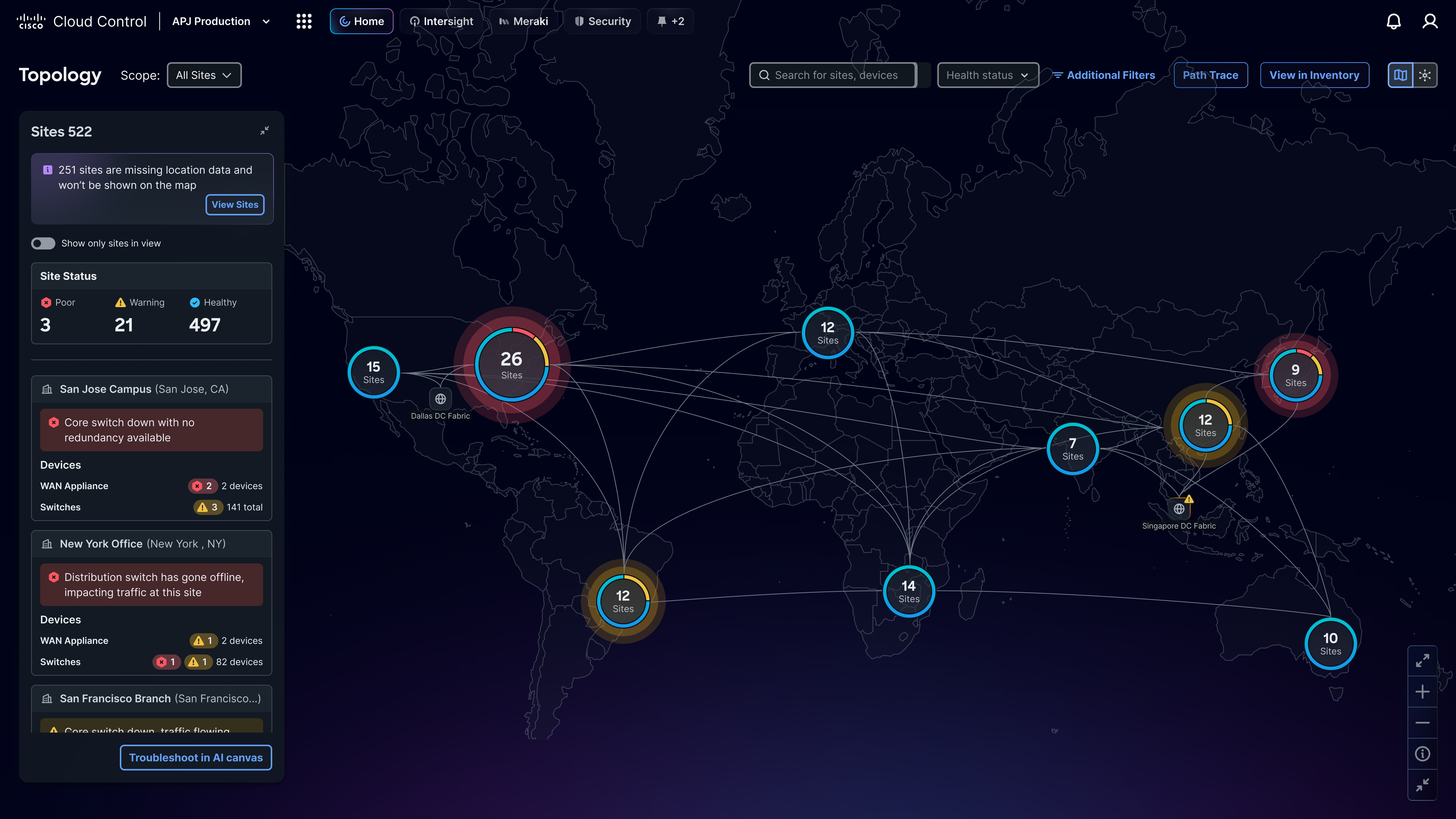
The announcements, made at Cisco Live in Las Vegas, are “the most consequential that Cisco has made in many years,” said Jeff Schultz, senior vice president of portfolio strategy for Cisco’s product organization. The anchor is Cisco Cloud Control (pictured), a new platform that unifies networking, security, observability, infrastructure and collaboration management into a single operational environment for both human administrators and AI agents.
Cisco said the platform addresses an evolving scenario in which AI agents function as digital coworkers, creating operational demands that conventional IT management tools were never designed to handle.
“We are moving from the age of chatbots to the age of agentic AI, where chatbots are productivity tools that help us do our work and agents are digital coworkers,” Schultz said.
Unlike chatbots, agents operate continuously, interact with other agents and directly access enterprise systems. Executives said that creates new challenges around networking, security and operational visibility.
“They’re being deployed everywhere now,” Schultz said. “Every action that an agent takes is a combination of a routing challenge, a trust decision and a telemetry event.”
Cisco executives said enterprises face three major barriers to scaling agentic AI: infrastructure limitations, a growing trust deficit around autonomous systems and an explosion of telemetry data generated by AI-driven operations. Anthropic PBC’s Claude Mythos has raised the specter of attacks being coordinated at machine speed, requiring defenses that leverage autonomous agents.
Cloud Control is the foundation of Cisco’s AgenticOps, an operating model that shifts IT and security operations from manual, human-led processes to autonomous, agent-driven orchestration with human oversight.
Executives described the platform as a response to fundamental changes in how enterprise infrastructure is managed.
“It’s not just about humans clicking through dashboards trying to keep up, but a true collaborative operating model where agents are doing the heavy lifting and humans are staying in control of what matters,” said DJ Sampath, senior vice president and general manager of Cisco’s AI software and platform group.
Cisco describes Cloud Control as a single management plane that brings together its networking, security, computing, observability and collaboration platforms. Single sign-on access is provided to a unified data layer called Cisco Data Fabric, based on the Splunk log data analysis platform Cisco acquired two years ago.
Executives said the platform combines cross-domain telemetry with domain-specific AI models trained on Cisco’s operational data. These include specialized networking and cybersecurity models as well as frontier AI models when appropriate.
AI agents automate operational workflows. Cisco said they can identify problems, perform root-cause analysis, recommend and implement fixes, test proposed changes on digital twins of the customer’s environment and validate outcomes with human oversight and policy controls.
“These agents are explainable, policy aware, permissioned, auditable and constrained by the guardrails that we put in,” Sampath said.
Cisco is also introducing two major platform components designed to help enterprises build their own AI-powered workflows.
Cloud Control Studio provides tools for creating custom agents and applications. Its Agent Builder allows organizations to create agents connected to more than 40 third-party platforms, including the major hyperscale clouds, ServiceNow Inc., PagerDuty Inc. and Google LLC’s Wiz through native integrations and the Model Context Protocol. Cisco said App Builder enables users to create applications and workflows using natural-language prompts and integrates with OpenAI LLC’s Codex software engineering agent and coding assistant.
Cisco AI Canvas is a collaborative workspace where operators and AI agents can investigate and resolve issues using shared operational context and telemetry. Cisco said the environment preserves context across shifts and escalations so operational knowledge is not lost.
The company also emphasized openness as a key design principle. “Enterprises are fundamentally dynamic,” Sampath said. “Every one of them has vendors other than just Cisco.”
The second major pillar of today’s announcement is cloud security. Executives said advances in frontier AI models have dramatically compressed the time between vulnerability discovery and exploitation.
“The frontier models have fundamentally changed the operating assumptions that have been in place in the data center for more than a decade,” said Tom Gillis, senior vice president and general manager of infrastructure and security.
Cisco’s response is Live Protect, which applies security controls directly to running infrastructure without requiring software upgrades, maintenance windows or system reboots. The technology is now available on Nexus 9000 switches and is expected to expand across additional Cisco products.
“Live Protect allows us to identify vulnerabilities in that infrastructure and apply a compensating control with pinpoint accuracy on a running switch without rebooting that switch,” Gillis said.
The company also unveiled new capabilities aimed at securing AI agents. DefenseClaw is a security and governance framework for local AI agents such as OpenAI Codex, Claude Code and OpenClaw. The technology scans for vulnerabilities, enforces access controls and integrates with Cisco AI Defense and Splunk for monitoring and governance.
Gillis said enterprises must simultaneously protect AI agents from malicious environments and protect enterprise assets from potentially risky agent behavior.
“We need to be able to protect these agents from hostile environments in the outside world,” he said. “At the same time, we need to protect our assets that are living in the outside world from agents.”
Cisco is also extending its Zero Trust architecture to AI agents by enabling more granular controls over what actions agents can perform and what resources they can access.
The company is further expanding its security portfolio with Agentic SOC capabilities that use AI agents to automate workflows in the security operations center. Cisco said the technology can reduce incident response times from hours or days to minutes.
Splunk, which Cisco acquired last year, plays a central role in its new security strategy.
“Data quality is a primary constraint for agentic systems,” said Kamal Hathi, senior vice president and general manager of Splunk. New Splunk capabilities included federated search, a machine data lake and an AI toolkit designed to help organizations process and analyze telemetry at scale.
Hathi said new observability capabilities focus on AI environments, including monitoring of agent behavior, performance, safety and costs.
“The cost of AI systems and the use of tokens is fast becoming a top concern for organizations,” Hathi said.
Cisco is also expanding its quantum-security offerings, saying it is committed to enabling quantum-safe communications capabilities across much of its core portfolio by the end of 2026.
New Quantum Ready Assessments help customers identify infrastructure vulnerable to future “harvest now, decrypt later” attacks, in which assailants harvest encrypted information intending to decrypt it later with speedy quantum code-breaking tools.
On the services side, the company added Resilient Infrastructure Services to its Cisco IQ support and services platform. The offering combines exposure assessments, infrastructure modernization guidance and defense resiliency planning.
“Mythos changes the rule permanently,” said Bhaskar Jayakrishnan, senior vice president of engineering for customer experience. “Things are coming at us at machine speed, but the principles don’t change. We need to help our customers with the structural resilience so that they can withstand the unknown.”
Cisco Cloud Control enters controlled availability in the United States beginning today, with broader global availability planned later.
Support our mission to keep content open and free by engaging with theCUBE community. Join theCUBE’s Alumni Trust Network, where technology leaders connect, share intelligence and create opportunities.
Founded by tech visionaries John Furrier and Dave Vellante, SiliconANGLE Media has built a dynamic ecosystem of industry-leading digital media brands that reach 15+ million elite tech professionals. Our new proprietary theCUBE AI Video Cloud is breaking ground in audience interaction, leveraging theCUBEai.com neural network to help technology companies make data-driven decisions and stay at the forefront of industry conversations.