
















 BIG DATA
BIG DATA
BIG DATA

BIG DATA

What does a data-driven business look like? Is it endless lines of code and algorithms running on cloud infrastructure, sending signals back to a predictive analytics lab? Is it a huddle of Ph.D. data scientists poring over graphs that no one else can understand? Both experts and technologies have a place in it, but relying too much on either can blow the whole thing. A business that runs day-to-day on data needs a culture that meshes machine intelligence and human business sense.
“It’s more about attitude than it is aptitude,” said Rob Thomas, general manager of IBM Analytics at IBM Corp. That attitude can be summed up in the phrase data first. This means that data must come out of the silos of elite data scientists and spread across an organization. It means that any decision in any department that can be informed by data should be informed by data.
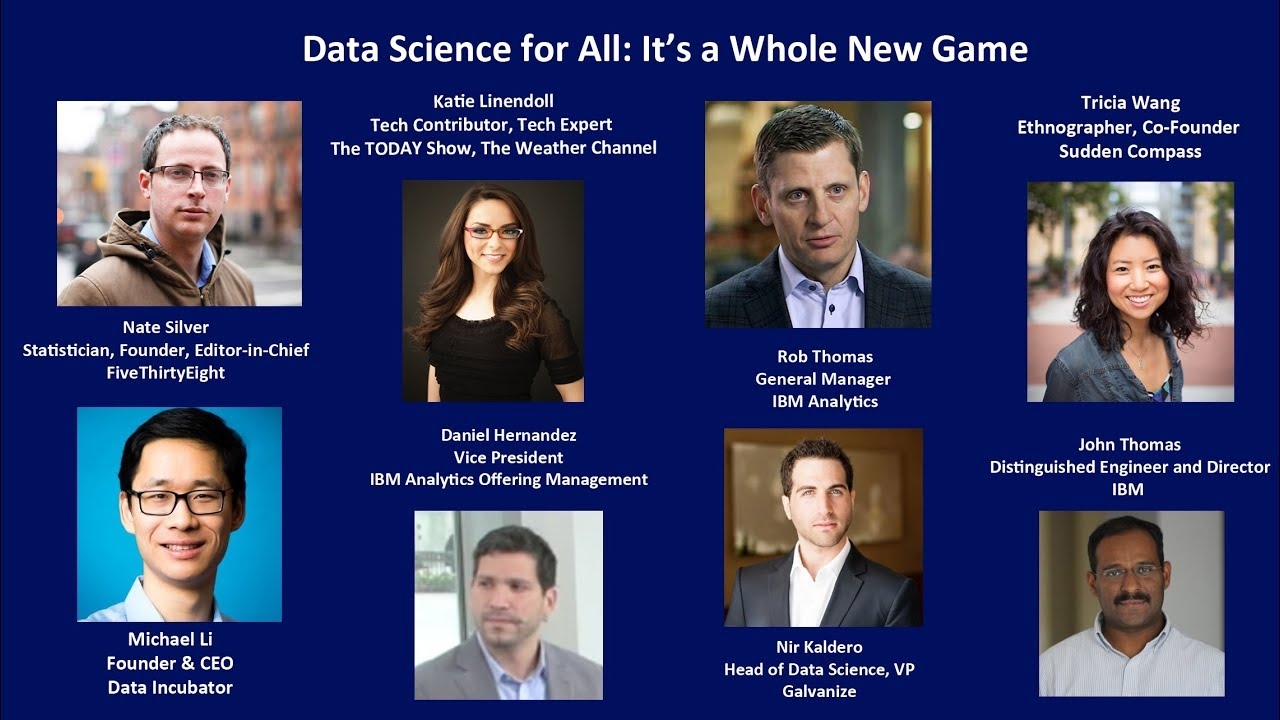
How are businesses going to do accomplish this? Thomas and several other data and technology professionals gathered to answer this question during the recent IBM Data Science for All event in New York City. Tech expert and TV personality Katie Linendoll hosted the special presentation titled, “Data Science for All: It’s a Whole New Game.” (* Disclosure below.)
The massive data now choking many companies requires strategy; executives cannot just go wading into it blindly. Even expert data scientists can’t manage it all. “A data scientist cannot possibly know every algorithm or every model that they could use,” Thomas said.
Machine learning and artificial intelligence-enabled automation is practically a given for any company that wants to make sense of big data. “Machine learning is what gives you the ability to automate tasks,” Thomas said.
Via machine learning, data scientists can automate the selection of an appropriate algorithm. Automation can also take data matching, metadata creation and a number of other mundane tasks off human hands. “Some of these things may not be exciting, but they’re hugely practical,” Thomas stated. The more of these low-level tasks data professionals can automate, the more time they can devote to playing data offense — designing creative, profit-driving schemes.
This type of automation requires IT systems built for big data, according to Thomas. “I love the phrase, There’s no AI without IA. That means you’re not going to get the AI unless you have the right information architecture to start with.” Since most companies these days are moving toward a multicloud environment, hauling data around to analytic models is not feasible, Thomas stated, pointing out that it’s much more practical to move the analytics to the data.
The best technology architecture available, however, is not hitting it home for most companies seeking to monetize data. Vendors are flooding the market with AI and ML big data software. Still, 94 percent of businesses trying to improve data quality continue running into obstacles, according to the Experian Data Quality “2016 Global Data Management Benchmark Report.” Businesses surveyed cite knowledge and human skills shortage as the culprit more often than technology.
What constitutes quality data to these businesses? Ninety-seven percent of those surveyed said that a 360-view of the customer through data would improve consumer relationships and help them drive profit.
So why is their data falling short?
“Often times they’re misusing data science to try to flatten their understanding of the customer, as if you can do more traditional marketing where you’re putting people into boxes,” said Tricia Wang, co-founder of Sudden Compass, a data-centric business consultancy in New York City.
More software tools that crunch more numbers will not provide a 360 customer view if business people don’t know how to put the numbers in context. When both those in technical and nontechnical roles can fold quantitative and qualitative insights into a cohesive customer story, they achieve “data literacy,” Wang explained.
Nir Kaldero, head of data science and vice president at Galvanize Inc., agreed. “In order to see the ROI behind the data, you also have to have a creative, fluid conversation between nontechnical and technical people,” he said. This lack of communication is a major pain point for companies trying to profit from big data.
Who are the data literate, and how can companies acquire them? Bringing technical data and nontechnical business people together and having them learn each others’ language can create them, according to Wang. Social scientists and ethnographers could potentially teach much to data science teams, she added.
The Data Incubator, from Data Science Evangelists Inc., offers an eight-week fellowship that trains domain experts on how to apply data science in their departments. Data science hype has given rise to many crafty resume rewrites, according to Michael Li, founder and chief executive officer of The Data Incubator.
“Sometimes you have people who are maybe rebranding themselves, trying to move up their title one notch to try to attract the higher salary,” Li said. The Data Incubator’s fellowship produces individuals with solid know-how that companies can hire with confidence, he stated.
The skills of professionals such as these can make a huge difference in data outcomes. Nate Silver, editor-in-chief of ESPN’s FiveThirtyEight, has become something of a data celebrity for his predictive analytics in sports and last year’s presidential election. Silver gave Trump a 30-percent chance of winning some states, while others with access to the same tools gave him a one-percent chance.
“Modeling strategies and skill do matter quite a lot when you have someone saying 30 percent versus one percent,” Silver said.
Iteration and debugging are skills that humans can use to sharpen predictive analytics. FiveThirtyEight’s predictive reporting accuracy owes much to trial and error. “We’ve had models that were bad and got good results, good models that got bad results, and everything else,” Silver explained.
Businesses can start training and testing their own data models with platforms, such as IBM’s Data Science Experience. “You can build your models anywhere and deploy them right next to where your data is,” said Daniel Hernandez, vice president of offering management for IBM Analytics.
Siva Anne, senior software architect of competitive technology at IBM, joined Thomas onstage to demo how models are built and deployed with Data Science Experience. “We are able to federate queries across multiple data sources,” like Hortonworks Inc. and Apache Hadoop frameworks, Anne explained.
IBM’s Cognitiveclass.ai now offers data science courses free of charge. Not a bad sticker price to learn a skill with such a high potential payoff. “What you do in this area is probably going to define how competitive you are going forward,” Thomas concluded.
Watch the complete video interview below, and be sure to check out more of SiliconANGLE’s and theCUBE’s coverage of the IBM Data Science for All event. (* Disclosure: TheCUBE is a paid media partner for the IBM Data Science for All event. Neither IBM, the event sponsor, nor other sponsors have editorial control over content on theCUBE or SiliconANGLE.)
Support our mission to keep content open and free by engaging with theCUBE community. Join theCUBE’s Alumni Trust Network, where technology leaders connect, share intelligence and create opportunities.
Founded by tech visionaries John Furrier and Dave Vellante, SiliconANGLE Media has built a dynamic ecosystem of industry-leading digital media brands that reach 15+ million elite tech professionals. Our new proprietary theCUBE AI Video Cloud is breaking ground in audience interaction, leveraging theCUBEai.com neural network to help technology companies make data-driven decisions and stay at the forefront of industry conversations.