



 Technology firms like Google, Facebook and Microsoft were fully aware of the NSA’s PRISM surveillance program and its mass monitoring of web traffic, says its general counsel Rajesh De.
Speaking at a meeting organized by the US government’s Privacy and Civil Liberties Oversight Board (PCLOB) in Washington DC on Wednesday, De revealed that the NSA’s data gathering campaign – justified by a secret order under Section 702 of the FISA Act – was carried out with the “full knowledge and assistance” of all companies concerned, claims The Guardian.
That’s a pretty emphatic statement from De, and one that deserves some consideration.
So the NSA and Google etc are taking pretty contradictory statements about this. As most will recall, Snowden’s first major bombshell was his exposure of the NSA’s PRISM program – some kind of system or agreement that allowed the spooks to gain access to the emails, instant messenger chats, files, social networking profiles and so on of millions of Google’s, Microsoft’s, Apple’s and Facebook’s (and others) users.
The NSA more or less admitted that it was true as soon as the story came out, yet the tech companies were steadfast in their denials – almost in unison, they screamed they had no knowledge of PRISM.
But De says differently. In the meeting, he insists that the companies were all willing participants, reports The Guardian:
“PRISM was an internal government term that as the result of leaks became the public term. Collection under this program was a compulsory legal process, that any recipient company would receive.”
So whilst it may be true that Google et al didn’t have any knowledge of PRISM, that’s only because they knew of the NSA’s program under a different name.
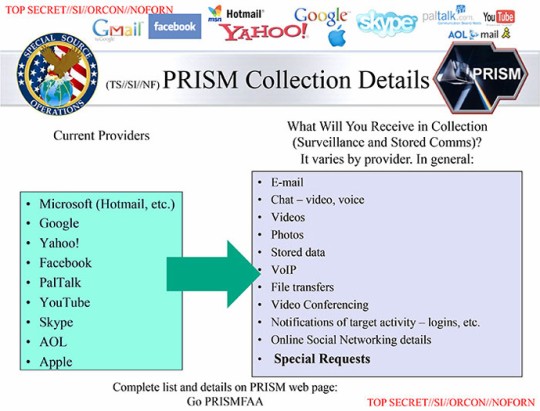
Alleged PRISM participants
The Guardian goes on to say that the nine tech firms involved in PRISM all faced legal restrictions about what they could and couldn’t say. However, since then they have all detailed the number of ‘requests’ for user’s private data they have received from the NSA, although they’re not allowed to give exact figures, only broad ranges.
From the get go, Snowden has argued that PRISM is widespread and basically the whole thing is pretty much automated, facilitated by the tech firms; meanwhile, De is now saying that the companies all knew of PRISM and cooperated with it; but the companies are still denying any knowledge of “PRISM”, though they’ve admitted to providing the US government with user’s personal data regardless.
Interestingly, we should recall that the NSA, along with Britain’s GCHQ, was ‘tapping’ into undersea cables and sifting through millions of international communications that way. In addition to this, the spies were also tapping into cables that link Google and Yahoo’s servers to the world. When these revelations were made, Google, Yahoo and Facebook reacted furiously in public, and denied that they were willing participants. However, telecommunications firms such as BT and Level 3 (who could have also assisted the NSA and GCHQ) declined to comment on these reports.
Now we come back to De, who was asked at the meeting whether or not the NSA collected its data with the “full knowledge and assistance of any company from which the information is obtained,” to which he replied that “yes, it was”. However, it’s unclear is De is referring to Google, Facebook etc., or the telcos, or both.
We’re not really any further to the truth, but one has to wonder how truthful the technology firms are being. While it’s probably not beyond the NSA’s capabilities to gather this data without their knowledge, it surely would be much easier with their acquiescence. And it’s very possible that under the FISA laws the NSA could force these companies to do their bidding. As noted by deputy assistant attorney general Brad Wiegmann at the PCLOB meeting, the NSA apparently acted within the law at all times. He pointed out that searches of data collected in bulk under FISA were reviewed on an annual basis by a secret court, noting that it would be impractical to do things any other way.
“If you have to go back to court every time you look at the information in your custody, you can imagine that would be quite burdensome,” stated Wiegmann.
photo credit: Stian Eikeland via photopin cc
Support our mission to keep content open and free by engaging with theCUBE community. Join theCUBE’s Alumni Trust Network, where technology leaders connect, share intelligence and create opportunities.
Founded by tech visionaries John Furrier and Dave Vellante, SiliconANGLE Media has built a dynamic ecosystem of industry-leading digital media brands that reach 15+ million elite tech professionals. Our new proprietary theCUBE AI Video Cloud is breaking ground in audience interaction, leveraging theCUBEai.com neural network to help technology companies make data-driven decisions and stay at the forefront of industry conversations.